
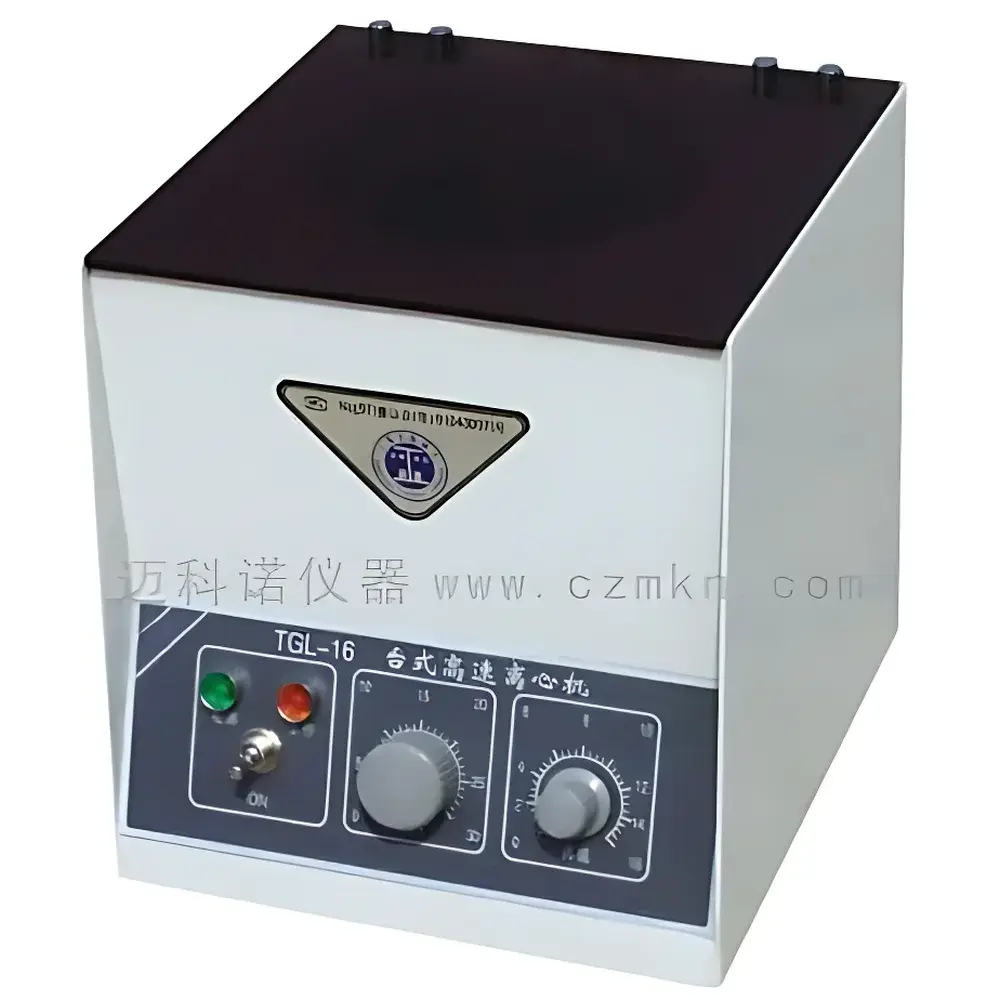
MKN TGL-16 Benchtop High-Speed Centrifuge
| Brand | MKN |
|---|---|
| Origin | Jiangsu, China |
| Model | TGL-16 |
| Maximum Speed | 16000 rpm (infinitely variable) |
| Relative Centrifugal Force (RCF) | 17000 × g |
| Capacity | 12 × 1.5 mL / 12 × 0.5 mL / 8 × 5 mL |
| Timer Range | 0–30 min |
| Noise Level | ≤60 dB(A) |
| Power Supply | AC 220 V, 50 Hz, 5 A |
Overview
The MKN TGL-16 Benchtop High-Speed Centrifuge is an engineered solution for rapid, reliable separation of biological and chemical samples in resource-constrained or space-limited laboratory environments. Operating on the principle of sedimentation under controlled centrifugal force, this instrument accelerates phase separation by applying rotational acceleration to heterogeneous mixtures—enabling differential pelleting of cellular components, precipitates, macromolecules, and particulates based on density, size, and shape. Designed for routine analytical workflows in clinical diagnostics, molecular biology, and pharmaceutical quality control labs, the TGL-16 delivers consistent RCF up to 17,000 × g at a maximum rotational speed of 16,000 rpm, with infinitely variable speed control ensuring precise adaptation to protocol-specific requirements. Its compact footprint and low thermal output (<10 °C ambient rise during continuous operation) support integration into biosafety cabinets, cold rooms, or shared instrumentation benches without compromising operator safety or sample integrity.
Key Features
- Infinitely variable speed control: Enables fine-tuned optimization across diverse protocols—from gentle plasma separation (e.g., 2,000–3,000 rpm) to high-resolution nucleic acid pelleting (≥13,000 rpm).
- Automatic rotor balancing system: Compensates for minor mass asymmetries during acceleration, reducing mechanical stress and extending bearing life while maintaining operational stability at full speed.
- Die-cast aluminum rotor assembly: Precision-machined for dimensional repeatability and thermal conductivity; corrosion-resistant surface treatment ensures long-term compatibility with common solvents, buffers, and disinfectants.
- Intelligent timer with auto-stop function: Programmable 0–30 minute countdown with audible alert and automatic motor shutdown prevents over-centrifugation and sample degradation.
- Low-noise acoustic enclosure: Engineered housing with vibration-damping mounts limits operational noise to ≤60 dB(A), meeting ISO 15712-1 standards for laboratory equipment sound emission in shared workspaces.
- Over-speed and over-temperature protection circuits: Embedded microcontroller continuously monitors rotor RPM and motor winding temperature, initiating immediate shutdown if thresholds exceed IEC 61010-1 Class II safety limits.
Sample Compatibility & Compliance
The TGL-16 accommodates standard microcentrifuge tube formats—including 0.5 mL, 1.5 mL, and 5 mL conical tubes—without adapter requirements. Its rotor geometry supports both fixed-angle and swing-out configurations via interchangeable rotor inserts (sold separately), facilitating applications ranging from serum/plasma separation (clinical chemistry) to protein precipitation (HPLC sample prep). The device complies with essential international safety and electromagnetic compatibility directives: IEC 61010-1 (Safety Requirements for Electrical Equipment for Measurement, Control, and Laboratory Use), IEC 61326-1 (EMC for Laboratory Equipment), and ISO/IEC 17025:2017 Annex A.2 (for laboratories performing accredited testing where centrifugation is a defined step in method validation). While not certified for GLP/GMP production environments, its design supports audit-ready documentation when integrated into SOP-driven workflows requiring traceable parameter logging (e.g., speed, time, date stamp).
Software & Data Management
The TGL-16 operates as a standalone instrument with no proprietary software dependency. All operational parameters are set via tactile membrane keypad with LED display, eliminating driver installation, firmware updates, or network connectivity requirements—reducing cybersecurity exposure and simplifying qualification in regulated settings. For laboratories requiring electronic recordkeeping per FDA 21 CFR Part 11, optional RS-232 serial interface (available upon request) enables connection to LIMS or ELN systems for timestamped export of run logs—including start/stop time, set speed, actual RCF, elapsed duration, and fault codes. Audit trails remain human-readable and machine-verifiable, supporting ALCOA+ principles (Attributable, Legible, Contemporaneous, Original, Accurate, Complete, Consistent, Enduring, Available) when paired with validated data capture protocols.
Applications
- Clinical diagnostics: Separation of serum from whole blood (e.g., CLSI GP44-A4 compliant protocols), isolation of PBMCs using density gradient media, and preparation of urine sediments for microscopy.
- Molecular biology: Pellet recovery of plasmid DNA, PCR products, and RNA after ethanol precipitation; clarification of lysates prior to column-based purification.
- Pharmaceutical QC: Removal of insoluble excipients from suspension formulations; particle size distribution analysis support via sequential centrifugal washing steps.
- Industrial hygiene: Concentration of airborne particulates collected on filter membranes for gravimetric or elemental analysis (per NIOSH Method 7300).
- Academic research: Routine cell harvesting (bacterial, yeast, mammalian), organelle enrichment, and subcellular fractionation in teaching and discovery labs.
FAQ
What is the maximum relative centrifugal force (RCF) achievable with the TGL-16?
The TGL-16 achieves a maximum RCF of 17,000 × g when operated at its rated speed of 16,000 rpm with the standard 12-position fixed-angle rotor.
Does the centrifuge include rotor identification or automatic speed calibration?
No. The TGL-16 does not feature rotor recognition sensors or factory-calibrated speed verification; users must manually confirm rotor type and apply appropriate RCF calculations using standard nomograms or online tools (e.g., Thermo Fisher’s RCF Calculator).
Is the unit suitable for use with infectious or biohazardous samples?
Yes—provided sealed rotors and capped tubes are used, and the centrifuge is operated inside a certified biosafety cabinet (BSC) or secondary containment hood. Decontamination procedures must follow institutional biosafety protocols (e.g., BMBL 6th Ed.).
Can the timer be bypassed for continuous operation?
No. The timer is mandatory and non-defeatable per IEC 61010-1 safety compliance; continuous operation requires manual restart after each cycle.
What maintenance is required to sustain performance over time?
Routine cleaning of the rotor chamber with 70% ethanol, biannual inspection of rotor threads and locking mechanisms, and annual verification of speed accuracy using a certified tachometer are recommended per manufacturer guidelines.
Related Products



