
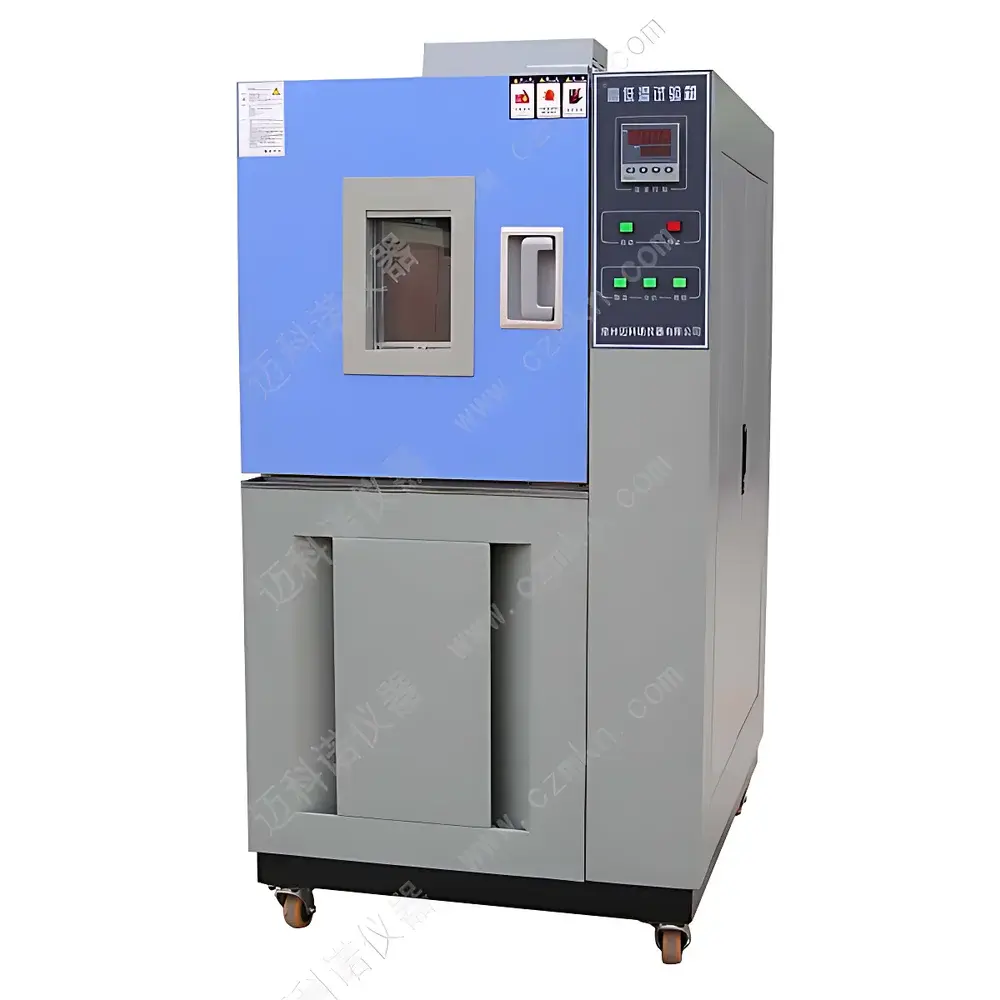
Micono GDW-100 High-Low Temperature Alternating Environmental Test Chamber
| Origin | Zhejiang, China |
|---|---|
| Manufacturer Type | Authorized Distributor |
| Domestic Origin | Yes |
| Model | GDW-100 |
| Pricing | Upon Request |
| Internal Chamber Dimensions | 1000 × 1000 × 1000 mm |
| Temperature Range | −20 °C / −40 °C / −60 °C to 100 °C / 150 °C / 200 °C (configurable) |
| Temperature Uniformity | ±2 °C |
| Temperature Stability | ±0.5 °C |
| Ramp Rate | 0.7–1.0 °C/min |
| Construction | Interior – SUS304 brushed stainless steel |
| Control System | PID-based digital touchscreen controller (RKC or Fuji optional) |
| Sensor | PT100 platinum resistance thermometer |
| Compressor | Hermetic French Tecumseh unit |
| Refrigeration Components | Imported OEM parts |
| Viewing Window | Tempered, conductive, low-temperature-resistant double-glazed window with internal lighting |
| Cable Port | One Ø50 mm feedthrough (imported) |
| Safety Protections | Over-temperature, over-pressure, phase failure/reversal, overload, and earth leakage detection |
Overview
The Micono GDW-100 High-Low Temperature Alternating Environmental Test Chamber is an engineered solution for accelerated environmental stress testing of electronic components, automotive modules, aerospace subsystems, and industrial materials. Designed in strict accordance with GB 10592–1989 (Technical Specifications for High-Low Temperature Test Chambers), it supports standardized thermal cycling, steady-state exposure, and temperature-humidity profile execution per IEC 60068-2-1 (Cold), IEC 60068-2-2 (Dry Heat), MIL-STD-810H Method 502.7 (Low Temperature), and MIL-STD-810H Method 501.7 (High Temperature). Its robust thermal architecture enables precise simulation of operational and storage environments encountered during product lifecycle validation—critical for reliability engineering, design verification, and qualification testing under GLP and GMP-aligned laboratory practices.
Key Features
- Triple-range temperature capability: configurable low-end options (−20 °C, −40 °C, or −60 °C) paired with high-end limits (100 °C, 150 °C, or 200 °C), enabling broad application coverage across military, automotive, and consumer electronics sectors.
- High-fidelity thermal control: ±0.5 °C stability and ±2 °C uniformity across the full 1 m³ working volume (1000 × 1000 × 1000 mm), verified per ISO/IEC 17025 traceable calibration protocols.
- Dual-sensor redundancy-ready architecture: Standard PT100 Class A sensor with provision for secondary monitoring—supporting audit-ready data integrity in regulated environments.
- Industrial-grade refrigeration system: Hermetically sealed Tecumseh compressor integrated with imported expansion valves, filters, and heat exchangers—ensuring long-term operational consistency and reduced maintenance frequency.
- Human-centered interface: Programmable touchscreen controller with PID tuning capability; optional integration of RKC (Japan) or Fuji (Japan) controllers for enhanced repeatability and compliance logging.
- Structural integrity: Seamless SUS304 stainless-steel inner chamber resists corrosion from condensate and chemical off-gassing; powder-coated outer casing provides mechanical durability and ESD-safe grounding continuity.
Sample Compatibility & Compliance
The GDW-100 accommodates large-format assemblies—including EV battery packs, avionics enclosures, and HVAC control units—via its cubic 1 m³ workspace and Ø50 mm cable port for real-time signal monitoring. It meets mandatory test requirements outlined in GB/T 2423.1 (Cold Testing), GB/T 2423.2 (Dry Heat), GJB 150.3A–2009 (Low Temperature), GJB 150.4A–2009 (Operational Temperature), and IEC 60068-2 series standards. All safety circuits—including over-temperature cutoff, phase-loss protection, and earth leakage detection—are independently certified to IEC 61000-4 and UL 61010-1. The chamber is compatible with external data acquisition systems for synchronized thermal-electrical performance mapping under FDA 21 CFR Part 11-compliant software environments.
Software & Data Management
While the base configuration includes standalone PID control, the GDW-100 supports RS485/Modbus RTU and Ethernet (optional) connectivity for integration into centralized lab management platforms. When paired with validated third-party software (e.g., NI LabVIEW or Keysight PathWave), it enables automated test sequencing, alarm-triggered event logging, and time-stamped CSV export with operator ID and calibration certificate metadata. Audit trails include parameter change history, cycle start/stop timestamps, and deviation alerts—all structured to support GLP documentation requirements and internal quality audits.
Applications
- Qualification testing of printed circuit boards (PCBs) and solder joints per IPC-J-STD-020D thermal shock profiles.
- Storage life assessment of lithium-ion battery modules under extended low-temperature soak conditions (−40 °C, 96 h).
- Thermal aging studies of polymer-based gaskets and seals used in automotive powertrain applications.
- Pre-conditioning of optical sensors prior to photometric calibration in controlled ambient gradients.
- Environmental screening of medical device housings per ISO 14971 risk management frameworks.
FAQ
Does the GDW-100 support programmable ramp-soak cycles?
Yes—the controller allows up to 99 segments per program, including ramp rates, dwell times, and loop counts, compliant with IEC 60068-2-14 Change of Temperature testing profiles.
Can the chamber be calibrated to ISO/IEC 17025 standards?
Yes—Micono provides optional factory calibration with NIST-traceable certificates; users may also engage accredited third-party labs for on-site verification.
Is remote monitoring supported out of the box?
Standard RS485 Modbus RTU enables integration with SCADA or building management systems; Ethernet and cloud telemetry require optional hardware add-ons.
What is the warranty coverage and service response time?
One-year comprehensive parts-and-labor warranty; technical support available via email or phone within 2 business hours during working days (GMT+8); on-site service dispatched within 5 business days for major faults.
Are non-standard configurations available?
Yes—custom chamber dimensions, extended temperature ranges (e.g., −70 °C), humidity integration (as hybrid THB chambers), or explosion-proof variants can be engineered upon formal technical specification submission.



