
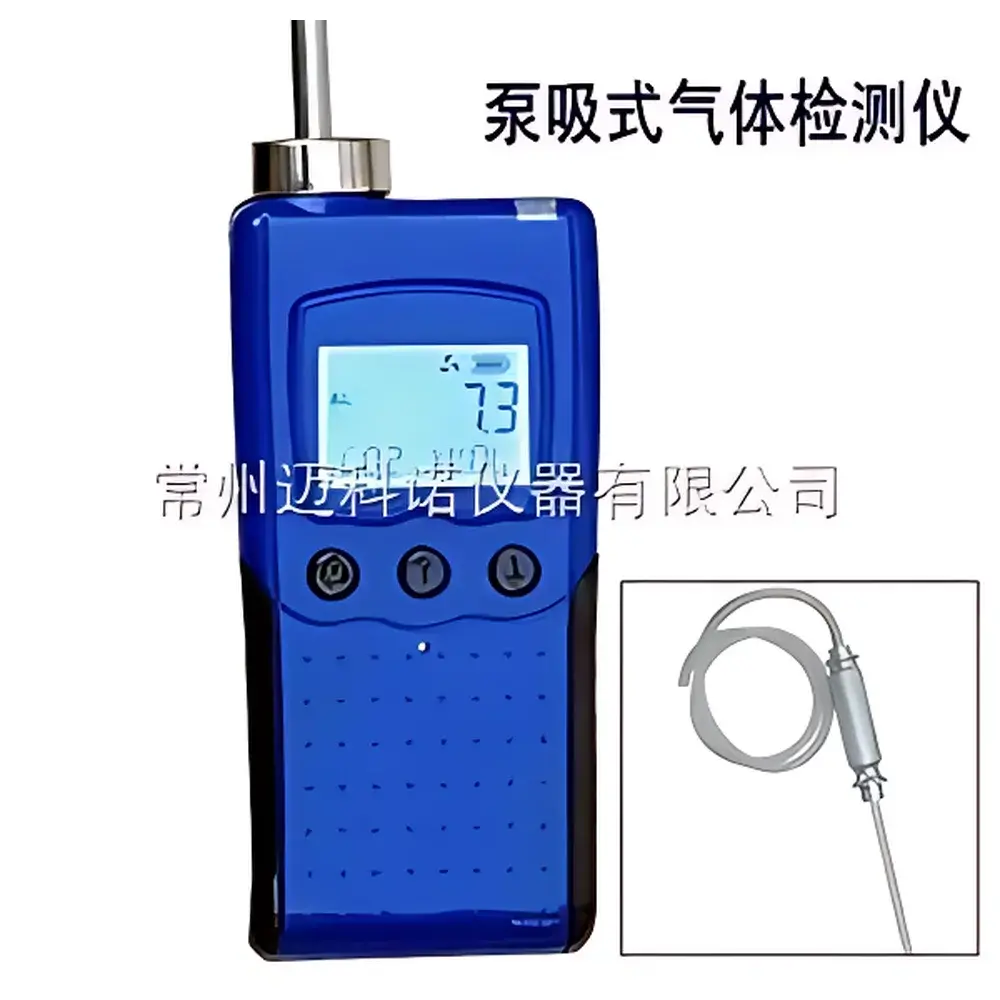
MKN ST-800-EX Pump-Aspiration Combustible Gas Detector
| Brand | MKN |
|---|---|
| Origin | Zhejiang, China |
| Model | ST-800-EX Pump-Aspiration Combustible Gas Detector |
| Detection Principle | Catalytic Combustion |
| Target Gases | Natural Gas (LNG), Liquefied Petroleum Gas (LPG), Coal Gas, Alkanes, Alcohols, Ketones, Benzene, Gasoline, Volatile Organic Liquids, Hydrogen |
| Measurement Range | 0–100% LEL |
| Resolution | 0.1% LEL |
| Accuracy | ≤±3% FS |
| Response Time (T90) | <30 s |
| Recovery Time | <40 s |
| Power Supply | 3.6 VDC, 1800 mAh Rechargeable Li-ion Battery with Charging Protection |
| Operating Temperature | −20 °C to +70 °C |
| Relative Humidity | ≤95% RH (non-condensing) |
| Ingress Protection | IP65 |
| Explosion Protection | Ex ia II C T6 |
| Dimensions | 125 × 52 × 30 mm (L×W×H) |
| Weight | 200 g |
| Sensor Lifetime | 3 years |
| Display | Backlit LCD |
| Alarm Modes | Audible (≥75 dB at 30 cm), Visual (LED flash), Vibration |
| Calibration | Built-in zero and span calibration function |
| Optional Accessory | 0.8 m sampling probe (additional USD 150) |
Overview
The MKN ST-800-EX is a compact, intrinsically safe pump-aspiration combustible gas detector engineered for reliable, real-time monitoring of flammable gases in hazardous industrial environments. It operates on the catalytic combustion principle—where target gases oxidize exothermically on a heated platinum coil within a Wheatstone bridge configuration—generating a measurable resistance change proportional to gas concentration. Designed specifically for use in Zone 1 and Zone 2 classified areas per IEC 60079 standards, the instrument delivers high reproducibility and stability across demanding conditions including confined spaces, petrochemical facilities, LNG terminals, paint spray booths, and solvent-handling zones. Its integrated micro-pump ensures consistent sample draw—even against mild backpressure or low ambient airflow—enabling accurate detection where diffusion-based units may underperform.
Key Features
- Intrinsically safe design certified to Ex ia II C T6, suitable for use in explosive atmospheres containing hydrogen, methane, propane, butane, ethanol vapor, acetone, benzene, and other hydrocarbon-based combustibles.
- Pump-aspiration sampling system with adjustable flow rate and automatic suction diagnostics, ensuring representative intake from up to 0.8 m distance when used with optional probe.
- High-sensitivity catalytic bead sensor sourced from globally recognized OEM suppliers, featuring built-in temperature compensation for stable output across −20 °C to +70 °C operational range.
- Backlit LCD display with dual-unit readability (percentage LEL only), configurable high/low alarm thresholds, and intuitive menu navigation via three tactile buttons.
- Dual-stage alarm logic: visual (red LED flash), audible (≥75 dB @ 30 cm), and haptic (vibration) alerts—each independently enabled or disabled per user preference.
- Robust housing constructed from chemical-resistant, abrasion-proof polymer with IP65-rated ingress protection—resistant to dust, water jets, and routine decontamination with alcohol wipes or mild detergents.
- Onboard data recovery and auto-zero retention functions mitigate impact of accidental key presses or transient environmental interference during field operation.
Sample Compatibility & Compliance
The ST-800-EX is validated for continuous monitoring of gases with lower explosive limits (LEL) between 1.0% (hydrogen) and 5.0% (methane) by volume in air. It complies with multiple international safety and performance benchmarks, including IEC 61779-1 (electrical apparatus for detection and measurement of combustible gases), EN 60079-29-1 (gas detectors – performance requirements), and GB 15322.1–2019 (Chinese national standard for point-type combustible gas detectors). While not FDA- or GLP-regulated, its calibration traceability supports adherence to internal QA/QC protocols required under OSHA 1910.120 (HAZWOPER) and NFPA 70E arc-flash safety guidelines. The device does not require external gas certification for routine use but must be bump-tested prior to each shift and fully calibrated every 6 months—or after exposure to sensor-poisoning agents such as silicones, sulfides, or halogenated solvents.
Software & Data Management
The ST-800-EX operates as a standalone field instrument without proprietary PC software or cloud connectivity. All configuration—including alarm setpoints, backlight timeout, and unit language—is performed directly on-device using the keypad interface. Calibration data (zero and span values, date/time stamps, and technician ID if manually entered) are stored in non-volatile memory and persist through battery replacement. No audit trail or electronic record is generated; therefore, manual logbook entries remain the primary compliance mechanism for regulated industries requiring documentation per ISO/IEC 17025 or ANSI Z240.10. For enterprises seeking digital integration, third-party Bluetooth-enabled adapters (sold separately) may enable basic data logging via compatible mobile applications—but MKN provides no firmware-level API or data export functionality.
Applications
- Pre-entry verification of confined spaces (tanks, manholes, reactors) prior to hot work or maintenance activities.
- Continuous leak detection along pipeline right-of-ways, compressor stations, and fuel transfer points.
- Monitoring volatile organic compound (VOC) emissions during coating, cleaning, or degreasing operations.
- Backup verification for fixed gas detection systems during commissioning, maintenance, or sensor drift events.
- Mobile patrol duties in refineries, chemical plants, biogas facilities, and municipal wastewater treatment centers.
- Educational and training environments where hands-on understanding of LEL measurement fundamentals is required.
FAQ
What gases can the ST-800-EX detect?
It detects any combustible gas or vapor with a defined Lower Explosive Limit (LEL) in air, including methane, propane, hydrogen, ethanol, acetone, gasoline vapors, and aromatic hydrocarbons—provided they react catalytically on the sensor element.
Is the device suitable for hydrogen detection?
Yes. Its catalytic sensor responds effectively to hydrogen, though users should note that H₂ exhibits faster diffusion and higher thermal conductivity than hydrocarbons, potentially influencing response dynamics in mixed-gas environments.
How often does it require calibration?
Full calibration is recommended every six months under normal operating conditions; however, daily bump testing is mandatory before each use in safety-critical applications per OSHA and manufacturer guidance.
Can it operate in high-humidity environments?
Yes—up to 95% relative humidity (non-condensing). Prolonged exposure to condensation or immersion will compromise sensor integrity and invalidate intrinsic safety certification.
Does it support data logging or PC connectivity?
No. The ST-800-EX is a self-contained indicator-alarm device with no embedded memory beyond calibration history and no wired or wireless communication interfaces.
Related Products







