
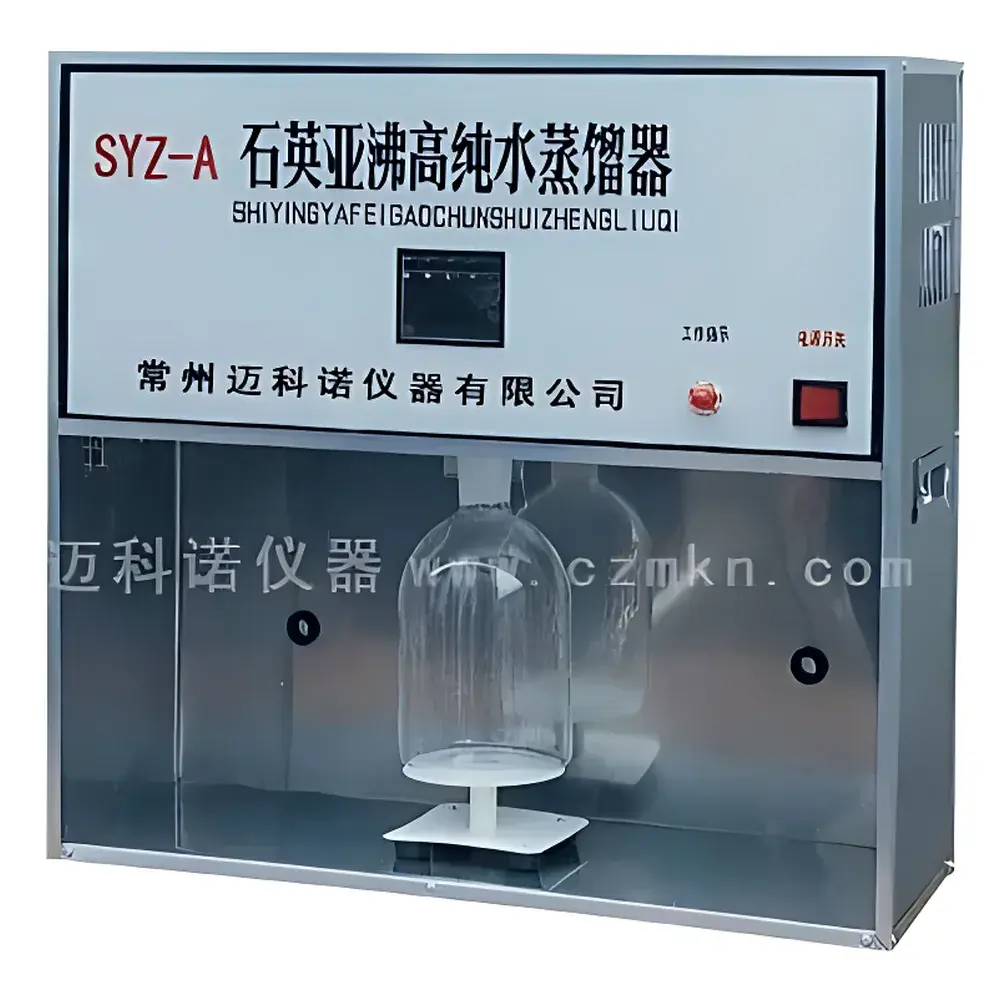
Quartz Sub-Boiling Distillation Apparatus SYZ-A
| Origin | Jiangsu, China |
|---|---|
| Manufacturer Type | Authorized Distributor |
| Origin Category | Domestic (PRC) |
| Model | SYZ-A |
| Price | USD 490 (FOB Jiangsu) |
| Purity | ≤5 ppb (single-pass), ≤5 ppt (multi-pass) |
| Conductivity | 0.08 × 10⁻⁶ Ω⁻¹·cm⁻¹ (25 °C, single-pass) |
| Power Supply | 220 V ±10%, 50 Hz |
| Rated Power | 1000 W |
| Output Rate | 400–500 mL/h |
| Construction Material | High-Purity Fused Quartz (≥99.995% SiO₂) |
| Configuration | Dual-stage sub-boiling distillation system with integrated quartz storage bottle and enclosed horizontal cylindrical housing |
| Compliance | Designed to meet ASTM D1193 Type I water specifications |
Overview
The Quartz Sub-Boiling Distillation Apparatus SYZ-A is a fully enclosed, dual-stage high-purity water purification system engineered for laboratories requiring ultralow-metal, low-organic, and thermally stable Type I reagent water. Unlike conventional boiling-point distillation, this apparatus operates on the principle of sub-boiling evaporation—maintaining the feedwater temperature significantly below its atmospheric boiling point (typically 95–98 °C) while applying controlled radiant heating to the quartz chamber wall. This thermal gradient induces gentle, non-turbulent vapor generation at the liquid–quartz interface, minimizing aerosol entrainment and carryover of particulates or volatile contaminants. The generated vapor travels through a high-temperature quartz condensation path maintained above 100 °C, ensuring condensate remains sterile, pyrogen-free, and devoid of re-condensed volatile organics or CO₂-derived carbonic acid. All wetted surfaces—including evaporator chambers, vapor ducts, condenser coils, and the integrated storage reservoir—are fabricated from synthetic fused quartz (≥99.995% SiO₂), eliminating metal ion leaching and ensuring compatibility with trace elemental analysis and ultra-low-background applications.
Key Features
- Dual-stage sub-boiling architecture: Enables sequential purification without manual intervention—raw water enters the first stage, proceeds automatically to the second stage, and exits as certified high-purity water.
- Fully enclosed quartz system: Horizontal cylindrical design with standard taper ground-glass joints (ISO K 29/32) ensures hermetic sealing; no exposure to ambient air during distillation or storage.
- Internally shielded heating elements: Nichrome resistance wires are fully encapsulated within the outer quartz jacket—no direct contact with water, eliminating electrode corrosion and metallic contamination.
- High-temperature condensation zone: Maintains condensate path >100 °C to suppress microbial growth and prevent back-diffusion of atmospheric CO₂ or NH₃.
- Integrated quartz storage bottle: 2 L capacity, with PTFE-lined cap and inert gas inlet port for optional nitrogen blanketing during long-term storage.
- Thermal stability and reproducibility: Quartz’s low coefficient of thermal expansion (5.5 × 10⁻⁷ /K) ensures dimensional consistency across repeated thermal cycles, supporting method robustness in regulated environments.
Sample Compatibility & Compliance
The SYZ-A is validated for production of water meeting ASTM D1193 Type I specifications (conductivity ≤0.055 µS/cm at 25 °C, TOC ≤10 µg/L, Na⁺ ≤1 µg/L, SiO₂ ≤0.01 mg/L). Its performance has been verified in conjunction with atomic absorption spectroscopy (AAS), inductively coupled plasma mass spectrometry (ICP-MS), anodic stripping voltammetry (ASV), and high-performance liquid chromatography (HPLC) gradient elution—where it consistently delivers lower procedural blanks and improved signal-to-noise ratios compared to single-stage distillers or deionized water systems. The apparatus supports GLP-compliant operation when paired with calibrated conductivity meters and loggers; though not inherently 21 CFR Part 11 compliant, its output is routinely used in FDA-regulated analytical workflows where raw material purity directly impacts assay validity.
Software & Data Management
The SYZ-A is a standalone analog instrument with no embedded firmware or digital interface. Operation relies on mechanical thermostatic control (±2 °C accuracy) and visual flow monitoring via calibrated borosilicate sight tubes. For traceability, users are advised to integrate external data loggers for time-stamped recording of input voltage, output flow rate (via gravimetric measurement), and effluent conductivity (using a calibrated benchtop meter such as Mettler Toledo SevenCompact™ S220). All maintenance records—including quartz component replacement dates, cleaning protocols (e.g., 10% v/v HNO₃ soak followed by triple-rinse with pre-distilled water), and calibration certificates for ancillary instruments—should be retained per ISO/IEC 17025 requirements.
Applications
- Preparation of calibration standards and blanks for ICP-OES and ICP-MS analysis of trace metals (Cu, Pb, Cd, Zn, As, Hg) at sub-ppt levels.
- Mobile phase preparation in HPLC and UHPLC methods requiring low UV absorbance and minimal baseline drift at 190–220 nm.
- Electrochemical techniques including differential pulse polarography and catalytic adsorptive stripping voltammetry, where background current stability is critical.
- Neutron activation analysis (NAA) and isotope dilution mass spectrometry (IDMS), where isotopic integrity depends on absence of exogenous elemental contamination.
- Preparation of solvents for X-ray fluorescence (XRF) sample digestion and electron probe microanalysis (EPMA) standards.
- Long-term storage of reference materials under inert atmosphere, leveraging the integrated quartz reservoir’s chemical inertness and low outgassing profile.
FAQ
What distinguishes sub-boiling distillation from conventional boiling-point distillation?
Sub-boiling distillation avoids nucleate boiling entirely, operating below the saturation temperature to eliminate bubble formation and associated splashing or aerosol transport—resulting in substantially lower metal and particulate carryover.
Can the SYZ-A produce water suitable for ICP-MS analysis?
Yes—when operated with proper pretreatment (e.g., pre-filtration of feed water through 0.22 µm PVDF membrane) and routine quartz chamber passivation, it consistently yields water with total metal content <5 ppt, meeting ICP-MS blank requirements for most environmental and clinical assays.
How often should the quartz components be cleaned or replaced?
Quartz chambers require acid cleaning (10% HNO₃, 60 min, 60 °C) after every 200 L of output or if visible residue accumulates; full replacement is recommended every 18–24 months under continuous use, depending on feed water quality.
Is the SYZ-A compatible with automated water delivery systems?
It features standard 6 mm OD quartz tubing outlets and can be interfaced with peristaltic pumps or gravity-fed distribution manifolds—but lacks built-in pressure regulation or level-sensing outputs.
Does the apparatus require cooling water?
No—it utilizes passive air-cooling of the condenser section; ambient lab temperature must remain between 15–30 °C for optimal condensation efficiency and output stability.



