
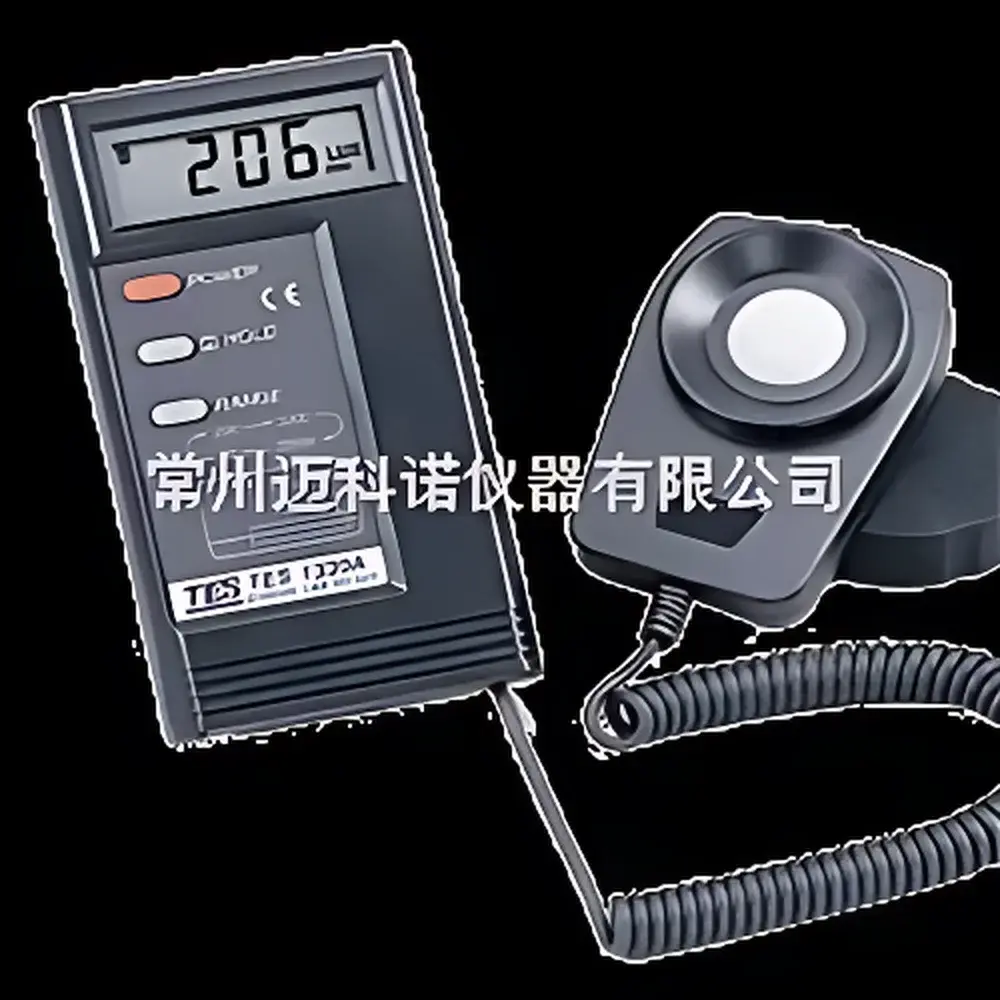
MKN TES-1330A Digital Lux Meter
| Brand | MKN |
|---|---|
| Model | TES-1330A |
| Measurement Range | 20 / 200 / 2000 / 20000 lux (also supports foot-candle display on TES-1334A variant) |
| Resolution | 0.01 lux |
| Accuracy | ±3% rdg ± 0.5% f.s. (<10,000 lux) |
| Repeatability | ±2% |
| Temperature Coefficient | ±0.1% / °C |
| Sampling Rate | ~2 Hz |
| Overload Indication | Leading digit “1” displayed |
| Display | 3½-digit LCD |
| Analog Output | DC 2 V / f.s. (for TES-1332A recorder interface) |
| Operating Environment | 0–40 °C, <70% RH |
| Power | 9 V alkaline battery |
| Detector Dimensions | 100 × 60 × 27 mm |
| Meter Dimensions | 135 × 72 × 33 mm |
| Weight | 250 g |
| Accessories | Instruction manual, protective carrying case, 9 V battery |
Overview
The MKN TES-1330A Digital Lux Meter is a precision photometric instrument engineered for reliable, repeatable measurement of illuminance in industrial, laboratory, architectural, and occupational health & safety environments. Based on silicon photodiode detection with cosine-corrected optical response, the device conforms to CIE photopic luminosity function (V(λ)) requirements for accurate human-eye-weighted light intensity assessment. Its dual-range auto-scaling architecture—covering 20 to 20,000 lux with 0.01 lux resolution at the lowest range—enables high-fidelity evaluation across ambient lighting, task lighting, emergency egress illumination, and display backlight validation. Calibration traceability is maintained against a 2856 K tungsten-filament standard lamp per ISO/CIE reference practices, ensuring metrological consistency in routine field and benchtop use.
Key Features
- 3½-digit LCD display with real-time digital readout and intuitive range indication
- Dual functionality: Manual data hold for static measurements and peak-hold mode (compatible with TES-1334A variant) for capturing transient illuminance maxima
- Four selectable measurement ranges (20 / 200 / 2000 / 20000 lux), optimized for dynamic lighting conditions without manual gain adjustment
- Integrated analog output (DC 2 V full-scale) compatible with external chart recorders or data acquisition systems (e.g., TES-1332A)
- Low-drift temperature compensation (±0.1% / °C) ensures stable performance across typical indoor operating environments (0–40 °C)
- Robust mechanical design: compact handheld form factor (135 × 72 × 33 mm), lightweight construction (250 g), and IP54-rated detector housing for dust and splash resistance
- Battery-powered operation using a single 9 V alkaline cell, supporting >100 hours of continuous use under typical sampling conditions
Sample Compatibility & Compliance
The TES-1330A is designed for non-contact measurement of planar or diffuse light sources, including LED arrays, fluorescent tubes, HID lamps, and natural daylight through glazing. Its cosine-corrected sensor head minimizes angular response error (<±3% deviation up to 75° incidence), satisfying IESNA LM-79 and EN 13032-1 requirements for photometric testing. While not certified for regulatory compliance reporting per se, its calibration methodology aligns with ISO 50001 energy management verification workflows and OSHA/NIOSH recommended lighting assessment protocols. The instrument supports documentation integrity via manual log entry and optional analog recording—suitable for GLP-aligned facility audits where electronic audit trails are not mandated.
Software & Data Management
The TES-1330A operates as a standalone analog/digital hybrid meter with no embedded firmware or USB connectivity. Data capture relies on manual transcription or integration with third-party analog-input DAQ systems (e.g., National Instruments USB-6009 or Keysight 34972A). When used with the TES-1332A recorder, continuous time-stamped illuminance profiles can be archived for post-processing in MATLAB, Python (NumPy/Pandas), or Excel. Though lacking native cloud synchronization or FDA 21 CFR Part 11-compliant electronic signatures, its analog output path supports legacy industrial SCADA environments and satisfies basic ISO 9001 clause 7.6 (monitoring and measuring equipment control) when paired with documented calibration certificates and user-maintained logbooks.
Applications
- Workplace lighting validation per IES RP-1 and EU Directive 2002/44/EC on artificial optical radiation
- Photobiological safety screening of LED lighting products (IEC TR 62778)
- Architectural daylight harvesting system commissioning and seasonal performance trending
- Quality control of display brightness uniformity in consumer electronics manufacturing
- Educational laboratory experiments in photometry, color science, and human factors engineering
- Facility maintenance audits for ASHRAE 90.1 and LEED EQ Credit 8.1 (Daylight and Views)
FAQ
Does the TES-1330A support foot-candle units?
Yes—only when used with the TES-1334A variant, which includes dual lux/foot-candle scaling. The base TES-1330A model displays lux only.
What is the calibration uncertainty of this instrument?
The stated accuracy (±3% rdg ± 0.5% f.s. below 10,000 lux) reflects total error under standard calibration conditions using a 2856 K tungsten reference source; NIST-traceable recalibration is recommended annually or after physical impact.
Can it measure pulsed or modulated light sources (e.g., PWM-driven LEDs)?
Due to its ~2 Hz sampling rate and lack of RMS or peak-detection circuitry optimized for high-frequency modulation, it is not suitable for quantitative assessment of flicker or rapid temporal variations.
Is the sensor head detachable or fiber-optic coupled?
No—the photodiode sensor is permanently integrated into the front housing; remote sensing requires external extension cables or alternative instrumentation such as the MKN TES-1339A with detachable probe.
How often should the 9 V battery be replaced?
Battery life exceeds 100 hours under normal intermittent use; low-battery indication appears as segment dropout on the LCD. Alkaline chemistry is recommended—lithium or rechargeable cells may cause voltage regulation instability.
Related Products







