
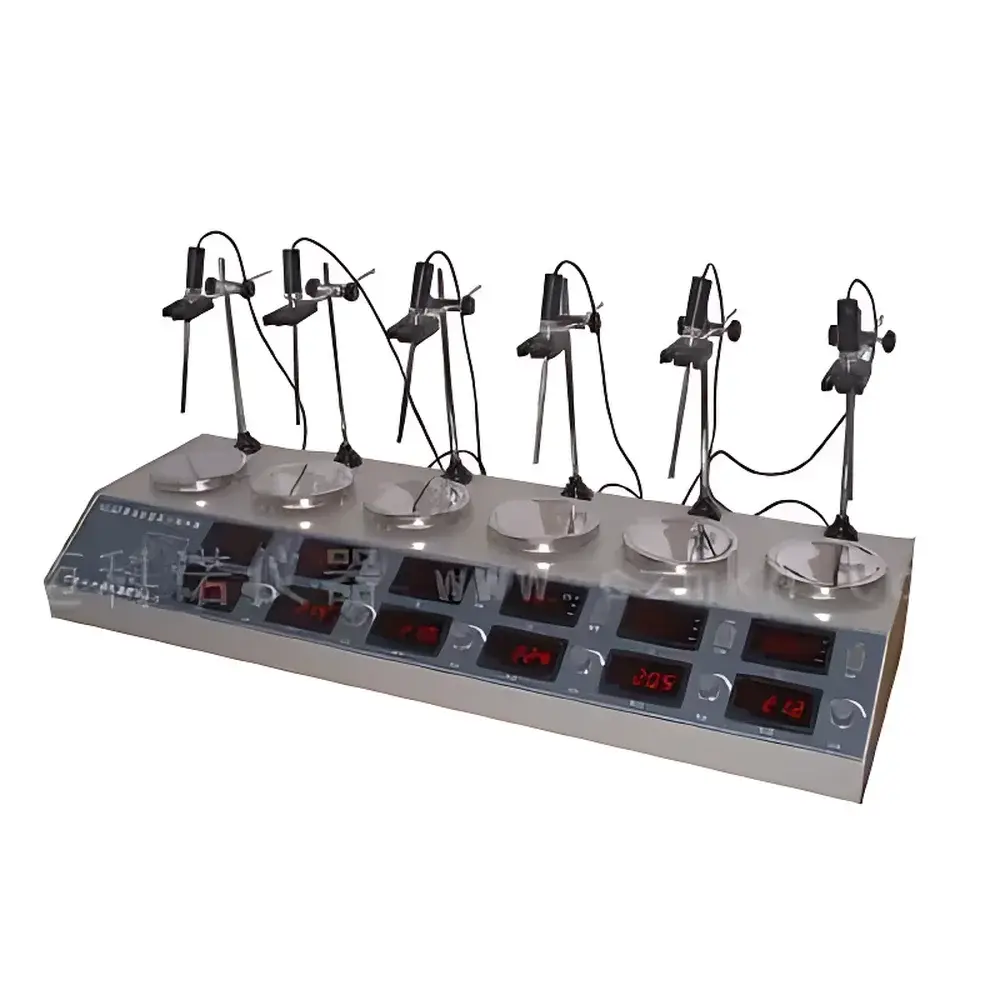
MKN HJ-6A Six-Position Dual-Display Magnetic Stirrer with Independent Heating & Speed Control
| Brand | MKN |
|---|---|
| Model | HJ-6A |
| Type | Benchtop Magnetic Stirrer |
| Positions | 6 independent stations |
| Power Supply | 220 V ±10%, 50–60 Hz |
| Stirring Volume per Position | 20–2000 mL |
| Motor Power | 25 W × 6 |
| Heating Power | 200 W × 6 |
| Speed Range | 0–2000 rpm (digital speed display, continuously adjustable) |
| Temperature Range | RT to 100 °C (digital PID temperature control) |
| Timer | 0–120 min (programmable, auto-shutdown) |
| Stir Bar Compatibility | PTFE-coated magnetic stir bars with high-temp sintered NdFeB magnets |
| Construction | Ceramic-coated aluminum alloy heating plate, corrosion-resistant stainless steel housing |
| Safety Features | Over-temperature protection, motor thermal cutoff, dry-run detection |
Overview
The MKN HJ-6A is a six-position benchtop magnetic stirrer engineered for parallel sample processing in analytical, quality control, and synthetic chemistry laboratories. It operates on the principle of contactless rotational actuation via rotating magnetic fields generated beneath each station’s heated ceramic surface—enabling simultaneous stirring and precise temperature control across six independent reaction vessels. Unlike single-station units, the HJ-6A eliminates batch-to-batch variability by ensuring identical thermal and hydrodynamic conditions across all positions. Its dual digital display interface provides real-time, position-specific readouts of both rotational speed (rpm) and setpoint temperature (°C), facilitating method reproducibility and GLP-compliant documentation. Designed for continuous operation under moderate load, the unit integrates a brushless DC motor architecture to minimize electromagnetic interference, mechanical wear, and acoustic emissions—critical for vibration-sensitive applications such as gravimetric analysis or optical spectroscopy sample preparation.
Key Features
- Six fully independent stirring/heating stations with individual digital speed and temperature controls
- Dual-display LED interface showing simultaneous rpm and °C values per active station
- Brushless DC motors (25 W each) delivering stable torque from 0–2000 rpm with <±2 rpm speed accuracy at steady state
- Ceramic-coated aluminum heating plates (200 W per station) offering uniform thermal distribution and resistance to chemical splashes
- PID-based temperature regulation with ±0.5 °C stability at 100 °C (load-dependent), including overshoot suppression and ramp-soak profiles
- Programmable timer (0–120 min) with audible alert and automatic power cutoff upon completion
- Integrated safety systems: over-temperature cut-off (>110 °C), motor thermal protection, and dry-run detection to prevent coil damage
- PTFE-encapsulated stir bars compatible with aggressive solvents (e.g., conc. HNO₃, DMF, THF) and rated for continuous use up to 100 °C
Sample Compatibility & Compliance
The HJ-6A accommodates standard laboratory glassware—including beakers (50–1000 mL), Erlenmeyer flasks, and round-bottom flasks—within its 130 mm diameter heating zones. Each station supports sealed-vessel operation using magnetic stir bars through borosilicate glass up to 10 mm wall thickness. The device complies with IEC 61010-1:2010 for electrical safety in laboratory equipment and meets EMC requirements per CISPR 11 Group 1, Class B. While not certified for hazardous location use (e.g., ATEX/IECEx), it is suitable for general-purpose chemical handling under ISO/IEC 17025-accredited QC environments. All firmware logic adheres to ALCOA+ data integrity principles; though the unit lacks electronic audit trail functionality, its analog-digital hybrid control architecture permits manual logbook correlation of time-stamped setpoints and observed outcomes—supporting FDA 21 CFR Part 11 readiness when integrated into validated SOP workflows.
Software & Data Management
The HJ-6A operates as a standalone instrument without proprietary software or USB/RS-232 connectivity. All operational parameters are configured locally via membrane keypad and retained in non-volatile memory during power cycling. For traceability, users may record setpoints (speed, temperature, duration) and endpoint observations manually or integrate the unit into external data acquisition systems via optional analog voltage outputs (0–5 V corresponding to 0–2000 rpm and 0–100 °C). No cloud connectivity, remote access, or firmware update capability is provided—consistent with ISO 13485-aligned risk management strategies for low-complexity lab instrumentation where deterministic behavior and long-term calibration stability are prioritized over digital feature expansion.
Applications
- Parallel dissolution testing per USP and Ph. Eur. 2.9.3 protocols using standardized vessel arrays
- pH adjustment and buffer equilibration across multi-sample titration series
- Preparation of homogeneous catalyst suspensions for heterogeneous reaction screening
- Heating/stirring of reagent solutions prior to HPLC or ICP-MS analysis to ensure thermal equilibrium and particle dispersion
- Controlled evaporation of solvent mixtures in synthetic intermediate isolation workflows
- Standardization of viscosity reference samples under defined shear and thermal history (ISO 2555)
FAQ
Does the HJ-6A support external temperature probe input for jacketed vessel control?
No. Temperature feedback is derived exclusively from built-in NTC sensors embedded beneath each heating plate. External probe integration is not supported.
Can all six stations operate at different speeds and temperatures simultaneously?
Yes. Each station features independent control circuits, enabling heterogeneous parameter configurations across positions.
What is the maximum recommended glassware height for optimal stirring efficiency?
For consistent vortex formation and heat transfer, vessels should not exceed 200 mm in height when using standard 30 mm × 8 mm PTFE stir bars.
Is the unit compatible with magnetic stir bars containing samarium-cobalt (SmCo) magnets?
Yes—though PTFE-coated NdFeB stir bars supplied with the system provide superior torque density and thermal stability up to 100 °C.
How often does the unit require recalibration?
Speed calibration is factory-set and drift-resistant due to encoder-based feedback; temperature calibration is recommended annually using a NIST-traceable RTD probe per ISO/IEC 17025 Clause 6.5.



