
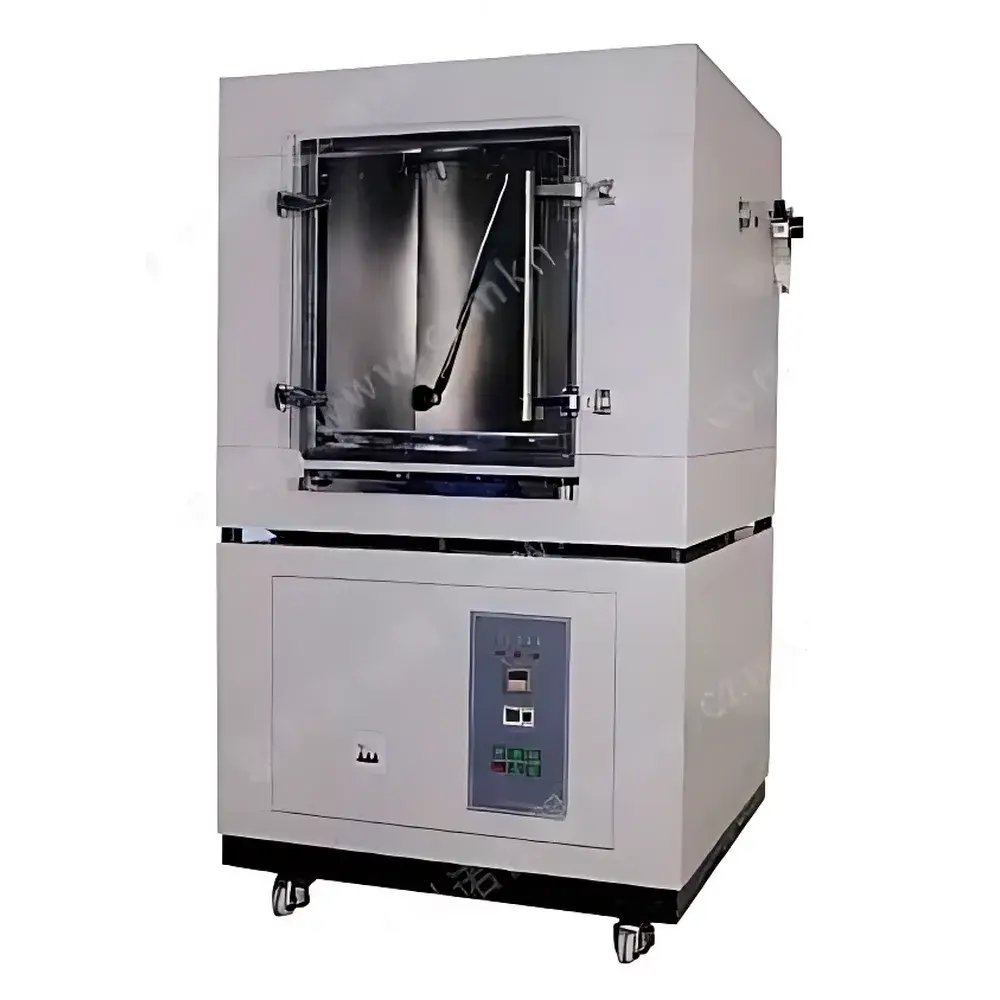
SC-050 Sand and Dust Test Chamber
| Origin | Zhejiang, China |
|---|---|
| Manufacturer Type | Authorized Distributor |
| Origin Category | Domestic (China) |
| Model | SC-050 |
| Pricing | Available Upon Request |
| Internal Temperature Range | 15–35 °C |
| Relative Humidity | 45–75% RH |
| Dust Loading | 2–4 kg/m³ |
| Sieve Mesh Specification | Nominal Wire Diameter 50 µm, Nominal Aperture 75 µm |
| Test Dust Types | Dry Talcum Powder, Silicate Cement, Fly Ash |
| Control System | Moeller (Eaton) Programmable Logic Controller (PLC) |
| Dust Blowing Mode | Continuous or Cyclic (On/Off Timing Configurable) |
| Vibration Function | Integrated Timer-Controlled Vibration Cycle |
| Compliance | GB/T 2423.37–1989, GB 4208–2008 (IP Code), GB 10485–2007 |
Overview
The SC-050 Sand and Dust Test Chamber is an environmental simulation system engineered for evaluating the ingress protection (IP) performance of enclosures, components, and assemblies under controlled airborne particulate exposure. It operates on the principle of forced dust suspension and directed airflow, replicating real-world desert, industrial, or roadside conditions where fine particulates—such as talcum powder, silicate cement, or fly ash—are suspended in air and impinged upon test specimens. Designed in strict accordance with national standards GB/T 2423.37–1989 (equivalent to IEC 60068-2-68 for sand and dust testing), GB 4208–2008 (defining IP5X and IP6X dust-tightness classifications), and GB 10485–2007 (methodology for dust resistance validation), the chamber supports both qualitative sealing verification and quantitative durability assessment. Its primary application domain includes mechanical, electro-mechanical, and electronic systems subjected to long-term operation in arid or dusty environments—particularly automotive lighting assemblies, instrument clusters, steering column housings, door latch mechanisms, and protective gaskets.
Key Features
- Corrosion-resistant stainless steel inner chamber with electrophoretically coated mild steel outer enclosure and tempered safety glass observation door
- Moeller (now Eaton) programmable logic controller (PLC) for precise sequencing of dust injection, vibration cycles, dwell periods, and power cycling
- Configurable operational modes: continuous dust suspension, timed on/off blowing cycles, programmable vibration intervals, and user-defined total test duration
- Integrated Schneider Electric contactors, push-button controls, and circuit breakers for industrial-grade reliability and safety compliance
- Fujitsu time relays and Panasonic dust-rated electrical sockets ensure stable signal integrity and EMI resilience during prolonged particulate exposure
- Calibrated dust dispersion system maintaining uniform volumetric concentration (2–4 kg/m³) across the working volume using standardized 50 µm wire-diameter / 75 µm aperture mesh sieving
Sample Compatibility & Compliance
The SC-050 accommodates a broad range of test specimens—including complete vehicle subassemblies, sealed electronic modules, optical housings, and polymer-based gasketed interfaces—without requiring disassembly or modification. Its internal dimensions support standard automotive component footprints while maintaining laminar flow characteristics necessary for reproducible particle impact distribution. All operational parameters adhere to the procedural rigor defined in GB/T 2423.37–1989, which specifies dust composition, particle size distribution, airflow velocity, and exposure duration for both non-abrasive (talcum-based) and abrasive (cement/fly ash) test media. The chamber further satisfies the physical construction and functional verification requirements outlined in GB 4208–2008 for IP5X (dust-protected) and IP6X (dust-tight) classification testing. While not certified to ISO/IEC 17025, its design enables traceable calibration and audit-ready documentation when deployed within GLP-compliant quality assurance workflows.
Software & Data Management
The SC-050 utilizes a hardware-based PLC control architecture without embedded GUI software or cloud connectivity. All test sequences—including blow duration, pause intervals, vibration timing, and total runtime—are configured via front-panel keypad input and stored in non-volatile memory. Event logs (start/stop timestamps, cycle counts, fault codes) are retained locally and can be exported manually via RS-232 interface for integration into external LIMS or QA documentation systems. The controller supports configurable alarm thresholds for overtemperature, overhumidity, or motor stall conditions, triggering audible/visual alerts and automatic shutdown to preserve specimen integrity. For regulated environments requiring electronic records, users may supplement operation with third-party data acquisition systems compliant with FDA 21 CFR Part 11 for audit trail generation and user access control.
Applications
- Validation of IP rating compliance for automotive lighting units (headlamps, fog lamps, taillights) per GB 4208–2008 and SAE J575
- Dust ingress resistance testing of instrument panel clusters, infotainment bezels, and HVAC control modules
- Sealing performance evaluation of electric power steering (EPS) gear housings and brake booster vacuum chambers
- Long-term durability assessment of rubber and thermoplastic dust caps used in door lock actuators and window regulator mechanisms
- Pre-certification screening for industrial control cabinets, marine electronics enclosures, and railway signaling equipment
- Material compatibility studies involving elastomeric seals exposed to abrasive particulates under thermal cycling conditions
FAQ
What dust types are recommended for routine qualification testing?
Dry talcum powder (per GB/T 2423.37–1989 Annex A) is the default test medium for non-abrasive sealing verification; silicate cement or fly ash may be substituted for abrasion-sensitive applications.
Can the SC-050 replicate IP6K dust-tightness testing per ISO 20653?
While optimized for GB-series standards, the chamber’s airflow control, dust concentration stability, and sealing verification protocol align closely with ISO 20653 IP6K methodology when operated at specified 2 kg/m³ loading and 2 m/s inlet velocity.
Is temperature or humidity control integrated into the SC-050 system?
No. The chamber maintains ambient laboratory conditions (15–35 °C, 45–75% RH) but does not include active heating, cooling, or humidification subsystems.
What maintenance intervals are recommended for the dust circulation blower and filter assembly?
Blower bearings require lubrication every 500 operational hours; primary cyclonic separator and HEPA-grade exhaust filters must be inspected and cleaned after each 20-hour test cycle.
Does the SC-050 support automated reporting or CSV data export?
Not natively. Data logging is limited to PLC event timestamps and cycle counters; full reporting requires external DAQ integration or manual transcription from the operator interface.



