
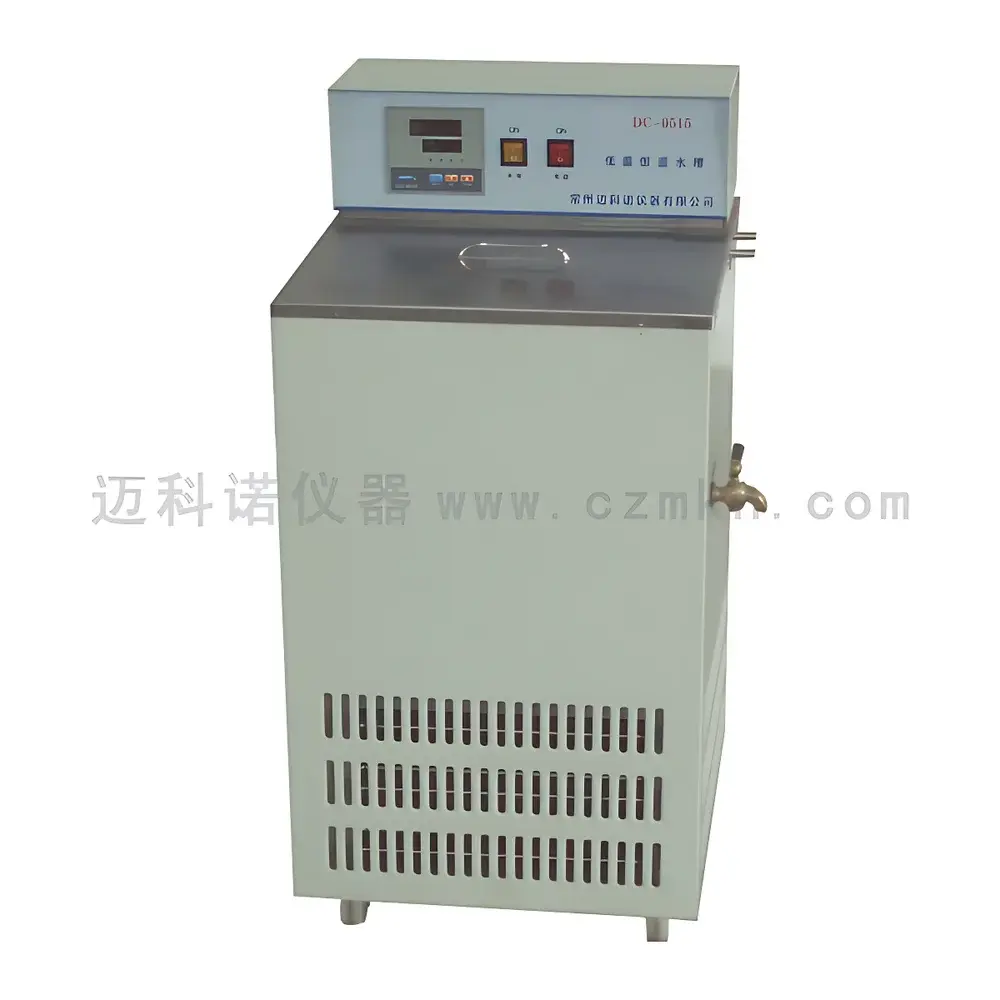
DC-2015 Low-Temperature Constant-Temperature Circulating Bath
| Origin | Zhejiang, China |
|---|---|
| Manufacturer Type | Authorized Distributor |
| Product Origin | Domestic (PRC) |
| Model | DC-2015 |
| Instrument Category | Constant-Temperature Bath |
| Circulation Mode | Internal Recirculation |
| Temperature Range | −20 °C to +100 °C |
| Temperature Stability & Uniformity | ±0.5 °C |
| Sensor Sensitivity | ±0.5 °C |
| Inner Tank Volume | 20 L |
| Inner Chamber Dimensions | 295 mm × 370 mm × 150 mm |
| Power Supply | 220 V ±10%, 50–60 Hz, 10 A |
| Control System | Microprocessor-Based PID Controller with LED Digital Display |
| Tank Material | Imported Stainless Steel (SUS304) |
| Heating Method | Far-Infrared Heaters |
| Temperature Acquisition | Dual-Integration High-Accuracy A/D Conversion |
| Thermal Equilibrium Time | Optimized for Rapid Stabilization |
Overview
The DC-2015 Low-Temperature Constant-Temperature Circulating Bath is a precision-engineered thermal management system designed for laboratory-scale temperature control in applications requiring stable, reproducible thermal environments from −20 °C to +100 °C. It operates on the principle of forced convection within a sealed stainless-steel bath reservoir, utilizing internal recirculation to maintain spatial temperature uniformity and minimize thermal gradients across the working volume. Unlike open-bath water baths, the DC-2015 integrates a closed-loop circulation path and microprocessor-based PID temperature regulation—enabling consistent thermal delivery to external apparatus (e.g., rotary evaporators, spectrophotometer cuvette holders, or reaction jackets) or direct immersion of samples and vessels. Its architecture supports both static immersion and dynamic heat exchange protocols, making it suitable for routine QC testing, preparative chemistry, pharmaceutical stability studies, and biological sample conditioning where precise thermal setpoint adherence is critical.
Key Features
- Stainless-steel inner tank (SUS304) fabricated via precision machining for corrosion resistance, thermal durability, and long-term dimensional stability under repeated thermal cycling
- Far-infrared heating elements coupled with high-stability operational amplifiers and dual-integration A/D conversion circuitry for accurate, low-drift temperature sensing and feedback control
- Microprocessor-driven PID controller with LED digital display offering intuitive setpoint entry, real-time temperature readout, and visual status indicators for operation mode and fault conditions
- Rapid thermal equilibration profile: achieves ±0.5 °C stability within ≤15 minutes of setpoint change under standard load conditions (20 L water, ambient start)
- Internal recirculation pump ensures homogeneous temperature distribution (±0.5 °C uniformity across full bath volume), eliminating stratification without requiring external plumbing
- Wide operating range (−20 °C to +100 °C) supported by optimized refrigeration-compressor and heating subsystem integration, validated per IEC 61000-6-3 for electromagnetic compatibility
Sample Compatibility & Compliance
The DC-2015 accommodates standard laboratory glassware—including round-bottom flasks (up to 5 L), condenser assemblies, jacketed reactors, and immersion probes—within its 295 mm × 370 mm × 150 mm usable chamber. The 20 L capacity allows sufficient thermal mass for stable operation during extended evaporation, concentration, or enzymatic incubation protocols. All wetted surfaces comply with ISO 8573-1 Class 4 for non-contaminating material contact, and the unit meets CE marking requirements for electrical safety (EN 61010-1) and electromagnetic emissions (EN 61326-1). While not certified for GMP manufacturing environments, its logging-capable controller and stable thermal performance support GLP-aligned documentation when paired with external calibrated reference thermometers (e.g., NIST-traceable Pt100 sensors).
Software & Data Management
The DC-2015 operates via embedded firmware with no proprietary software dependency. Temperature setpoints, real-time readings, and alarm thresholds are managed exclusively through the front-panel interface. Though the base model does not include RS232/USB data logging or remote control capability, its analog output (0–5 V or 4–20 mA, optional upon request) enables integration into centralized lab monitoring systems compliant with ASTM E2500-13 for equipment qualification. For audit-trail requirements under FDA 21 CFR Part 11, users may deploy third-party data acquisition hardware with time-stamped calibration verification—consistent with common practice for Class II laboratory thermal devices.
Applications
- Controlled-temperature solvent evaporation in rotary evaporation systems
- Thermal preconditioning of reagents and standards prior to HPLC or GC analysis
- Stability testing of APIs and excipients per ICH Q1A(R2) guidelines (at defined storage temperatures)
- Enzyme kinetics assays requiring strict thermal control between 4 °C and 45 °C
- Drying and concentration of heat-sensitive biological extracts under reduced pressure
- Calibration of thermocouples, RTDs, and infrared thermometers using traceable reference baths
FAQ
Does the DC-2015 support external circulation to auxiliary equipment?
No—the standard configuration provides internal recirculation only. External circulation requires optional pump and port modifications, which must be specified at time of order.
What is the minimum fluid volume required for safe operation?
The bath must be filled to at least 60% capacity (≥12 L) to ensure proper sensor immersion, compressor cooling, and thermal mass stability.
Is the unit compatible with silicone oil or other heat-transfer fluids?
Yes—provided viscosity remains below 500 cSt at operating temperature and fluid is chemically inert toward SUS304. Oil use voids warranty unless pre-approved by technical support.
Can temperature calibration be performed onsite?
Yes—using a NIST-traceable reference thermometer and the unit’s manual calibration offset function, per manufacturer-specified procedure in Section 4.2 of the operator manual.
What maintenance intervals are recommended?
Biannual inspection of refrigerant levels, condenser coil cleaning, and verification of pump impeller integrity; annual verification of temperature sensor linearity against certified references.



