
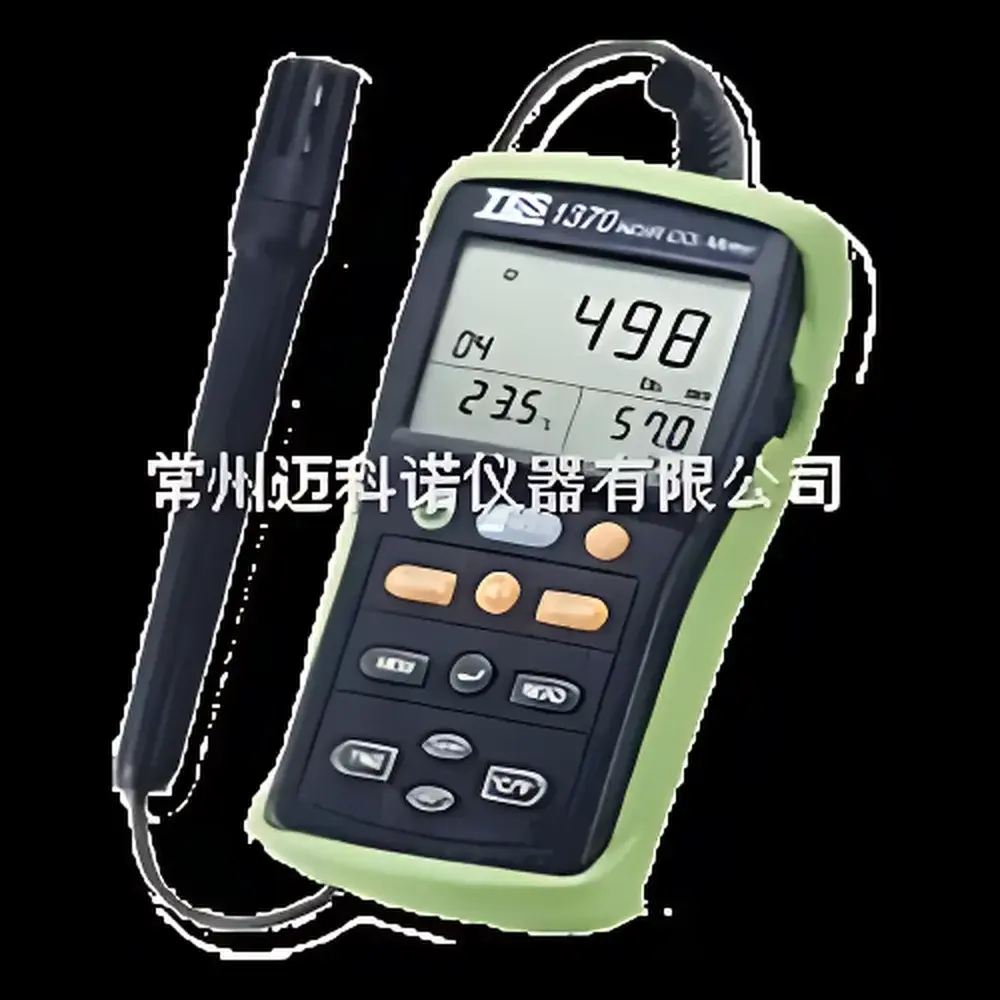
MKN TES-1370 Portable NDIR Carbon Dioxide Analyzer
| Brand | MKN |
|---|---|
| Model | TES-1370 |
| Type | Portable CO₂ Analyzer |
| Measurement Principle | Non-Dispersive Infrared (NDIR) |
| CO₂ Range | 0–6,000 ppm |
| Resolution | 1 ppm (CO₂), 0.1 °C / 0.1 °F (temperature), 0.1 %RH (humidity) |
| Accuracy | ±3% of reading or ±50 ppm (whichever is greater) for CO₂ |
| Operating Environment | 5–50 °C, 10–90 %RH |
| Power | 6×AAA alkaline batteries (≈8 h runtime, no backlight/alarms) or AC adapter |
| Dimensions | 158 × 72 × 35 mm |
| Weight | 255 g (with batteries) |
| Data Storage | 20,000 records + 99 manual entries |
| Connectivity | RS-232 interface |
| Compliance | Designed for field-deployable environmental monitoring per ISO 7243 and ASHRAE 62.1 guidance |
Overview
The MKN TES-1370 Portable NDIR Carbon Dioxide Analyzer is a field-deployable, battery-operated instrument engineered for reliable, real-time measurement of carbon dioxide concentration in ambient air and indoor environments. It employs dual-wavelength non-dispersive infrared (NDIR) spectroscopy—a well-established, interference-resistant optical method—where CO₂ molecules absorb specific IR wavelengths (typically near 4.26 µm), enabling selective quantification without chemical reagents or consumables. Unlike electrochemical or metal-oxide sensors, the NDIR architecture delivers long-term stability, minimal drift, and immunity to cross-sensitivity from common atmospheric gases such as CO, CH₄, or VOCs. The device is optimized for HVAC commissioning, indoor air quality (IAQ) assessments, classroom and office ventilation audits, greenhouse climate monitoring, and occupational hygiene surveys where trace-level CO₂ tracking (0–6,000 ppm) supports compliance with ASHRAE Standard 62.1, EN 13779, and WHO indoor air guidelines.
Key Features
- Dual-wavelength NDIR sensing technology with built-in temperature and humidity compensation for improved accuracy across variable environmental conditions
- Simultaneous measurement of CO₂ (0–6,000 ppm), ambient temperature (−20 to +60 °C), and relative humidity (10–95 %RH)
- High-resolution LCD display with backlight, supporting real-time data viewing, min/max value capture, and time-stamped peak detection
- On-device data logging: automatic storage of up to 20,000 sequential readings plus 99 manually triggered entries, accessible directly via LCD navigation
- Configurable audible and visual alarm thresholds with programmable delay and reset logic for continuous exposure monitoring
- Zero-point calibration routine executable in fresh ambient air (≈400 ppm CO₂), requiring no external gas standard or service tools
- RS-232 serial interface for direct connection to PCs; included software enables export of time-series datasets in CSV format for trend analysis and reporting
- Robust mechanical design: compact housing (158 × 72 × 35 mm), IP20-rated enclosure, and 255 g mass—including six AAA alkaline cells—for extended handheld operation
Sample Compatibility & Compliance
The TES-1370 operates via diffusion sampling—requiring no pump or inlet tubing—and is therefore suited for static or low-velocity air environments (e.g., occupied rooms, laboratories, storage facilities). It is not intended for pressurized, corrosive, or particulate-laden gas streams. While not certified to IEC 61000-6-3 (EMC) or ATEX/IECEx standards, its design aligns with functional safety expectations for non-hazardous area use. The instrument’s accuracy specifications meet typical requirements for IAQ verification under ISO 16814 (Indoor Air Quality — General Principles) and support documentation for GLP-aligned field studies. Humidity and temperature compensation algorithms are validated per manufacturer test protocols traceable to NIST-traceable reference instruments.
Software & Data Management
The bundled Windows-compatible software provides secure local configuration, firmware update capability, and bidirectional data exchange. Logged records include timestamp (YYYY-MM-DD HH:MM:SS), CO₂ concentration (ppm), temperature (°C/°F), and RH (%), all stored with millisecond-level resolution. Exported CSV files contain header metadata (device ID, calibration date, operator ID field) to facilitate audit-ready recordkeeping. The software supports basic statistical summarization (mean, standard deviation, min/max) and time-binned averaging (1-min to 1-h intervals). No cloud connectivity or remote access functionality is implemented—ensuring full data sovereignty and compatibility with air-gapped laboratory networks.
Applications
- Verification of demand-controlled ventilation (DCV) system performance in commercial buildings
- Occupancy estimation and ventilation adequacy assessment per CDC and EPA IAQ recommendations
- Baseline CO₂ mapping during HVAC system commissioning and retro-commissioning
- Educational demonstrations of respiration dynamics and closed-environment gas accumulation
- Greenhouse and growth chamber environmental control validation
- Post-occupancy evaluation (POE) studies supporting LEED IEQ Credit 1 and WELL Building Standard W02
- Field screening for potential combustion byproduct accumulation in residential basements or garages
FAQ
Does the TES-1370 require periodic factory recalibration?
No scheduled factory recalibration is mandated. Users may perform on-site zero-point adjustment using ambient outdoor air; the sensor’s inherent stability minimizes need for span calibration under normal operating conditions.
Can the device measure CO₂ in confined spaces with elevated humidity?
Yes—the integrated humidity sensor (10–95 %RH range) and on-board compensation algorithm maintain stated accuracy across the full specified RH band, including condensing conditions at 95 %RH.
Is the RS-232 interface compatible with modern USB-C laptops?
The unit outputs standard RS-232 voltage levels (±12 V); a powered USB-to-RS-232 converter (FTDI chipset recommended) is required for connection to USB-only hosts.
What is the expected lifetime of the NDIR sensor?
The dual-wavelength infrared source and detector array are rated for >15,000 hours of continuous operation under typical environmental conditions, corresponding to approximately 5–7 years of daily field use.
Does the instrument comply with FDA 21 CFR Part 11 for electronic records?
No—the TES-1370 lacks electronic signature capability, audit trail generation, or user access controls required for Part 11 compliance; it is intended for general-purpose environmental monitoring, not regulated pharmaceutical or clinical applications.
Related Products







