
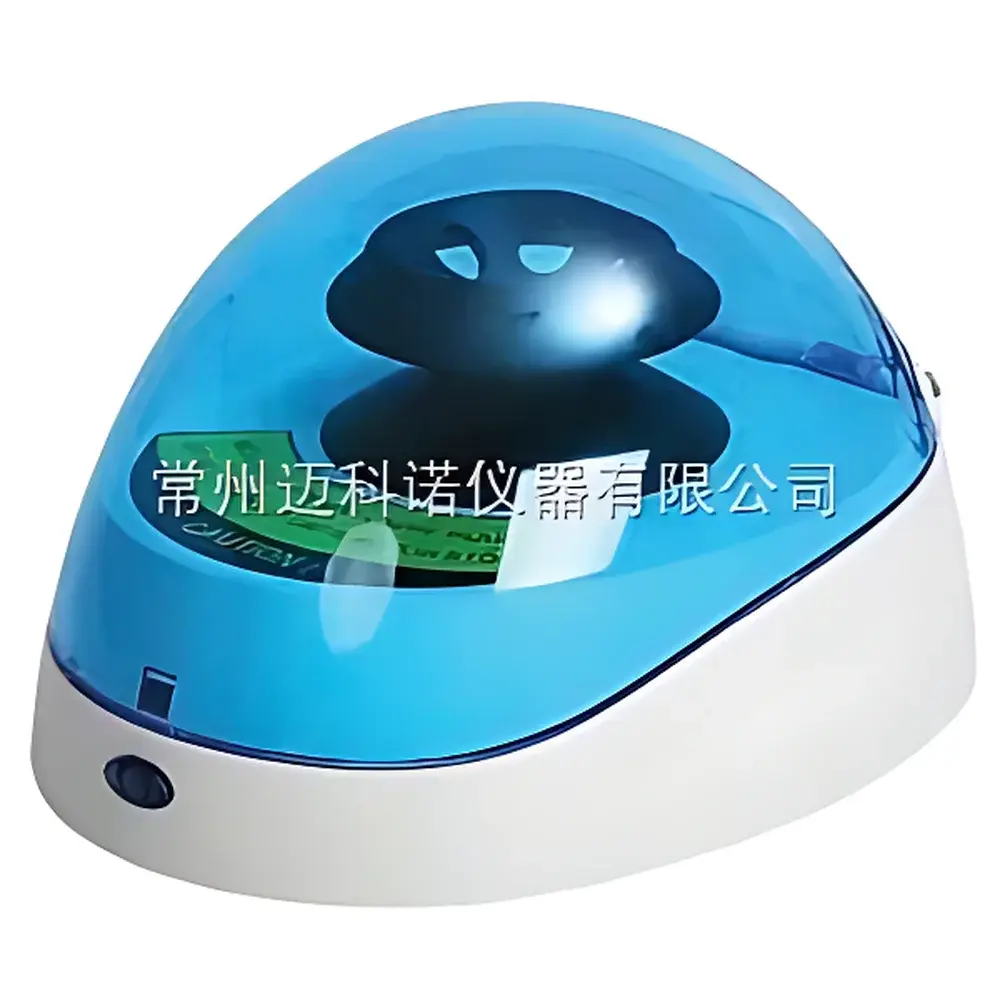
MKN Mini-6K Compact Benchtop Centrifuge
| Brand | MKN |
|---|---|
| Model | Mini-6K |
| Max Speed | 6000 rpm |
| RCF | 2000 × g |
| Capacity | 6 × 1.5/2.0 mL tubes, 2 × 8 × 0.2 mL PCR strips, 6 × 0.2 mL or 6 × 0.5 mL adapters, slide rotor for microscope slides |
| Noise Level | <50 dB(A) |
| Drive System | Brushless DC Motor |
| Rotor Material | Carbon Fiber |
| Dimensions | Not specified |
| Weight | Not specified |
| Power Supply | AC 100–240 V, 50/60 Hz |
Overview
The MKN Mini-6K Compact Benchtop Centrifuge is an engineered solution for rapid, low-volume sample separation in resource-constrained laboratory environments—including teaching labs, point-of-care testing stations, field-deployable diagnostic units, and molecular biology workstations. Designed around a brushless DC motor and carbon fiber rotor architecture, the Mini-6K delivers stable rotational dynamics with minimal thermal drift and mechanical hysteresis. Its operation follows classical centrifugal sedimentation principles: acceleration of samples radially outward under controlled angular velocity generates relative centrifugal force (RCF), enabling phase separation based on particle density, size, and medium viscosity. With a maximum RCF of 2000 × g and rotational speed up to 6000 rpm, the Mini-6K supports routine pelleting of cellular debris, precipitation of nucleic acids, microfiltration of reagents, and preparation of clarified supernatants—without requiring refrigeration or vacuum sealing.
Key Features
- Brushless DC motor ensures extended service life, consistent torque delivery, and reduced electromagnetic interference—critical for integration near sensitive instrumentation such as spectrophotometers or PCR thermocyclers.
- Carbon fiber rotor provides high strength-to-weight ratio, excellent fatigue resistance, and inherent damping properties that contribute to sub-50 dB(A) acoustic performance during operation.
- Streamlined ergonomic housing with integrated grip zones facilitates single-handed placement and removal of rotors; non-slip rubber feet prevent lateral displacement on benchtops during high-speed runs.
- Dual-mode rotor compatibility enables simultaneous processing of diverse consumables: standard 1.5/2.0 mL microcentrifuge tubes, 0.2 mL PCR strip formats (2 × 8-position), and specialized accessories including glass slide holders and volume-specific adapters (0.2 mL and 0.5 mL).
- No-touch lid actuation with automatic safety interlock prevents rotor exposure during operation and enforces mandatory lid closure prior to acceleration—compliant with IEC 61010-2-020 requirements for laboratory centrifuges.
Sample Compatibility & Compliance
The Mini-6K accommodates common polypropylene and polycarbonate microcentrifuge tubes (1.5 mL and 2.0 mL), thin-walled PCR strips, and standard 76 × 26 mm glass microscope slides. All rotor assemblies are balanced to ISO 1940-1 Grade G6.3 specifications and validated for use with commercially available certified consumables. The device meets essential safety and electromagnetic compatibility standards including IEC 61010-1 (Safety Requirements for Electrical Equipment for Measurement, Control, and Laboratory Use) and IEC 61326-1 (EMC Requirements for Laboratory Equipment). While not designed for clinical diagnostics under FDA 21 CFR Part 820 or ISO 13485, it supports GLP-aligned documentation workflows when paired with external audit-trail-capable lab information systems.
Software & Data Management
The Mini-6K operates via an embedded push-button interface with LED status indicators—no external software, drivers, or firmware updates required. Time, speed, and RCF values are displayed in real time using a 3-digit segmented display. Run history is not stored internally; however, the device supports manual logging protocols compatible with paper-based or electronic laboratory notebooks (ELN) compliant with ALCOA+ data integrity principles. For laboratories implementing 21 CFR Part 11 compliance, timestamped run records can be captured externally using barcode-scanned protocol sheets or synchronized with LIMS via serial output (RS-232 optional accessory, sold separately).
Applications
- Routine clarification of bacterial lysates and cell culture supernatants prior to SDS-PAGE or ELISA analysis.
- Spin-down of enzymatic reaction mixtures (e.g., restriction digests, ligations, phosphorylations) to concentrate DNA fragments or remove unincorporated nucleotides.
- Preparation of RNA pellets following guanidinium thiocyanate–phenol–chloroform extraction protocols.
- Microcentrifugation of chromatography fractions to eliminate particulate carryover before HPLC injection.
- Field-deployable separation of whole blood into serum/plasma layers using capillary tube rotors (adapter-dependent).
- Quality control centrifugation of reagent stocks to verify absence of precipitates or aggregation prior to assay deployment.
FAQ
What is the maximum relative centrifugal force (RCF) achievable with the Mini-6K?
The Mini-6K achieves a maximum RCF of 2000 × g at 6000 rpm with the standard 6-position microtube rotor.
Can the Mini-6K accommodate 0.2 mL PCR strips?
Yes—it supports two independent 8-position PCR strip rotors, allowing parallel processing of up to 16 reactions per run.
Is the Mini-6K suitable for continuous operation?
It is rated for intermittent duty cycles: maximum 15 minutes ON followed by 5 minutes OFF to maintain thermal stability of the motor and electronics.
Does the device include rotor balancing verification tools?
No dedicated balancer is included; users must manually balance tube loads by mass (±0.1 g tolerance recommended) prior to insertion.
Are replacement rotors and adapters available through MKN authorized distributors?
Yes—original equipment manufacturer (OEM) rotors, slide holders, and volume-specific adapters are stocked globally and traceable to batch-certified manufacturing records.



