
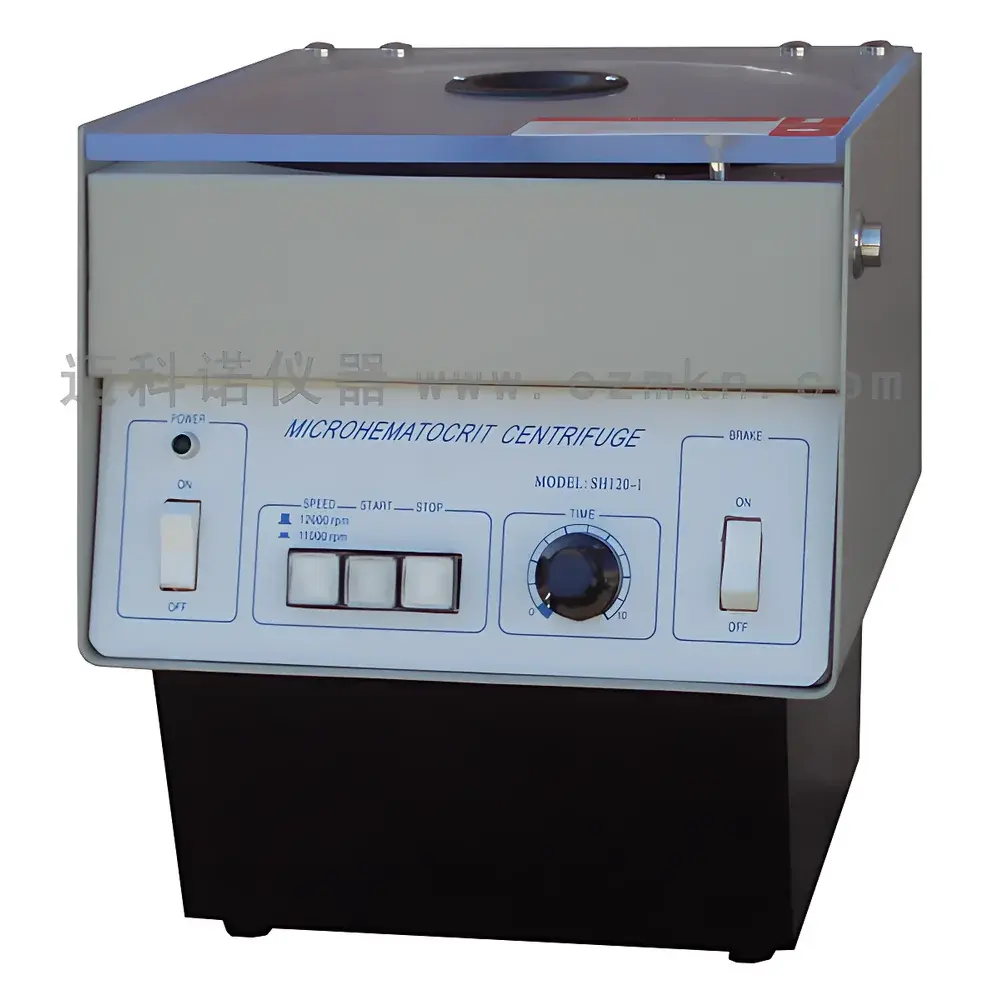
MKN SH120-1 Microhematocrit Centrifuge
| Brand | MKN |
|---|---|
| Origin | Zhejiang, China |
| Manufacturer Type | Authorized Distributor |
| Product Category | Domestic |
| Model | SH120-1 |
| Maximum Speed | 12,000 rpm |
| Relative Centrifugal Force (RCF) | 13,500 × g |
| Capacity | 24 × capillary tubes (Φ1.5 mm × 75 mm) |
| Power Input | 230 VA |
| Power Output | 100 W |
| Voltage/Frequency | 110 V / 60 Hz & 220 V / 60 Hz |
| Acceleration Time | < 1 min |
| Deceleration Time | < 2 min |
| Timer Range | 0–30 min (non-continuous operation only) |
| Speed Selection | Push-button dual setting (11,000 rpm / 12,000 rpm) |
| Net Weight | 10 kg |
| Compliance | Designed for clinical hematology and point-of-care microvolume sample processing |
Overview
The MKN SH120-1 Microhematocrit Centrifuge is a compact, benchtop centrifugal instrument engineered specifically for rapid sedimentation and separation of microvolume blood samples in clinical laboratories, field diagnostics, and veterinary settings. It operates on the principle of fixed-angle rotor centrifugation, generating controlled relative centrifugal force (RCF) to accelerate phase separation of whole blood into packed red blood cells (RBCs), white blood cells (WBCs), platelets, and plasma within calibrated capillary tubes. Its design prioritizes reproducibility in hematocrit (HCT) determination—critical for anemia screening, dehydration assessment, and pre-transfusion evaluation—while accommodating minimally invasive sampling methods such as earlobe or fingertip capillary blood collection. The device complies with standard methodologies outlined in CLSI H26-A3 and ISO 15189–accredited workflows for microhematocrit analysis.
Key Features
- Optimized fixed-angle rotor geometry ensuring uniform RCF distribution across all 24 capillary positions, minimizing inter-tube variability in packed cell volume measurement.
- Dual-speed push-button control (11,000 rpm and 12,000 rpm) enables protocol-specific acceleration profiles aligned with CLSI-recommended spin durations for capillary hematocrit assays.
- Thermally stable brushless DC motor delivers consistent rotational performance over repeated cycles, with built-in thermal cutoff protection to prevent overheating during sequential runs.
- Compact footprint (designed for ≤0.15 m² bench space) and lightweight construction (10 kg net weight) support deployment in mobile clinics, satellite labs, and resource-limited environments.
- Timer-integrated safety interlock prevents lid opening during operation and enforces mandatory rest intervals between consecutive 30-minute cycles to maintain mechanical longevity and rotor integrity.
- Low electromagnetic interference (EMI) design ensures compatibility with adjacent diagnostic instrumentation without signal disruption.
Sample Compatibility & Compliance
The SH120-1 accepts standard heparinized or EDTA-coated glass or plastic capillary tubes (1.5 mm inner diameter × 75 mm length), conforming to ASTM E2027–20 specifications for microhematocrit tube dimensions and material transparency. It supports both manual and automated hematocrit readers via standardized tube geometry. While not certified under FDA 510(k) or CE-IVD directives, the unit meets general electrical safety requirements per IEC 61010-1:2010 and is suitable for use in laboratories adhering to Good Laboratory Practice (GLP) frameworks where instrument qualification is performed per internal SOPs. Routine verification of RCF output and timer accuracy is recommended per ISO/IEC 17025 Clause 6.4.3 for measurement traceability.
Software & Data Management
As a standalone mechanical centrifuge, the SH120-1 does not incorporate embedded firmware, touchscreen interfaces, or digital data logging capabilities. All operational parameters—including speed selection, timer activation, and run status—are managed via physical push-button controls and visual LED indicators. This architecture eliminates software validation requirements under FDA 21 CFR Part 11, making it appropriate for regulated environments where audit trails are maintained manually through logbooks or LIMS-integrated run records. Users may integrate post-centrifugation hematocrit readings into electronic health records (EHR) or laboratory information systems (LIS) using external scanning or manual entry protocols.
Applications
- Routine hematocrit quantification in primary care and emergency departments using capillary blood.
- Point-of-care monitoring of hematologic parameters in remote or low-infrastructure healthcare facilities.
- Veterinary hematology workflows requiring rapid RBC volume estimation from small-volume animal samples.
- Research applications involving microvolume plasma isolation for downstream ELISA, PCR, or metabolite profiling.
- Educational laboratories demonstrating sedimentation kinetics and density-based separation principles.
- Quality control checks for anticoagulant efficacy and blood sample integrity prior to automated hematology analyzer input.
FAQ
What capillary tube specifications are compatible with the SH120-1?
Standard 1.5 mm ID × 75 mm length capillaries—either heparinized or EDTA-coated—are required. Tubes must be filled to ≥80% capacity and balanced symmetrically in the rotor.
Is continuous operation permitted?
No. The timer is limited to 0–30 minutes per cycle, and the unit must cool for ≥5 minutes between successive runs to preserve motor life and rotor metallurgical stability.
Does the SH120-1 require calibration certification?
While no factory-issued calibration certificate is provided, users should verify rotational speed with a tachometer and timer accuracy with a stopwatch at installation and semiannually thereafter per ISO/IEC 17025 guidance.
Can this centrifuge be used for non-blood samples?
It is validated exclusively for microvolume biological fluids with viscosity and density profiles comparable to whole blood; use with high-viscosity or particulate-laden suspensions is not recommended.
What safety certifications apply to this model?
The device conforms to IEC 61010-1:2010 for electrical safety in laboratory equipment but carries no IVD-specific regulatory designation. Installation must follow local electrical grounding and ventilation requirements.



