
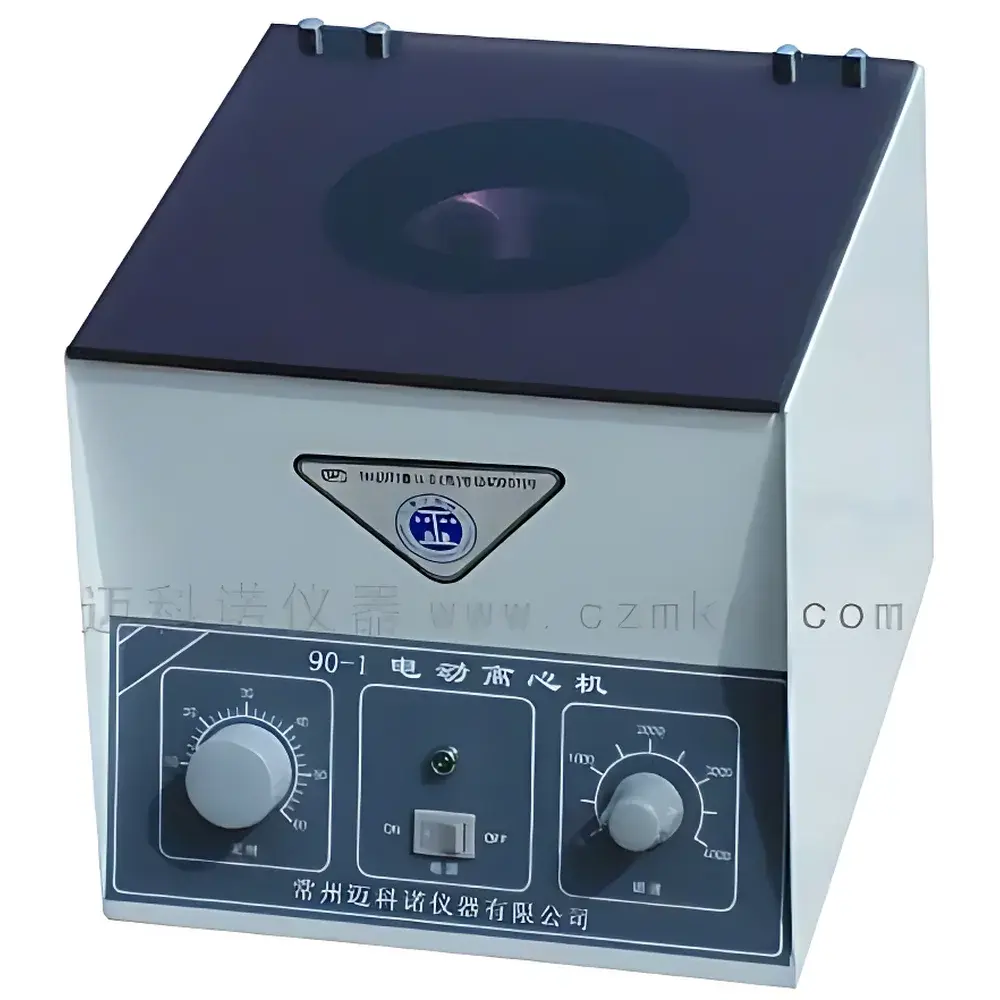
MKN 90-1 Benchtop Centrifuge
| Brand | MKN |
|---|---|
| Origin | Jiangsu, China |
| Manufacturer Type | Authorized Distributor |
| Country of Manufacture | China |
| Model | 90-1 |
| Max Speed | 4000 rpm |
| Relative Centrifugal Force (RCF) | 1430 × g |
| Timer Range | 0–60 min |
| Capacity | 6 × 20 mL or 6 × 15 mL or 8 × 5 mL |
| Noise Level | ≤60 dB(A) |
| Power Supply | AC 220 V, 50 Hz, 2 A |
Overview
The MKN 90-1 Benchtop Centrifuge is a compact, general-purpose centrifugal separation instrument engineered for routine laboratory applications requiring reliable sedimentation-based sample processing. It operates on the principle of centrifugal force generation through high-speed rotor rotation, enabling density-based separation of suspended particles, cells, organelles, or immiscible liquid phases within heterogeneous samples. Designed for consistent performance in clinical diagnostics, biochemical assay preparation, and basic research workflows, the unit delivers stable rotational dynamics without vacuum or refrigeration—making it suitable for ambient-temperature centrifugation of serum, plasma, whole blood, immunoprecipitates, and low-viscosity aqueous solutions. Its mechanical architecture integrates a brushless DC motor with analog speed control, ensuring smooth acceleration/deceleration profiles and minimal thermal drift during operation.
Key Features
- Stepless analog speed regulation from 0 to 4000 rpm, with automatic lid interlock shutdown for operator safety
- Integrated mechanical timer (0–60 minutes) with audible end-of-run signal
- Aluminum alloy rotor assembly precision-balanced at factory to minimize vibration and extend bearing service life
- Low-noise design (<60 dB[A]) achieved via optimized airflow pathways and vibration-damping base construction
- Compact footprint (270 × 250 × 220 mm) and lightweight chassis (≈12 kg) for flexible benchtop deployment in constrained lab spaces
- Thermally stable housing with passive convection cooling—no active fan required, reducing contamination risk in sterile environments
Sample Compatibility & Compliance
The MKN 90-1 supports standard conical-bottom centrifuge tubes (5 mL, 15 mL, and 20 mL volumes), accommodating common polypropylene and polycarbonate materials compliant with ISO 7218 and CLSI GP19-A3 guidelines for diagnostic specimen handling. Rotor geometry ensures uniform radial distribution of centrifugal force across all tube positions, supporting reproducible pelleting efficiency in accordance with ASTM D3924-22 (Standard Practice for Centrifugal Separation of Suspensions). While not certified for biosafety level (BSL)-2 or higher containment, the unit meets IEC 61010-1:2010 requirements for electrical safety in laboratory equipment and conforms to GB/T 14710–2009 (Chinese national standard for environmental adaptability of medical instruments).
Software & Data Management
As a manually operated analog centrifuge, the 90-1 does not incorporate digital control interfaces, data logging, or network connectivity. All operational parameters—including speed, time, and run status—are set and monitored via front-panel dials and mechanical indicators. This architecture eliminates software validation requirements under FDA 21 CFR Part 11 or EU Annex 11, rendering the device inherently compatible with GLP- and GMP-regulated environments where traceable manual entry into lab notebooks suffices for audit purposes. For laboratories requiring electronic records, external time-stamped video documentation or integrated stopwatch logging may be employed per internal SOPs.
Applications
- Routine serum/plasma separation from whole blood specimens prior to ELISA, spectrophotometric, or electrophoretic analysis
- Pelleting of mammalian cell cultures during transient transfection or antibody purification workflows
- Clarification of crude lysates in protein extraction protocols (e.g., following sonication or freeze-thaw cycles)
- Phase separation in solvent-based extractions (e.g., phenol-chloroform RNA isolation pre-centrifugation steps)
- Removal of particulate contaminants from buffer stocks, reagent solutions, or calibration standards
- Pre-analytical sample conditioning in clinical chemistry, hematology, and immunology laboratories operating under CAP or ISO 15189 frameworks
FAQ
What is the maximum relative centrifugal force (RCF) achievable with the MKN 90-1?
The unit generates up to 1430 × g at its rated maximum speed of 4000 rpm with the standard 6-position rotor.
Can this centrifuge be used for centrifuging infectious or hazardous samples?
No—this model lacks sealed rotor containment, aerosol-tight lids, or biosafety certification; it is intended only for non-hazardous, low-risk biological and chemical samples.
Is rotor imbalance compensation automated?
Yes—the unit includes a passive auto-balancing mechanism that compensates for minor load asymmetries up to ±0.5 g per tube position.
Does the MKN 90-1 support refrigerated operation?
No—it is an ambient-temperature-only centrifuge without temperature control or cooling capability.
What maintenance intervals are recommended for long-term reliability?
Visual inspection of rotor threads and lid latch integrity every 6 months; lubrication-free operation eliminates routine grease servicing; annual verification of speed accuracy using a calibrated tachometer is advised.



