
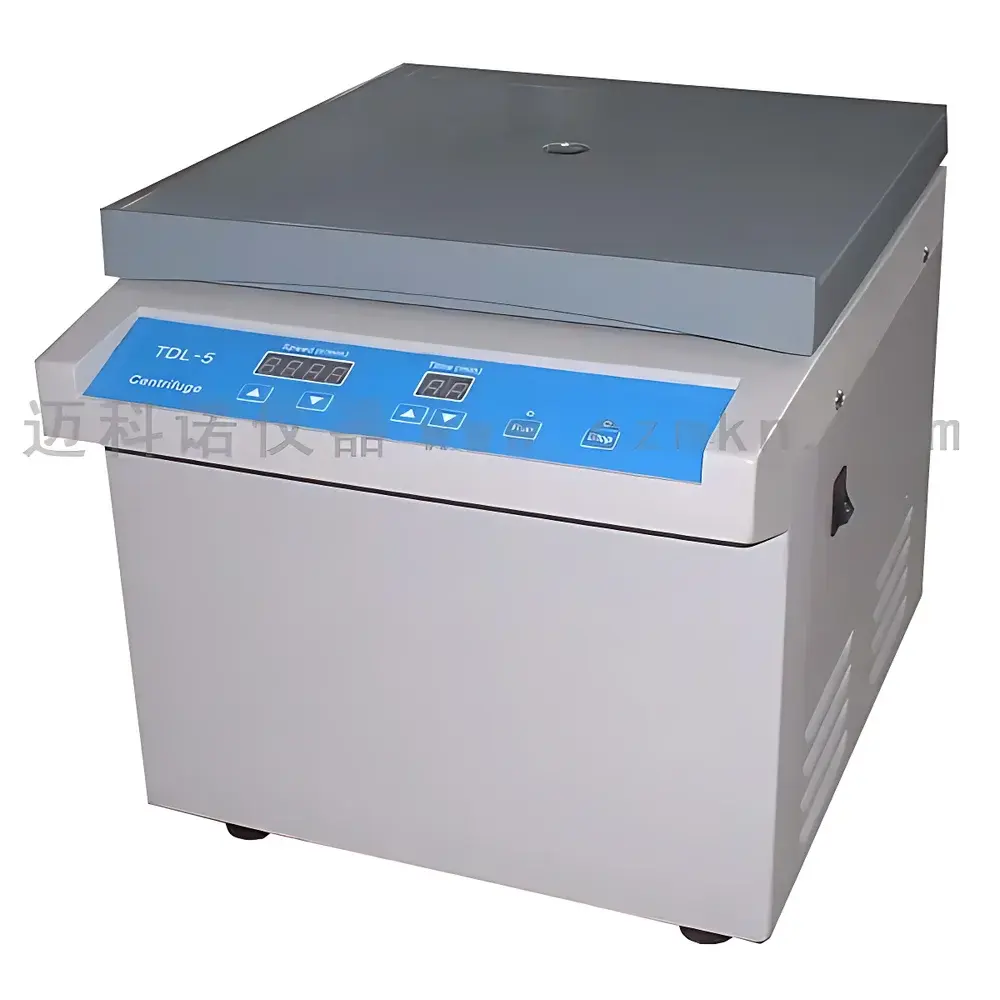
MKN TDL-5A Benchtop Low-Speed High-Capacity Centrifuge
| Brand | MKN |
|---|---|
| Model | TDL-5A |
| Max Speed | 0–4000 rpm |
| RCF | 2770 × g |
| Capacity | 250 mL × 4 / 50 mL × 8 / 10 mL × 28 |
| Timer Range | 0–30 min |
| Power | 320 W |
| Noise Level | ≤60 dB(A) |
| Voltage/Frequency | AC 220 V, 50 Hz, 10 A |
| Construction | Stainless Steel Rotor, Reinforced Polymer & Imported Steel Housing |
| Control | Digital LED Display, Touch Panel, Microprocessor-Based Control System |
| Safety | Electronic Door Lock, Dual Interlock Switches, Dual Fuses, Rotor Imbalance Protection |
| Compliance | Designed per IEC 61010-1 (Safety Requirements for Electrical Equipment for Measurement, Control, and Laboratory Use) |
Overview
The MKN TDL-5A is a benchtop low-speed high-capacity centrifuge engineered for routine separation of biological, clinical, pharmaceutical, and environmental samples where gentle sedimentation and large-volume processing are required. Operating on the principle of sedimentation under controlled gravitational force (RCF), it delivers reproducible separation of plasma, whole blood, cell suspensions, precipitates, and other low-density particulates without compromising sample integrity. Its design prioritizes operational safety, thermal stability, and long-term mechanical reliability—critical attributes for laboratories performing daily batch processing in QC, clinical diagnostics, and academic research settings. Unlike high-speed or ultracentrifuges, the TDL-5A operates at rotational speeds optimized for macro-scale phase separation rather than subcellular fractionation, making it ideal for applications requiring high throughput without shear-induced degradation.
Key Features
- Horizontal swing-out rotor configuration with automatic imbalance detection and immediate deceleration upon deviation beyond tolerance thresholds
- Digital LED display showing real-time values for speed (rpm), elapsed time, and relative centrifugal force (×g)
- Microprocessor-controlled acceleration/deceleration profiles to minimize sample disturbance during spin-up and braking
- Touch-sensitive control panel enabling intuitive parameter entry—including programmable run time (0–30 minutes in 1-minute increments) and speed selection (0–4000 rpm in 100-rpm steps)
- Double-safety interlock system: electronic door lock engages only when lid is fully closed and rotor is stationary; physical safety switch disables motor if lid is opened mid-run
- Dual redundant fuse protection integrated into main power circuitry to prevent overcurrent damage during transient load conditions
- Acoustically damped housing constructed from imported cold-rolled steel and high-impact polymer, reducing operational noise to ≤60 dB(A) at 1 m distance
- Stainless steel rotor compatible with standard conical tubes (10 mL, 50 mL) and custom 250 mL bottles—certified for autoclaving and corrosion resistance per ASTM A240
Sample Compatibility & Compliance
The TDL-5A accommodates common laboratory vessels including polypropylene and polycarbonate centrifuge tubes, glass bottles, and serum collection tubes. Its rotor geometry supports simultaneous processing of heterogeneous sample formats—up to four 250 mL bottles, eight 50 mL tubes, or twenty-eight 10 mL tubes—enabling flexible workflow integration across hematology, biobanking, food microbiology, and wastewater analysis labs. The unit conforms to IEC 61010-1:2010 for electrical safety in laboratory equipment and meets mechanical stability requirements outlined in ISO 13485:2016 for medical device manufacturing environments. While not FDA 21 CFR Part 11–validated out-of-the-box, its digital logging capability (via optional RS232 interface) supports audit-ready data capture when integrated into GLP/GMP-compliant workflows using third-party LIMS or ELN platforms.
Software & Data Management
The TDL-5A features embedded firmware that records run history—including date/time stamp, set parameters, actual RCF achieved, and fault codes—for up to 100 cycles. Data export is supported via optional serial communication (RS232) for integration with laboratory information management systems (LIMS) or electronic lab notebooks (ELN). No proprietary software installation is required; raw ASCII logs can be parsed directly by Python, MATLAB, or Excel-based validation tools. All parameter changes are logged with timestamped entries, satisfying basic traceability requirements for ISO/IEC 17025-accredited testing laboratories. Firmware updates are performed manually via USB interface using signed binary files provided by MKN technical support—ensuring version control and cybersecurity compliance.
Applications
- Clinical laboratories: Separation of serum/plasma from whole blood prior to immunoassay or clinical chemistry analysis
- Pharmaceutical QA/QC: Clarification of suspension formulations, excipient compatibility testing, and residual moisture determination in lyophilized intermediates
- Food safety labs: Isolation of pathogens (e.g., Salmonella, E. coli) from enrichment broths and sedimentation of fat globules in dairy emulsions
- Environmental monitoring: Concentration of suspended solids and microplastics from aqueous effluent samples prior to gravimetric or spectroscopic analysis
- Academic research: Harvesting bacterial cultures, yeast pellets, and plant protoplasts without inducing lysis or metabolic stress
- Blood banking: Preparation of platelet-rich plasma (PRP) and buffy coat isolation under standardized low-shear protocols
FAQ
What is the maximum RCF achievable at 4000 rpm with the standard rotor?
The TDL-5A achieves a maximum RCF of 2770 × g at 4000 rpm with the supplied horizontal rotor (radius = 152 mm). RCF varies linearly with rotor radius; users selecting alternative rotors must recalculate using the formula RCF = 1.118 × 10⁻⁵ × r × N².
Is the rotor autoclavable?
Yes—the stainless steel rotor is autoclavable at 121°C for 20 minutes. Repeated sterilization does not compromise structural integrity or balance certification, provided manufacturer-recommended cooling and drying protocols are followed.
Does the unit support continuous operation mode?
No. The TDL-5A is designed for timed batch operation only. Continuous runs are prohibited by firmware lockout to prevent thermal overload and bearing fatigue.
Can I retrofit this model with a refrigerated jacket?
No. The TDL-5A is air-cooled and lacks compressor integration or condensation management systems. For temperature-sensitive separations, users should consider the MKN RC-5 series refrigerated centrifuges.
How often should the rotor be balanced and certified?
Rotor balance verification is recommended every 6 months or after 500 runs, whichever occurs first. Certification documentation must be retained per ISO/IEC 17025 clause 6.4.4 for accredited laboratories.
Related Products



