
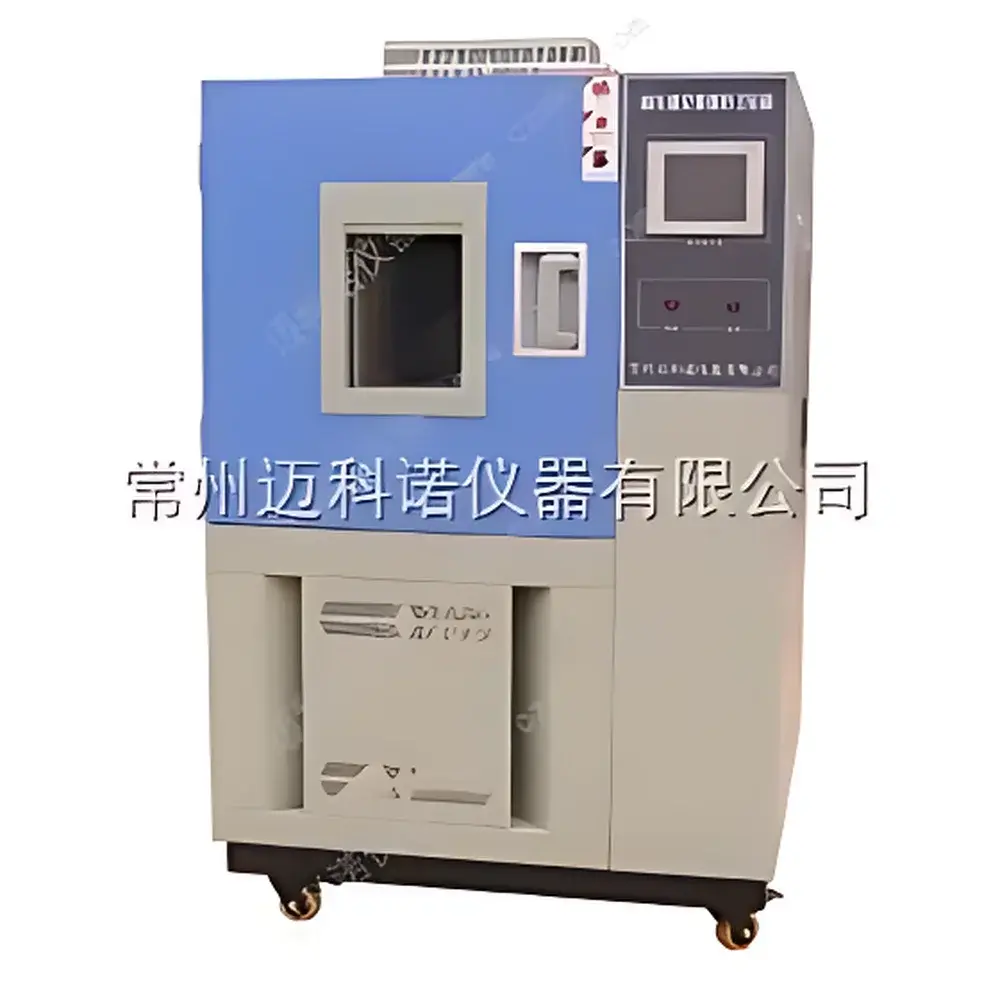
GDS-010 High-Low Temperature and Humidity Cycling Environmental Test Chamber
| Origin | Zhejiang, China |
|---|---|
| Manufacturer Type | Authorized Distributor |
| Country of Origin | China |
| Model | GDJS-010 |
| Pricing | Available Upon Request |
| Temperature Range | −20 °C to +100 °C (optional −40 °C / −60 °C / −70 °C to +150 °C) |
| Humidity Range | 30–98 %RH |
| Temperature Uniformity | ≤ ±2 °C |
| Temperature Fluctuation | ≤ ±0.5 °C |
| Humidity Deviation | +2 %RH / −3 %RH |
| Heating Rate | ≥ 2–3 °C/min |
| Cooling Rate | ≤ 1 °C/min |
| Internal Chamber Dimensions (W×D×H) | 400 × 500 × 500 mm |
| External Dimensions (W×D×H) | 1030 × 1020 × 1470 mm |
| Refrigeration System | Single-stage or cascade (dual-stage) refrigeration |
| Compressor | Original French Tecumseh hermetic compressor |
| Control System | OYO 8226A large-screen LCD touch-panel programmable controller |
| Humidification Method | Shallow-water tank surface evaporation |
| Air Circulation | Single-circuit stainless steel centrifugal blower with extended shaft and low-noise design |
| Insulation Material | Ultra-fine glass fiber |
| Safety Protections | Leakage current protection, water shortage protection, over-temperature cutoff, fast-acting fuse, compressor high-pressure protection |
Overview
The GDS-010 High-Low Temperature and Humidity Cycling Environmental Test Chamber is an engineered climate simulation system designed for rigorous reliability validation of industrial components, electronic assemblies, automotive parts, and packaging materials under controlled thermal and hygrothermal stress conditions. It operates on the principle of balanced heating–cooling–humidification control—where independent PID-regulated subsystems dynamically adjust power input to heaters, refrigerant flow through multi-stage evaporators, and water surface evaporation rate in a shallow reservoir to achieve precise, stable, and reproducible environmental profiles. Unlike static chamber designs, this unit supports programmable cycling between extreme temperature and humidity setpoints—including ramp-hold-soak sequences—enabling compliance testing per internationally recognized environmental stress protocols. Its structural architecture prioritizes long-term operational integrity: a SUS304 stainless steel inner chamber resists corrosion from condensate and humidity-induced oxidation, while the outer A3 steel cabinet with epoxy-polyester powder coating ensures mechanical robustness and chemical resistance in laboratory or production floor environments.
Key Features
- Stainless steel inner chamber (SUS304) and powder-coated carbon steel outer enclosure for durability and contamination control
- High-performance silicone door gasket rated for continuous operation across −70 °C to +150 °C, ensuring leak-tight sealing and minimal humidity loss
- Shallow-tank humidification system with automatic water level monitoring and low-water cutoff—minimizing mineral deposit accumulation and enabling stable RH generation at 30–98 %RH
- Intelligent refrigeration management: microprocessor-controlled compressor staging automatically selects optimal cooling circuit (single- or cascade-mode) based on target temperature, improving energy efficiency and extending compressor service life
- Large-format OYO 8226A touchscreen controller with intuitive menu navigation, real-time curve display, and up to 100 programmable test steps—including temperature/humidity ramps, holds, cycles, and dwell times
- Integrated safety suite: dual PT100 sensor redundancy for over-temperature detection, dedicated water-level sensor for humidifier protection, and hardware-based emergency shutdown via fast-acting fuse and pressure switches
Sample Compatibility & Compliance
The GDS-010 accommodates samples up to 400 × 500 × 500 mm (W×D×H) within its working volume, with two adjustable stainless steel sample shelves, a 250 × 300 mm double-glazed observation window, and a 50 mm diameter test port for external cabling or sensor feedthrough. Its performance conforms to multiple national and international standards governing environmental test equipment accuracy and repeatability—including GB/T 10586–2018 (Environmental Test Chambers — Technical Requirements), GB/T 10592–2008 (High-Low Temperature Test Chambers — Specification), and GB/T 2423.1–2022 / GB/T 2423.2–2022 / GB/T 2423.3–2016 / GB/T 2423.4–2022 (Environmental Testing — Part 2: Tests). While not certified to IEC 60068 or MIL-STD-810 by default, its calibrated thermal and humidity profiles are traceable to national metrology institutes and suitable for internal qualification, supplier audits, and pre-certification screening aligned with ISO/IEC 17025-accredited laboratories.
Software & Data Management
The OYO 8226A controller supports full data logging at user-defined intervals (1–600 seconds), storing time-stamped temperature and humidity values internally for up to 30 days. Logged data can be exported via USB flash drive in CSV format for post-test analysis in Excel, MATLAB, or statistical process control (SPC) platforms. The interface complies with basic FDA 21 CFR Part 11 requirements for electronic records: operator login authentication, audit trail of parameter changes, and password-protected program editing. Optional RS485 or Ethernet communication modules enable integration into centralized facility monitoring systems (e.g., LabVantage, Siemens Desigo, or custom SCADA), supporting remote supervision, alarm notification via email/SMS, and automated report generation. All firmware updates are delivered via signed binary files to ensure integrity and version control.
Applications
This chamber serves as a core tool in quality assurance workflows across regulated and non-regulated sectors. In electronics manufacturing, it validates solder joint integrity, conformal coating adhesion, and PCB warpage under thermal cycling (e.g., JEDEC JESD22-A104). Automotive suppliers use it for accelerated aging of infotainment displays, battery enclosures, and sensor housings per ISO 16750-4. Medical device firms apply it during packaging validation per ASTM F1980 (Accelerated Aging of Sterile Barrier Systems) and ISO 11607. Additionally, it supports material science research—including polymer crystallinity studies, adhesive cure profiling, and corrosion mechanism analysis—where precise coupling of thermal gradients and moisture exposure is essential to replicate field failure modes.
FAQ
What temperature and humidity ranges does the GDS-010 support?
Standard configuration covers −20 °C to +100 °C with 30–98 %RH; optional ultra-low temperature variants extend to −70 °C, and high-temperature models reach +150 °C.
Is the chamber suitable for testing lithium-ion battery cells?
Yes—when operated within defined safety limits (e.g., avoiding rapid thermal transients above ±2 °C/min near cell thermal runaway thresholds) and using appropriate containment fixtures, it supports UN 38.3 thermal cycling preconditioning per Section 38.3.4.2.
Can test programs be imported/exported between units?
Yes—via USB drive, users can copy fully configured test profiles, including step definitions, ramp rates, hold durations, and alarm thresholds, across identical GDS-series chambers.
Does the system include calibration documentation?
Each unit ships with a factory calibration certificate covering temperature and humidity sensors at three points (−20 °C/25 °C/+85 °C and 30 %RH/65 %RH/95 %RH), traceable to CNAS-accredited standards.
What maintenance is required for long-term reliability?
Recommended quarterly tasks include cleaning the humidifier tank and water inlet filter, inspecting door gasket integrity, verifying condensate drain line clearance, and validating sensor drift using NIST-traceable reference probes.



