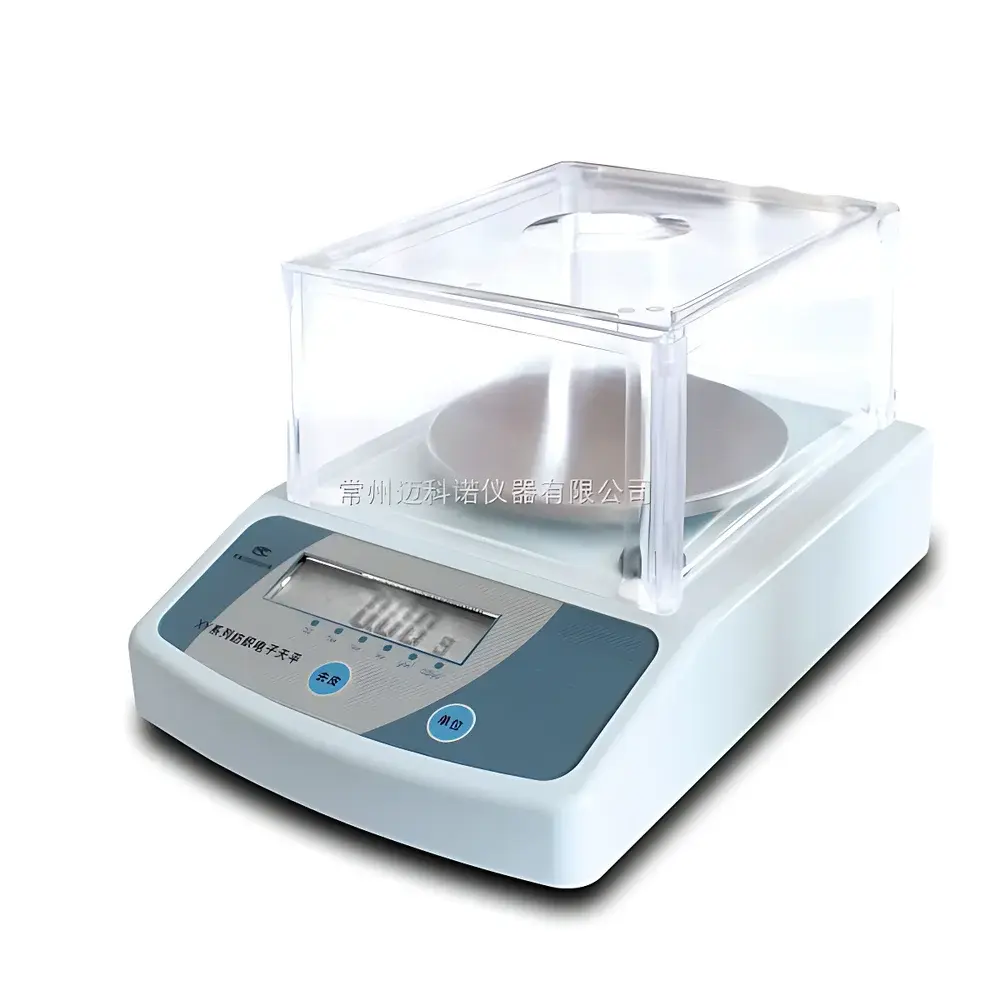
XY300S Textile-Specific Electronic Balance with Direct Yarn Count Conversion
| Key | Capacity: 310 g |
|---|---|
| Readability | 0.01 g |
| Pan Diameter | 130 mm |
| Power Supply | AC 220 V, 50 Hz |
| Compliance | ISO 9001 manufacturing environment |
| Interface Options | RS-232C or RS-485 (optional printer support) |
| Calibration | Internal or external single-point calibration |
Overview
The XY300S Textile-Specific Electronic Balance is an industrial-grade analytical balance engineered for precise mass measurement and direct yarn count conversion in textile quality control laboratories and R&D environments. Unlike general-purpose balances, the XY300S integrates dedicated textile metrology firmware that implements standardized conversion algorithms compliant with ISO 2060 (yarn linear density), ASTM D1907 (tensile testing of yarns), and GB/T 4743 (Chinese national standard for yarn count determination). Its core function is to convert measured mass—under controlled environmental conditions (20–25 °C, <65% RH)—into seven internationally recognized textile units: Ounce (oz), Tex, Metric Number (Nm), English Cotton Count (Ne), Denier (D), Grams per Square Meter (g/m²), and Ounces per Square Yard (oz/yd²). This eliminates manual calculation errors and ensures traceable, repeatable results across production batches and inter-laboratory comparisons.
Key Features
- Direct on-screen yarn count conversion with real-time unit switching—no external software or lookup tables required.
- High-stability load cell with electromagnetic force compensation (EMFC) architecture, delivering consistent 0.01 g readability across the full 310 g capacity range.
- 130 mm diameter stainless-steel weighing pan optimized for uniform distribution of fibrous samples, minimizing edge-loading error during yarn hank or fabric swatch placement.
- Dual-mode operation: standard mass mode (g, oz, ct) and textile-specific mode (Nm, Ne, Tex, etc.), each with independent tare memory and zero-tracking functionality.
- RS-232C and RS-485 serial interfaces support integration into LIMS or QC data logging systems; optional thermal printer enables GLP-compliant hardcopy output with timestamp and operator ID fields.
- Auto-zero tracking and drift compensation algorithms maintain baseline stability during extended textile sample conditioning periods (e.g., pre-test humidity equilibration per ISO 139).
Sample Compatibility & Compliance
The XY300S accommodates diverse textile specimens—including single-filament fibers, twisted yarn hanks (standardized 100 m or 120-yard lengths), knitted/woven fabric swatches (up to 10 × 10 cm), and nonwovens—without requiring auxiliary fixtures. Its mechanical design conforms to IP42 ingress protection standards for dust resistance in spinning mill or dye-house environments. The device is manufactured under ISO 9001-certified processes and supports audit-ready documentation: calibration certificates (traceable to NIM China), factory verification reports, and user-accessible calibration logs. While not FDA 21 CFR Part 11–certified out-of-the-box, its data export protocols (ASCII text via RS-232) are compatible with validated third-party electronic lab notebook (ELN) systems used in GMP-aligned textile testing labs.
Software & Data Management
No proprietary PC software is bundled; instead, the XY300S relies on industry-standard ASCII communication protocols for seamless interoperability. All weight and converted count values are transmitted as delimited strings (e.g., “310.25 g|Nm=42.8|Ne=25.1|Tex=23.5”) enabling direct ingestion into Excel, MATLAB, or custom SQL-based QC dashboards. Optional firmware upgrade packages provide enhanced audit trail features—including operator login prompts, session timestamps, and change history for unit selection and tare events—supporting ISO/IEC 17025 accreditation requirements for testing laboratories.
Applications
- Yarn linear density verification per ISO 2060 and ASTM D1907 for cotton, polyester, wool, and blended fibers.
- Finished fabric GSM (grams per square meter) validation during incoming inspection and final product release.
- Research-grade comparative analysis of fiber fineness across natural and synthetic polymer systems.
- Educational use in textile engineering curricula for hands-on demonstration of count-unit interconversion principles.
- Process monitoring in spinning mills where rapid Ne/Nm verification informs draw ratio adjustments in real time.
FAQ
Does the XY300S require external calibration weights for daily verification?
No—it supports internal calibration via built-in reference mass; however, annual external verification using Class M2 weights (per OIML R76) is recommended for ISO/IEC 17025 compliance.
Can the balance store multiple tare values for different yarn types?
Yes—up to 10 user-defined tare points can be saved and recalled by numeric keypress, facilitating rapid switching between standard hank lengths (e.g., 100 m for Nm, 120 yd for Ne).
Is the RS-485 interface galvanically isolated?
Yes—opto-isolated RS-485 ensures noise immunity in electrically noisy textile plant environments with variable-frequency drives and high-current motors.
What environmental conditions affect measurement repeatability?
Air currents, static charge accumulation on synthetic fibers, and temperature gradients >0.5 °C/min degrade repeatability; use with anti-static mats and draft shields (optional accessory) is advised for sub-0.02 g RSD performance.
How does the balance handle moisture-sensitive samples during GSM measurement?
The unit includes a timed hold mode (configurable 3–10 s) that locks the displayed value after stabilization, minimizing operator-induced vibration during humid fabric weighing.