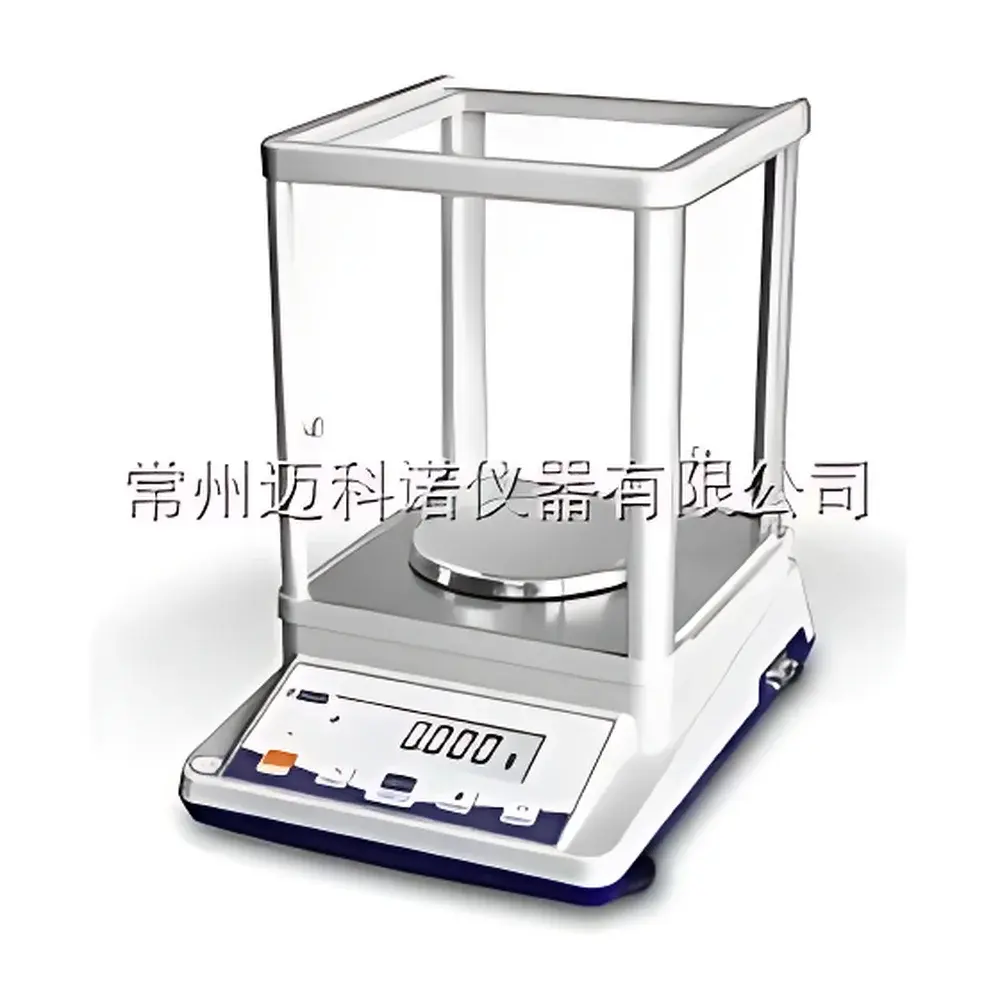
JA Series Analytical Electronic Balance
| Origin | Zhejiang, China |
|---|---|
| Manufacturer Type | Distributor |
| Product Origin | Domestic (China) |
| Model | JA103H / JA203H |
| Price Range | USD 1,150 – 1,430 (FOB) |
| Instrument Type | Analytical Balance |
| Capacity | 100 g / 200 g |
| Readability | 0.001 g |
| Minimum Weight | 0.006 g |
| Linearity Error | ±0.005 g |
| Stabilization Time | ≤3 s |
| Sensitivity Drift | ±0.005 g |
| Operating Temperature | 17.0–25.5 °C |
| Weighing Modes | g only |
| Counting Function | Yes |
| Draft Shield Dimensions | 240 × 185 × 265 mm |
| Pan Diameter | Φ90 mm |
| Display | LED backlight |
| Interface | RS-232 serial port with cable |
| Calibration | External weights (100 g / 200 g) |
| Housing Material | Precision die-cast aluminum body with tempered glass draft shield |
| Packaging | Inner box 415 × 285 × 430 mm |
Overview
The JA Series Analytical Electronic Balances are precision mass measurement instruments engineered for laboratory environments requiring high repeatability and traceable accuracy in routine analytical weighing tasks. Utilizing electromagnetic force compensation (EMFC) sensor technology—distinct from strain-gauge-based load cells—the JA103H (100 g capacity) and JA203H (200 g capacity) models deliver stable, drift-resistant performance under controlled ambient conditions (17.0–25.5 °C). Each unit integrates an internal auto-calibration mechanism supported by external reference weights (100 g or 200 g), ensuring compliance with fundamental metrological requirements for Class I analytical balances per OIML R 76-1 and ISO/IEC 17025–accredited workflows. The balance operates on the principle of restoring force equilibrium: when mass is placed on the pan, the electromagnetic coil generates a counteracting force proportional to the sample weight; this analog signal is digitized and displayed with 1 mg resolution. Designed for GLP-compliant documentation, the instrument supports audit-ready data export via RS-232 interface.
Key Features
- Electromagnetic force compensation (EMFC) transducer architecture—provides superior long-term stability and reduced thermal drift compared to strain-gauge sensors
- Dual-capacity configuration: JA103H (100 g / 0.001 g) and JA203H (200 g / 0.001 g), both meeting minimum weight criteria of 0.006 g per USP & EUR Pharm standard guidance
- Optimized draft shield design: fully sliding tempered glass enclosure (240 × 185 × 265 mm) with unobstructed visual access and ergonomic reach clearance
- Die-cast aluminum housing—enhances mechanical rigidity and minimizes vibration transmission from bench surfaces
- Five-key intuitive interface with backlit LED display—supports tare, counting, and unit conversion functions without menu nesting
- Stabilization time ≤3 seconds across full range—enabling efficient throughput in QC batch release or formulation development
- Linearity error maintained at ±0.005 g, verified across calibrated points per ASTM E898-22 Annex A1 procedures
Sample Compatibility & Compliance
The JA Series accommodates standard laboratory vessels—including volumetric flasks, crucibles, weighing boats, and filter papers—within its Φ90 mm stainless steel weighing pan. Its open-top draft shield permits handling of tall or irregularly shaped containers while maintaining airflow control. The balance conforms to international regulatory expectations for analytical instrumentation: it supports 21 CFR Part 11–compliant data integrity when paired with validated third-party software (e.g., LabX or BalanceLink); meets ISO 9001 calibration traceability requirements through NIST-traceable external weights; and satisfies EU Directive 2014/32/EU (Measuring Instruments Directive) for non-automatic weighing instruments. Environmental operating limits (17–25.5 °C, ≤70% RH non-condensing) align with ISO 17025 clause 6.3.2 for uncertainty-controlled measurement conditions.
Software & Data Management
Data output is delivered exclusively via RS-232 serial protocol at default 9600 baud rate, compatible with Windows-based laboratory information management systems (LIMS), electronic lab notebooks (ELN), and statistical process control (SPC) platforms. The balance transmits timestamped gross/net/tare values, count totals, and unit identifiers as ASCII strings—enabling automated parsing without proprietary drivers. While the device lacks built-in memory or Ethernet/Wi-Fi connectivity, its deterministic output format facilitates integration into FDA-auditable workflows where raw data archiving and operator attribution are enforced. Optional PC software packages support real-time graphing, statistical summary (mean, SD, CV%), and PDF report generation with digital signature fields.
Applications
These balances serve core functions across pharmaceutical quality control (e.g., active pharmaceutical ingredient (API) assay, excipient blending verification), academic research (gravimetric analysis, catalyst loading, stoichiometric reagent preparation), and materials science labs (powder density determination, thin-film mass deposition monitoring). Their 1 mg readability and low minimum weight make them suitable for small-scale synthesis, dissolution testing sample prep, and reference standard dilution workflows. In teaching laboratories, the simplified five-button interface and immediate visual feedback reduce operator training time while reinforcing metrological fundamentals.
FAQ
What calibration standards are required for routine use?
External calibration must be performed using Class M1 or better weights traceable to national metrology institutes (e.g., NIST, PTB). For daily verification, a 100 g or 200 g check weight (depending on model) is recommended per USP and ISO/IEC 17025 clause 7.7.
Is internal calibration available?
No—the JA Series relies solely on external calibration; no motorized internal weight mechanism is integrated.
Can the balance be connected to a networked LIMS?
Yes—via RS-232-to-Ethernet converters or serial servers compliant with RFC 2217, enabling seamless integration into centralized data infrastructure.
Does the balance meet GMP documentation requirements?
When used with validated software that captures user ID, timestamp, and raw values—and with defined calibration/maintenance logs—it satisfies ALCOA+ principles for attributable, legible, contemporaneous, original, and accurate records.
What is the expected service life under normal lab usage?
With proper environmental control and periodic verification, the EMFC sensor architecture typically exceeds 10 years of operational service before recalibration drift exceeds specification limits.