
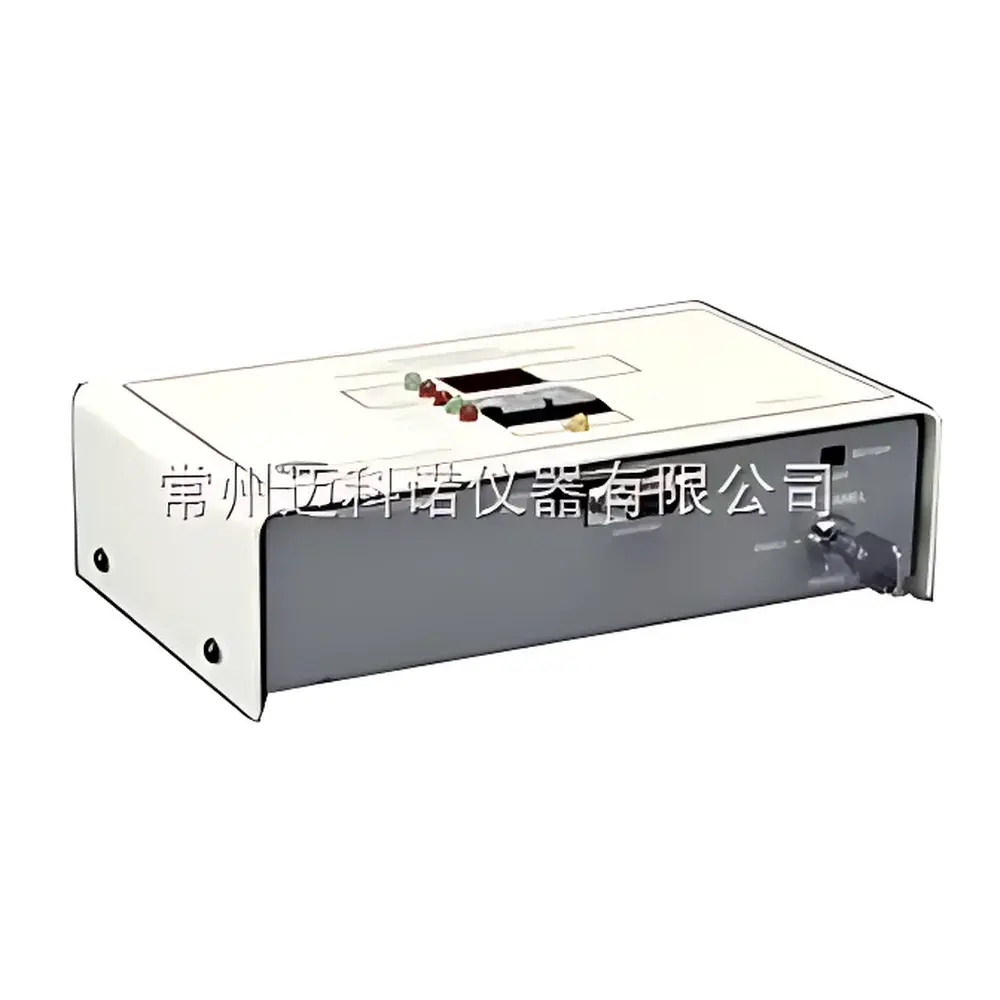
Radon Detection Instrument Model 1027
| Origin | Zhejiang, China |
|---|---|
| Manufacturer Type | Distributor |
| Domestic Origin | Yes |
| Model | 1027 |
| Price | Upon Request |
| Measurement Range | 0.1–999 pCi/L (3.7–37,000 Bq/m³) |
| Sensitivity | 2.5 cph/pCi/L |
| Accuracy | ±1 pCi/L |
| Display | 3-digit LCD |
| Power Supply | 220 VAC / 12 VDC with internal 9 V battery backup |
| Dimensions | 200 × 120 × 65 mm |
| Weight | 0.9 kg |
| Data Interface | RS232 |
| EPA Certification | Yes (U.S. Environmental Protection Agency) |
Overview
The Model 1027 Radon Detection Instrument is a portable, alpha-particle scintillation-based continuous radon monitor engineered for reliable, long-term measurement of Rn-222 gas concentration in indoor air environments. It operates on the principle of passive alpha spectrometry: radon gas diffuses into a sealed detection chamber where it decays, emitting alpha particles that strike a zinc sulfide (ZnS) scintillation screen. The resulting light pulses are amplified and counted by a photomultiplier tube (PMT), enabling quantitative determination of radon activity concentration. Designed for compliance with U.S. EPA Protocol for Radon Measurements (40 CFR Part 148), the instrument delivers traceable, field-deployable performance suitable for residential screening, real estate due diligence, occupational health assessments, and environmental baseline studies. Its certified design—first approved for production in 1986 and validated under EPA’s Radon Measurement Proficiency (RMP) Program—ensures metrological consistency across deployment cycles.
Key Features
- Continuous real-time monitoring with hourly integrated readout capability—no manual sampling or post-processing required
- Integrated 3-digit LCD display showing instantaneous radon concentration in pCi/L or Bq/m³ (user-selectable units)
- Dual-power architecture: AC-powered operation with automatic failover to internal 9 V alkaline battery during mains interruption; supports >24 h of uninterrupted logging on battery alone
- Non-consumable detection system: No replaceable filters, charcoal canisters, or electrochemical cells—maintenance limited to memory reset
- RS232 serial interface compliant with EIA/TIA-232-F standard for direct connection to external printers or host PCs
- Built-in data logger with non-volatile memory capable of storing up to 255 hourly averaged values (retained after power loss)
- Factory-calibrated sensitivity of 2.5 counts per hour per pCi/L (cph/pCi/L), traceable to NIST-traceable radon reference sources
Sample Compatibility & Compliance
The Model 1027 is optimized for ambient air sampling at standard temperature and pressure (STP). It is not intended for use in high-humidity (>90% RH), high-dust, or chemically aggressive atmospheres without optional desiccant pre-filtration. The instrument meets the U.S. EPA’s performance criteria for continuous radon monitors used in residential and school testing programs (EPA 402-R-92-002). While not certified to ISO 11665-2:2021 (Measurement of radon-222 — Part 2: Integrated measuring methods), its operational methodology aligns with the alpha-scintillation principles referenced therein. For regulatory reporting in jurisdictions requiring GLP or ISO/IEC 17025-compliant instrumentation, users must implement documented calibration verification procedures at least annually using certified radon test chambers.
Software & Data Management
No proprietary PC software is required for basic operation or data retrieval. Raw hourly values are transmitted via ASCII-formatted RS232 packets (9600 baud, 8N1) compatible with terminal emulators (e.g., PuTTY, Tera Term) or custom LabVIEW/Python scripts. A minimal embedded print driver enables direct thermal or dot-matrix printer output—no additional firmware installation needed. Users must supply a compatible RS232 printer; no USB or Bluetooth adapters are supported. All stored data retain timestamps synchronized to internal real-time clock (RTC), with no audit trail or electronic signature functionality. As such, the device does not comply with FDA 21 CFR Part 11 requirements for electronic records and signatures unless deployed within a validated third-party data acquisition framework.
Applications
- Residential radon screening per EPA Action Level guidance (≥4 pCi/L or 148 Bq/m³)
- Pre- and post-mitigation verification in homes, schools, and public buildings
- Long-term trend analysis in geologically sensitive regions (e.g., granite bedrock zones)
- Occupational exposure assessment in uranium mining support facilities or underground laboratories
- Field validation of passive alpha-track detectors (e.g., CR-39) in intercomparison studies
- Academic research on diurnal radon fluctuations and ventilation rate correlations
FAQ
Does the Model 1027 require annual recalibration?
Yes. While the detector has no consumables, EPA RMP guidelines recommend annual verification against a known radon source or accredited calibration laboratory to maintain measurement traceability.
Can the instrument measure radon progeny or thoron (Rn-220)?
No. The Model 1027 is specifically designed for Rn-222 detection only. It lacks progeny discrimination capability and exhibits negligible sensitivity to thoron due to its short half-life (55.6 s) and different alpha energy spectrum.
Is the RS232 interface compatible with modern Windows/macOS systems?
Yes—when paired with a USB-to-RS232 adapter certified for FTDI or CP2102 chipsets and configured with appropriate drivers and terminal settings.
What is the minimum detectable concentration (MDC) under typical conditions?
Based on 24-hour integration and background subtraction, the MDC is approximately 0.3 pCi/L (11 Bq/m³) at 95% confidence level, assuming ambient background < 0.1 pCi/L.
How is memory cleared between deployments?
Via front-panel button sequence (hold ‘Mode’ + ‘Enter’ for 3 seconds), which resets all logged data without affecting calibration constants or unit settings.
Related Products







