
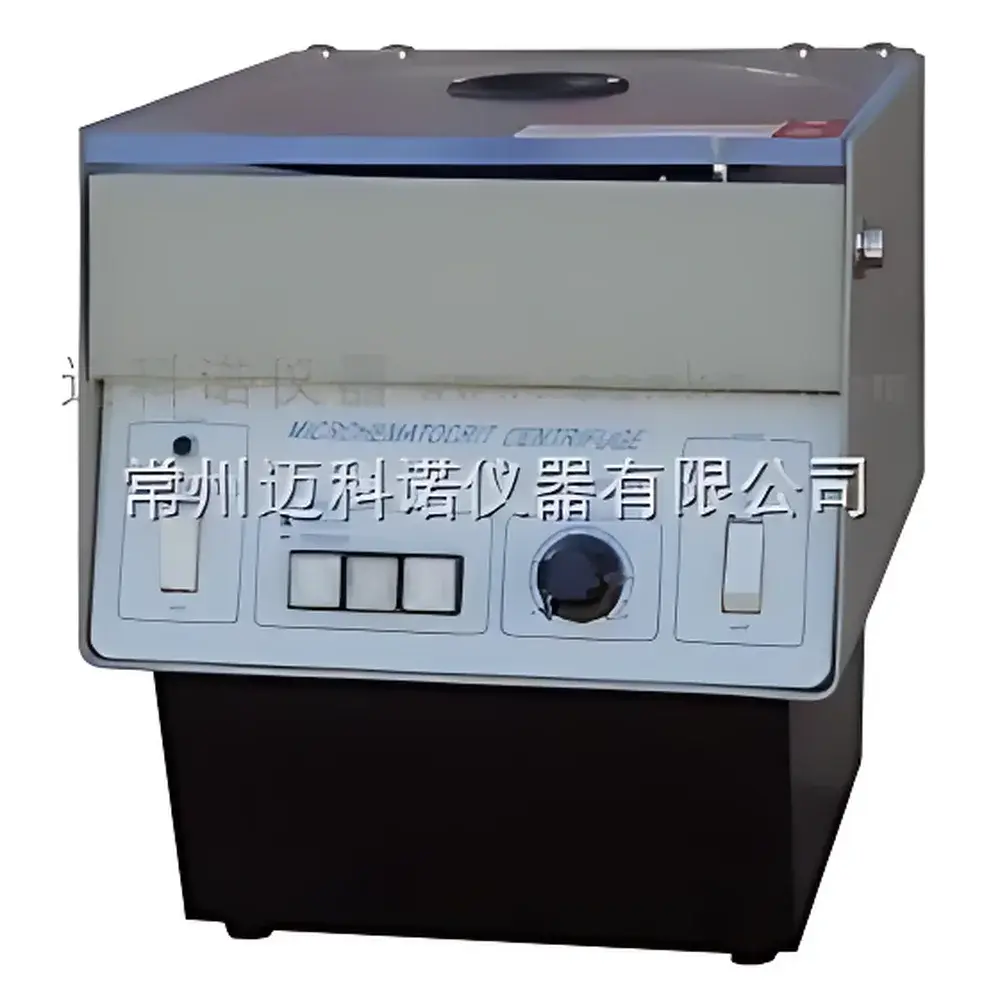
MKN SH120-1 Microhematocrit Centrifuge
| Brand | MKN |
|---|---|
| Origin | Zhejiang, China |
| Manufacturer Type | Authorized Distributor |
| Country of Origin | China |
| Model | SH120-1 |
| Maximum Speed | 12000 rpm |
| Relative Centrifugal Force (RCF) | 13500 × g |
| Capacity | 24 × capillary tubes (Φ1.5 mm × 75 mm) |
| Power Input | 230 VA |
| Power Output | 100 W |
| Voltage/Frequency | 110 V / 60 Hz & 220 V / 60 Hz |
| Acceleration Time | < 60 s |
| Deceleration Time | < 120 s |
| Timer Range | 0–30 min (non-continuous operation only) |
| Speed Selection | Push-button dual-speed (11000 rpm / 12000 rpm) |
| Net Weight | 10 kg |
Overview
The MKN SH120-1 Microhematocrit Centrifuge is a compact, purpose-engineered benchtop instrument designed specifically for rapid and reproducible separation of whole blood into cellular and plasma fractions using capillary tube geometry. It operates on the principle of fixed-angle centrifugation, where rotational motion generates radial acceleration—expressed as relative centrifugal force (RCF)—to sediment erythrocytes, leukocytes, and platelets within standardized hematocrit capillaries. Unlike general-purpose centrifuges, the SH120-1 features a dedicated rotor optimized for 1.5 mm diameter × 75 mm length capillaries, enabling accurate hematocrit determination (HCT %) in clinical point-of-care settings, veterinary diagnostics, and small-volume hematology research. Its mechanical design prioritizes thermal stability and vibration damping during high-speed operation, ensuring consistent pellet formation and minimizing sample disturbance during deceleration.
Key Features
- Dual-speed push-button control (11,000 rpm and 12,000 rpm) for method-specific protocol adherence—ideal for both standard hematocrit assays and accelerated micro-separation workflows.
- Fixed-angle aluminum rotor accommodating 24 capillary tubes (Φ1.5 mm × 75 mm), engineered for balanced loading and minimal runout at 13,500 × g.
- Integrated timer with 0–30 minute range and automatic shutdown; designed to prevent overheating during repeated short-duration runs—consistent with CLSI H18-A3 guidelines for microhematocrit testing.
- Low thermal mass motor and passive cooling architecture ensure stable operating temperature across consecutive cycles without active refrigeration.
- Compliance-ready mechanical interlock system prevents lid opening during rotation and enforces brake engagement before access is permitted.
- Universal voltage compatibility (110 V / 60 Hz and 220 V / 60 Hz) supports deployment across North American, European, and APAC laboratory infrastructures without external transformers.
Sample Compatibility & Compliance
The SH120-1 accepts standard heparinized or EDTA-coated glass or plastic capillary tubes conforming to ISO 8600-1:2019 specifications for hematocrit measurement. It is validated for use with ear-prick, finger-stick, and neonatal heel-stick blood volumes (typically 10–20 µL per tube). The instrument meets IEC 61010-1:2010 safety requirements for laboratory electrical equipment and incorporates electromagnetic compatibility (EMC) per EN 61326-1:2013. While not certified under FDA 21 CFR Part 11, its operational parameters align with CLIA-waived test system expectations when used in conjunction with analyte-specific reagents and documented SOPs. Routine maintenance—such as rotor inspection, capillary alignment verification, and speed calibration—is recommended per ISO/IEC 17025:2017 clause 6.4.10 for accredited laboratories.
Software & Data Management
The SH120-1 is a standalone electromechanical device with no embedded microprocessor or digital interface. All operational parameters—including speed selection, timer activation, and braking—are managed via discrete hardware controls. No firmware, data logging, or connectivity (USB/Ethernet/Wi-Fi) is provided. This architecture ensures deterministic behavior, eliminates cybersecurity attack surfaces, and simplifies validation for GLP and GMP environments where auditability of manual interventions is required. Users maintain traceability through handwritten or LIMS-linked run logs documenting date, operator ID, tube count, selected speed, duration, and observed pellet integrity.
Applications
- Routine hematocrit determination in outpatient clinics, mobile health units, and resource-limited settings where rapid CBC triage is needed.
- Veterinary field diagnostics for avian, rodent, and small-mammal species requiring microvolume blood analysis.
- Quality control of anticoagulant efficacy in capillary collection systems prior to downstream flow cytometry or PCR.
- Separation of serum from micro-clotted samples for ELISA or immunoassay pre-analytical processing.
- Training platforms in biomedical education for demonstrating sedimentation kinetics and RCF calculations.
FAQ
What capillary tube dimensions are supported?
The SH120-1 rotor is dimensionally constrained for Φ1.5 mm outer diameter × 75 mm length capillaries. Tubes exceeding ±0.1 mm in OD or ±2 mm in length may cause imbalance or failure to seat fully.
Is continuous operation permitted?
No. The timer enforces a maximum 30-minute runtime, and the unit must cool for ≥5 minutes between consecutive runs to prevent thermal degradation of motor insulation and bearing lubricant.
Can the centrifuge be calibrated for speed accuracy?
Yes. Certified tachometer verification against the displayed speed setting is recommended quarterly or after any rotor impact event, per ISO 15197:2013 Annex C guidance for centrifuge-based diagnostic devices.
Does it meet ISO 13485 requirements for medical device manufacturing?
As a Class I non-sterile, non-active diagnostic support device, the SH120-1 falls under general controls; full ISO 13485 compliance requires integration into a manufacturer’s QMS—including documented risk management (ISO 14971) and process validation protocols.
What maintenance intervals are specified?
Visual rotor inspection before each use; cleaning of chamber and lid gasket weekly with 70% ethanol; annual bearing lubrication and torque verification by authorized service technician.



