
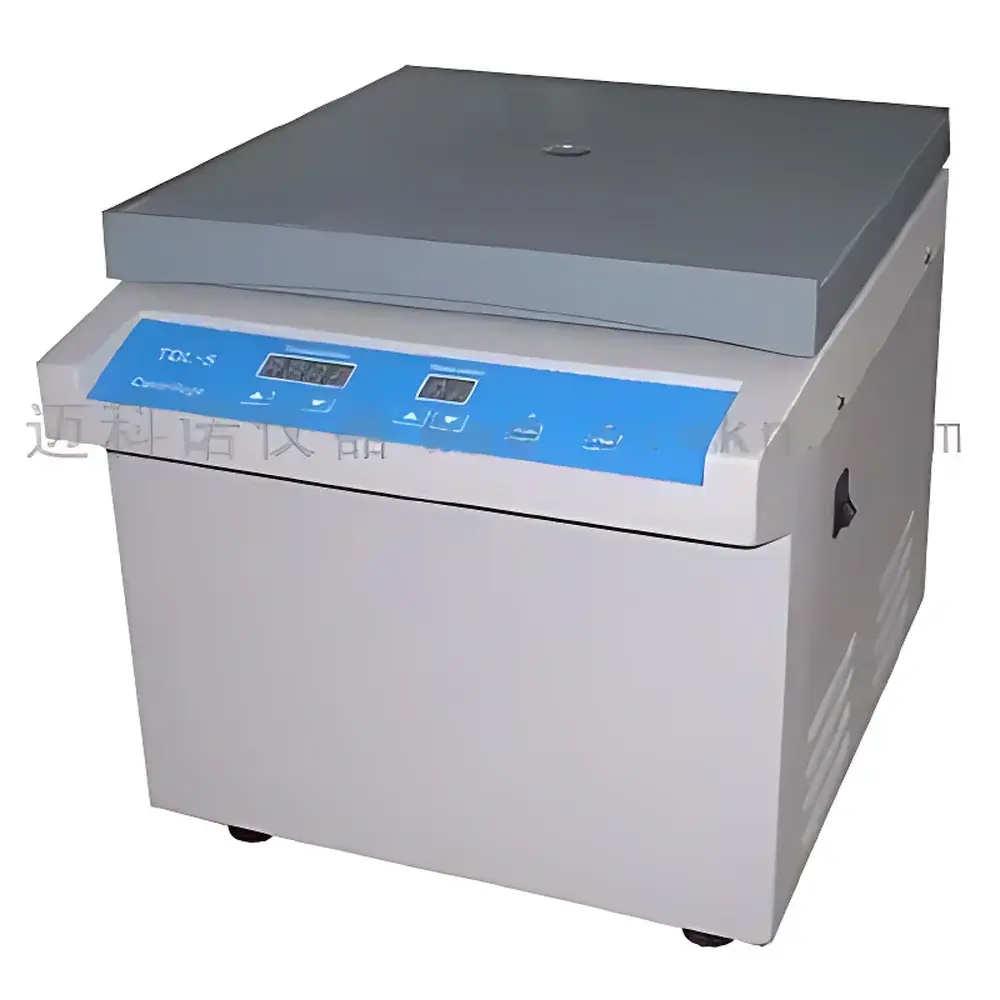
MKN TDL-5 Benchtop Low-Speed High-Capacity Centrifuge
| Brand | MKN |
|---|---|
| Origin | Jiangsu, China |
| Model | TDL-5 |
| Max Speed | 0–4000 rpm |
| Relative Centrifugal Force (RCF) | 2770 × g |
| Capacity | 100 mL × 4 / 50 mL × 8 / 15 mL × 16 |
| Timer Range | 0–30 min |
| Power | 250 W |
| Noise Level | ≤60 dB(A) |
| Voltage/Frequency | AC 220 V, 50 Hz, 3 A |
| Rotor Material | Stainless Steel |
| Control Interface | Digital Touch Panel with RPM/Time/RCF Display |
| Safety Features | Electronic Door Lock, Dual Safety Switches, Balanced-State Protection, Dual Fuse System |
| Compliance | Designed per GB/T 13785–2016 (Chinese National Standard for Centrifuges), GLP-aligned operational architecture |
Overview
The MKN TDL-5 Benchtop Low-Speed High-Capacity Centrifuge is an engineered solution for routine sedimentation and phase separation of low-density biological and chemical suspensions in academic, clinical, and industrial laboratory environments. Operating on the principle of centrifugal sedimentation—where differential particle migration under controlled rotational force enables stratification based on density, size, and shape—the TDL-5 delivers reproducible, scalable separations at speeds up to 4000 rpm and a maximum RCF of 2770 × g. Its low-speed design prioritizes gentle handling of fragile components such as whole blood, cell pellets, tissue homogenates, and colloidal suspensions, minimizing shear-induced damage while maintaining high throughput via its large-volume rotor configurations. Constructed with a reinforced polymer housing and imported cold-rolled steel chassis, the unit balances structural integrity with compact footprint (W × D × H: 390 × 540 × 350 mm), making it suitable for shared lab benches and biosafety cabinet-adjacent workflows.
Key Features
- Stainless steel horizontal swing-out rotor with automatic balancing protection—prevents operational interruption due to minor sample imbalance
- Digital touch control panel with real-time display of rotational speed (rpm), elapsed time, and calculated relative centrifugal force (×g)
- Integrated electronic door lock and dual mechanical safety switches—ensures rotor chamber remains sealed until full deceleration is achieved
- Double-fuse overcurrent protection circuitry compliant with IEC 61000-4-5 surge immunity requirements
- Brushless DC centrifuge motor with microprocessor-based speed regulation—enabling ±20 rpm speed accuracy across the full 0–4000 rpm range
- Acoustically damped enclosure design achieving ≤60 dB(A) noise emission at maximum load—meets ISO 7779:2010 laboratory ambient criteria
Sample Compatibility & Compliance
The TDL-5 accommodates standard conical-bottom centrifuge tubes (15 mL, 50 mL) and wide-mouth bottles (100 mL) without adapter modification. Its rotor geometry supports both fixed-angle and horizontal configurations (standardized for swing-bucket use), ensuring uniform pelleting across all positions. The system meets essential safety and performance benchmarks outlined in GB/T 13785–2016 (“General Technical Requirements for Laboratory Centrifuges”) and incorporates design elements aligned with Good Laboratory Practice (GLP) documentation workflows—including non-volatile timer memory retention and unambiguous status indication (e.g., lid open/closed, rotor stop/run). While not certified to FDA 21 CFR Part 11, its deterministic control logic and manual audit trail (via printed or handwritten log entries) support traceable operation in regulated QC/QA settings where electronic records are not mandated.
Software & Data Management
The TDL-5 operates as a standalone instrument with no embedded software stack or network interface. All parameter inputs—speed, time, and acceleration profile—are set locally via the tactile touch panel and retained in volatile RAM during active operation. Upon power loss, settings reset to default; therefore, users are advised to record run parameters manually or integrate the centrifuge into external LIMS or ELN systems using time-stamped procedural documentation. No firmware updates or driver installation is required. The absence of proprietary software reduces cybersecurity exposure and simplifies validation in ISO/IEC 17025-accredited laboratories where instrument qualification focuses on mechanical calibration and performance verification rather than digital compliance.
Applications
- Plasma and serum isolation from whole blood specimens (EDTA, heparin, citrate anticoagulated)
- Precipitation of bacterial cells, yeast, and mammalian suspension cultures prior to lysis or cryopreservation
- Clarification of crude tissue extracts and protein-containing supernatants
- Sedimentation of food emulsions, dairy suspensions, and environmental water samples for particulate analysis
- Preparative separation of polymer dispersions and nanoparticle suspensions prior to DLS or TEM characterization
- Routine quality control in pharmaceutical excipient manufacturing—e.g., removal of insoluble aggregates from buffer solutions
FAQ
What is the maximum recommended load imbalance tolerance for continuous operation?
The horizontal rotor is rated for ≤5 g mass differential between opposing buckets under full-load conditions (100 mL × 4). Exceeding this may trigger automatic shutdown.
Can the TDL-5 be used for temperature-controlled applications?
No. The unit lacks refrigeration or heating capability and is intended for ambient-temperature operation only.
Is rotor calibration traceable to national standards?
Yes—each stainless steel rotor is individually balanced and certified per ISO 1940-1 G6.3 grade; calibration certificates are available upon request with purchase order.
Does the timer support countdown pause/resume functionality?
No. The timer operates as a simple countdown; interruption requires manual restart with re-entry of parameters.
What maintenance intervals are recommended for optimal long-term performance?
Biannual inspection of drive belt tension, door latch mechanism, and fuse integrity is advised. Lubrication of rotor spindle bearings is not user-serviceable and must be performed by authorized MKN service technicians.



