
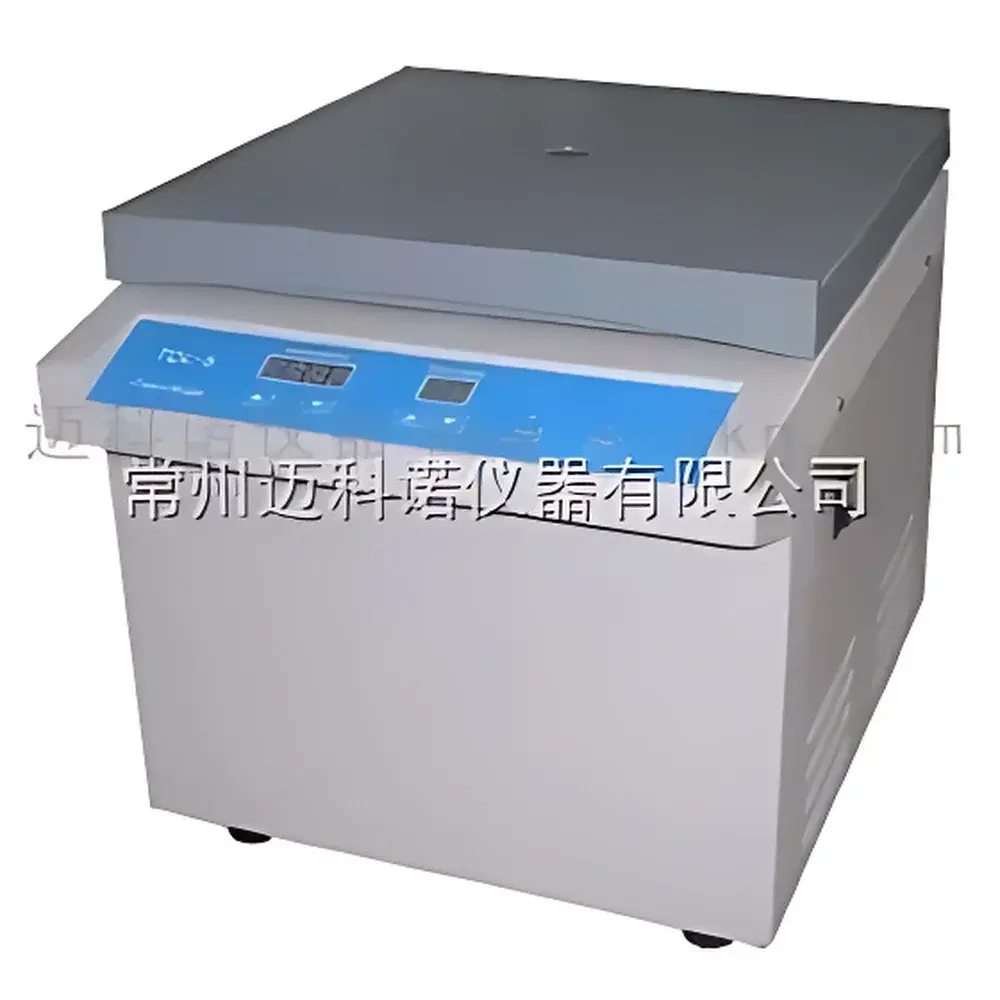
TDL-5A Benchtop High-Capacity Centrifuge
| Origin | Zhejiang, China |
|---|---|
| Manufacturer Type | Authorized Distributor |
| Country of Origin | China |
| Model | TDL-5A |
| Maximum Speed | 0–5000 rpm |
| Relative Centrifugal Force (RCF) | 2770 × g |
| Maximum Capacity | 250 mL × 4 / 50 mL × 8 / 10 mL × 28 |
| Timer Range | 0–30 min |
| Power Consumption | 320 W |
| Noise Level | ≤60 dB(A) |
| Supply Voltage | AC 220 V, 50 Hz, 5 A |
| Rotor Material | Stainless Steel |
| Control Interface | Touchscreen with Digital Display (RPM, Time, RCF) |
| Safety Features | Electronic Door Lock, Dual Thermal Fuses, Automatic Rotor Imbalance Detection |
Overview
The TDL-5A Benchtop High-Capacity Centrifuge is engineered for routine and high-throughput separation tasks in life science, clinical diagnostics, pharmaceutical quality control, and environmental laboratories. It operates on the principle of sedimentation under centrifugal force—accelerating phase separation based on particle density, size, and shape within liquid suspensions. Designed as a compact yet robust benchtop unit, it delivers reliable performance for preparative applications including plasma isolation, cell pellet recovery, precipitate concentration, and clarification of biological fluids such as serum, whole blood, culture supernatants, and food extracts. Its fixed-angle and swing-bucket compatible rotor architecture supports standardized workflows aligned with ISO 13485 and CLSI EP05-A3 guidelines for analytical precision in regulated environments.
Key Features
- Stainless steel rotor assembly with corrosion-resistant surface finish, validated for repeated sterilization cycles and long-term mechanical stability
- Microprocessor-controlled brushless DC motor ensuring consistent torque delivery across the full speed range (0–5000 rpm), minimizing thermal drift and rotational vibration
- Digital touchscreen interface with real-time display of rotational speed (rpm), elapsed time, and calculated relative centrifugal force (×g), supporting intuitive parameter entry and recall
- Integrated safety architecture comprising an electromagnetic door interlock, dual independent thermal fuses, and automatic imbalance detection that halts operation if rotor load asymmetry exceeds ±5% mass distribution tolerance
- Acoustically damped housing constructed from reinforced polymer composite and cold-rolled steel, achieving ≤60 dB(A) operational noise level at maximum load—suitable for shared laboratory spaces without dedicated acoustic enclosures
- Programmable timer (0–30 minutes) with auto-brake function and soft-start/soft-stop acceleration profiles to preserve sample integrity during sensitive separations
Sample Compatibility & Compliance
The TDL-5A accommodates standard laboratory centrifuge tubes (10 mL, 50 mL conical, and 250 mL bottles) via interchangeable rotor configurations. Its 250 mL × 4 capacity configuration enables batch processing of large-volume clinical specimens or bioprocess intermediates, while the 10 mL × 28 setup supports parallel microcentrifuge tube handling for high-sample-number assays. All rotors comply with IEC 61010-2-020 safety standards for centrifugal equipment. The system supports Good Laboratory Practice (GLP) documentation requirements through manual logbook traceability; optional external data logging via RS-232 interface allows integration into LIMS environments where audit trails are mandated per FDA 21 CFR Part 11.
Software & Data Management
While the TDL-5A operates as a standalone instrument with embedded firmware, its digital control module records all executed run parameters—including set speed, duration, final RCF, and error codes—in non-volatile memory for up to 99 cycles. These logs can be manually transcribed or exported via serial connection for inclusion in electronic lab notebooks (ELNs). No proprietary software installation is required; however, ASCII-formatted output is compatible with common spreadsheet and statistical analysis platforms (e.g., Microsoft Excel, GraphPad Prism). Firmware updates are performed via secure USB-based protocol upon authorization by certified service personnel.
Applications
- Preparation of platelet-poor plasma (PPP) and platelet-rich plasma (PRP) in clinical hematology labs
- Clarification of bacterial and yeast fermentation broths prior to downstream chromatography or filtration
- Isolation of extracellular vesicles and exosomes from cell culture media using differential centrifugation protocols (e.g., 300 × g → 2,000 × g → 10,000 × g cascades)
- Concentration of environmental water samples for microbial enumeration or heavy metal analysis
- Routine separation of immunoassay reagents, enzyme conjugates, and antigen-antibody complexes in diagnostic kit manufacturing QC
- Processing of food homogenates for fat extraction, starch sedimentation, or allergen residue removal
FAQ
What rotor types are compatible with the TDL-5A?
The TDL-5A accepts factory-certified swing-out rotors only. Custom or third-party rotors are not supported due to mechanical and safety certification constraints.
Does the unit support refrigerated operation?
No—the TDL-5A is a non-refrigerated model intended for ambient-temperature separations. For temperature-sensitive samples, users should pre-chill specimens and limit run duration to minimize thermal accumulation.
Can the centrifuge be validated for GMP compliance?
Yes—while the base unit does not include built-in validation tools, IQ/OQ protocols can be executed using external calibrated tachometers, thermocouples, and vibration analyzers per ASTM E2500 and EU Annex 15 guidance.
Is rotor balancing mandatory before each run?
Yes—symmetrical loading across opposing positions is required. The imbalance detection system triggers immediate shutdown if mass deviation exceeds allowable thresholds; however, this is a fail-safe, not a substitute for proper manual balancing.
What maintenance intervals are recommended?
Rotor inspection and cleaning every 6 months; drive belt and bearing assessment annually; full calibration verification every 2 years or after 500 operational hours—whichever occurs first.



