
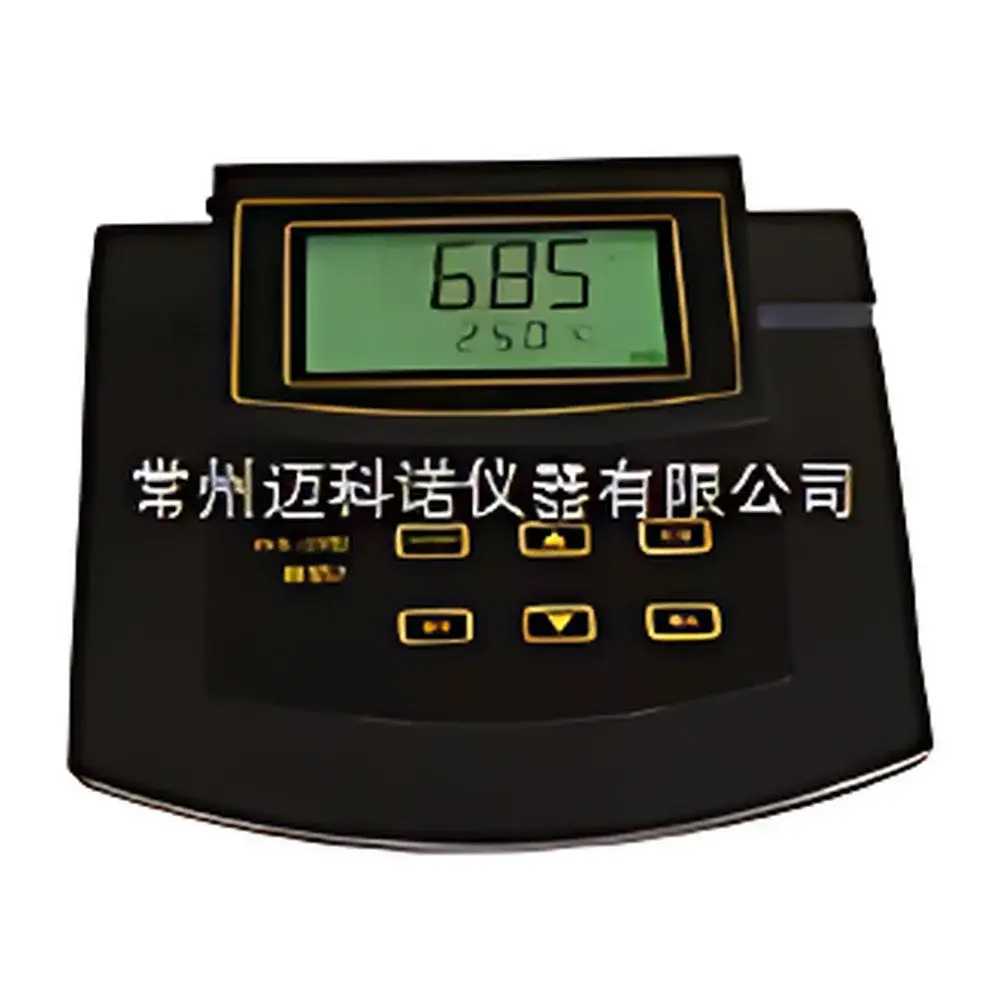
PHS-25 Benchtop pH Meter
| (Manufacturer | Jiangsu-based OEM |
|---|---|
| Origin | China |
| Type | Portable Benchtop pH/mV/ORP Meter |
| Model | PHS-25 |
| Accuracy Class | 0.1 |
| pH Range | 0.00–14.00 pH |
| mV Range | ±1400 mV |
| Resolution | 0.01 pH / 1 mV / 0.1 °C |
| Temperature Compensation | 0–60 °C |
| Input Impedance | ≥3 × 10¹¹ Ω |
| Input Current | ≤1 × 10⁻¹¹ A |
| Basic Error (pH) | ±0.1 pH |
| Repeatability (pH) | ≤0.05 pH |
| Stability | ±0.05 pH ±1 digit / 3 h |
| Dimensions | 220 × 160 × 65 mm |
| Weight | 0.3 kg |
| Power Supply | DC 6 V) |
Overview
The PHS-25 Benchtop pH Meter is a precision electrochemical instrument engineered for reliable, routine measurement of hydrogen ion activity (pH), redox potential (mV), and relative electrode potentials in aqueous solutions. Based on the potentiometric principle—measuring the electromotive force (EMF) generated across a glass pH electrode and reference electrode pair—the PHS-25 delivers stable, repeatable readings under standard laboratory conditions. Its dual-line LCD with blue backlight enables simultaneous display of pH and temperature, or mV and temperature, facilitating real-time thermal compensation without manual recalibration. Designed to meet the operational requirements of academic teaching labs, environmental monitoring stations, quality control departments in manufacturing, and municipal water testing facilities, the PHS-25 complies with fundamental metrological standards for Class 0.1 pH instruments per GB/T 11165–2022 (equivalent to ISO 7888:2019 for general-purpose pH meters). It supports interchangeable electrodes—including combination pH electrodes, ORP (oxidation-reduction potential) electrodes, and select ion-selective electrodes—enabling flexible adaptation to diverse analytical workflows.
Key Features
- Dual-parameter digital display: Simultaneous readout of pH/mV and temperature (°C) on a high-contrast blue-backlit LCD
- Manual temperature compensation (MTC) across 0–60 °C, compatible with standard Pt100 or thermistor-based temperature probes
- High-input-impedance amplifier (≥3 × 10¹¹ Ω) minimizes loading effects on high-resistance glass electrodes, ensuring signal integrity
- Low input current (≤1 × 10⁻¹¹ A) reduces polarization error and extends electrode service life
- Compact benchtop form factor (220 × 160 × 65 mm) and lightweight design (0.3 kg) optimize space utilization in shared lab environments
- DC 6 V power operation—compatible with standard AA battery packs or regulated external adapters—ensures portability and continuity during field sampling or mobile lab use
- Compliance with IEC 61010-1 safety requirements for electrical equipment used in measurement, control, and laboratory applications
Sample Compatibility & Compliance
The PHS-25 is validated for use with aqueous liquid samples within standard physicochemical limits: conductivity >50 µS/cm, total dissolved solids (TDS) <10,000 ppm, and absence of strong oxidizers or viscous solvents that may damage the glass membrane. It supports calibration per ASTM D1293 (Standard Test Methods for pH of Water) and EPA Method 150.1 (pH Determination in Surface Water and Wastewater). While not certified for GMP/GLP-regulated production environments, its documented repeatability (≤0.05 pH) and stability (±0.05 pH ±1 digit/3 h) align with internal QA protocols for non-critical process monitoring. The instrument does not include audit trail or electronic signature capabilities; therefore, it is not compliant with FDA 21 CFR Part 11 for regulated data submission.
Software & Data Management
The PHS-25 operates as a standalone analog-digital hybrid meter with no embedded firmware-based data logging, USB connectivity, or PC interface. All measurements are displayed in real time and must be manually recorded. No proprietary software, drivers, or cloud synchronization is provided. Users requiring traceable data capture are advised to integrate the meter with external recording systems—such as programmable logic controllers (PLCs), SCADA interfaces via analog output modules (if externally adapted), or manual entry into LIMS-compliant spreadsheets following institutional SOPs. Calibration records, electrode performance logs, and daily verification checks (e.g., using NIST-traceable buffer standards at pH 4.01, 7.00, and 10.01) must be maintained separately per ISO/IEC 17025 clause 7.7.
Applications
- Academic instruction: Undergraduate chemistry and environmental science laboratories for fundamental acid-base titration and buffer characterization
- Environmental field testing: On-site pH screening of surface water, groundwater, effluent streams, and stormwater runoff
- Industrial QC: Monitoring rinse bath pH in metal finishing, electroplating, and semiconductor wafer cleaning processes
- Food & beverage: Preliminary pH assessment of brines, dairy products, and fruit juices prior to HPLC or microbiological analysis
- Wastewater treatment: Routine verification of neutralization tank performance and biological reactor influent/effluent pH
- ORP monitoring: Sanitization validation in swimming pools, cooling towers, and disinfection contact tanks using platinum redox electrodes
FAQ
What electrode types are compatible with the PHS-25?
The meter accepts standard BNC-input pH electrodes, ORP electrodes with single-junction or double-junction reference systems, and generic ion-selective electrodes (e.g., fluoride, nitrate) when paired with appropriate reference electrodes.
Does the PHS-25 support automatic temperature compensation (ATC)?
No—it features manual temperature compensation only. An external temperature probe must be connected and the value entered manually before measurement.
Can this meter be used for non-aqueous or low-conductivity samples?
Not recommended. The high input impedance mitigates but does not eliminate errors in solvents with conductivity <50 µS/cm (e.g., pure ethanol, hexane, or deionized water below 1 µS/cm).
Is calibration verification required before each use?
Per ISO 7888:2019, calibration should be verified at least once per analytical session using two-point buffer calibration (e.g., pH 7.00 + pH 4.01); three-point calibration is advised for full-range accuracy validation.
What is the expected service life of the glass pH electrode when used with the PHS-25?
Under proper storage (in 3 M KCl solution), regular cleaning, and avoidance of proteinaceous or sulfide-rich matrices, typical electrode lifespan ranges from 12 to 24 months depending on usage frequency and sample matrix aggressiveness.




