
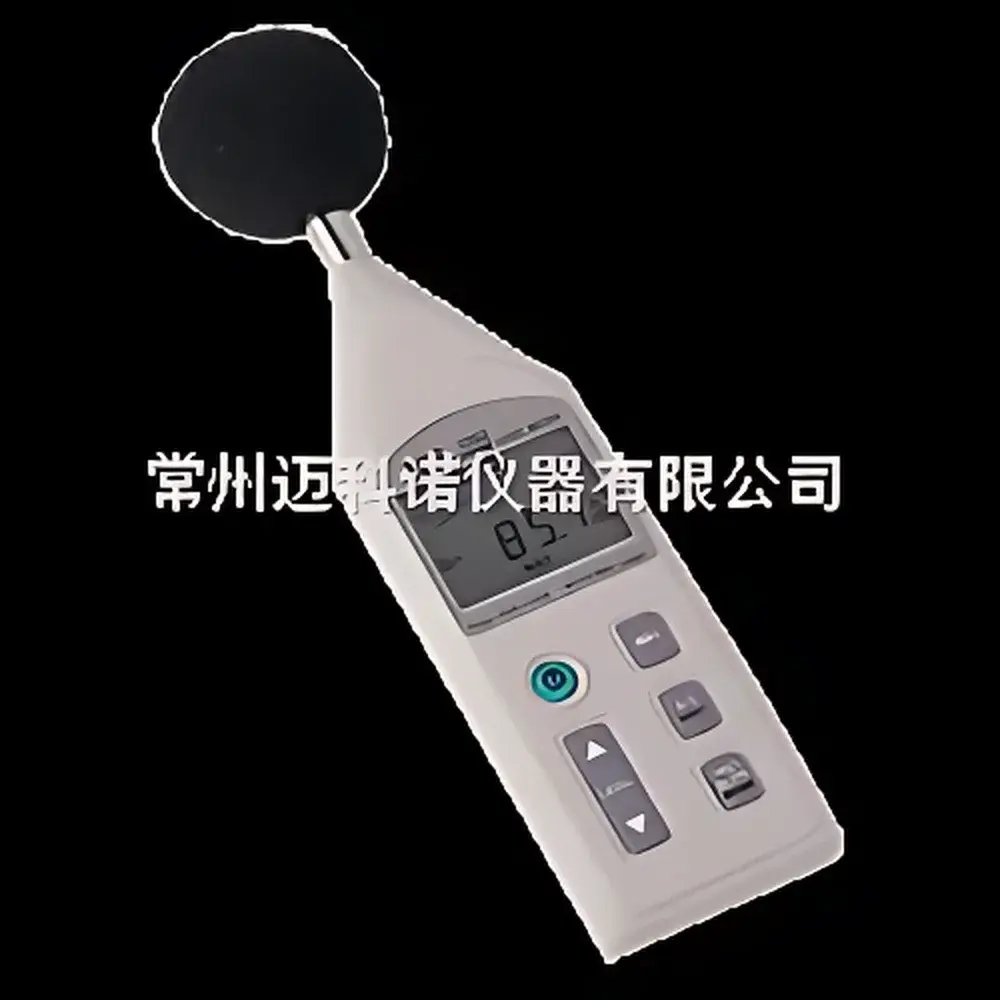
MKN TES-1352H Programmable Sound Level Meter
| Brand | MKN |
|---|---|
| Model | TES-1352H |
| Compliance | IEC 651 Type 2, ANSI S1.4 Type 2 |
| Measurement Range | 30–130 dB (A/C-weighted) |
| Frequency Range | 31.5 Hz – 8 kHz |
| Dynamic Range | 50 dB |
| Time Weighting | Fast & Slow |
| Resolution | 0.1 dB (4-digit LCD) |
| Analog Bar Display | 1 dB steps, 50 dB span, 50 ms update rate |
| Microphone | 1/2″ condenser |
| Output | AC (0.707 Vrms full-scale), DC (10 mV/dB) |
| Data Logging Capacity | 16,000 records |
| Operating Temp./RH | 0–50 °C / 10–90 % RH |
| Power | 9 V battery |
| Dimensions | 265 × 72 × 21 mm |
| Weight | 325 g |
| Interface | RS-232 |
Overview
The MKN TES-1352H Programmable Sound Level Meter is a precision-engineered instrument designed for reliable, repeatable acoustic measurements in industrial hygiene, environmental noise assessment, and occupational safety applications. It operates on the fundamental principle of converting sound pressure variations into proportional electrical signals via a calibrated 1/2″ electret condenser microphone, followed by analog signal conditioning, frequency weighting (A or C), time integration (Fast/Slow), and digital conversion. Conformance to IEC 651 Type 2 and ANSI S1.4 Type 2 standards ensures metrological traceability and regulatory acceptability for general-purpose noise surveys—particularly where compliance with OSHA 29 CFR 1910.95, EU Directive 2003/10/EC, or national environmental noise ordinances is required. Its 30–130 dB dynamic measurement range, coupled with six manually selectable or auto-ranging scales (30–80 dB through 80–130 dB), enables robust performance across diverse acoustic environments—from quiet office spaces to high-noise manufacturing zones—without manual gain adjustment during transient events.
Key Features
- Programmable operation with RS-232 serial interface for remote configuration, real-time data streaming, and firmware updates
- Integrated data logging capability storing up to 16,000 timestamped measurement records internally, supporting long-term trend analysis without external hardware
- Dual-weighting modes: A-weighting (optimized for human hearing perception per ISO 226:2003) and C-weighting (broadband, low-frequency sensitive) for comprehensive spectral characterization
- High-resolution 4-digit LCD display with 0.1 dB resolution and quasi-analog bar graph updating every 50 ms—enabling rapid visual identification of peak excursions and temporal stability
- True automatic ranging across six 10-dB overlapping decades (30–80 dB to 80–130 dB), minimizing user error and optimizing signal-to-noise ratio at all levels
- Dual analog outputs: AC output (0.707 Vrms at full scale) compatible with oscilloscopes or spectrum analyzers; DC output (10 mV/dB) suitable for PLC integration or custom DAQ systems
- Robust mechanical design: lightweight (325 g), compact form factor (265 × 72 × 21 mm), and IP54-rated ingress protection (with windscreen) for field durability
Sample Compatibility & Compliance
The TES-1352H is optimized for airborne sound pressure level (SPL) measurement in ambient air under standard atmospheric conditions (101.3 kPa, 23 °C, 50 % RH). It accommodates standard 1/2″ microphone cartridges and includes a foam windscreen to mitigate turbulence-induced artifacts above 5 m/s wind velocity. Calibration is performed using a Class 1 pistonphone (e.g., Brüel & Kjær 4228 or equivalent) traceable to NIST or national metrology institutes. The instrument meets IEC 651:1979 (Type 2) and ANSI S1.4-1983 (Type 2) accuracy specifications for sound level meters—ensuring ±1.5 dB linearity tolerance over its operating range. While not certified for legal metrology (e.g., ISO 9001 calibration records or ILAC-MRA traceability), it satisfies technical requirements for preliminary noise mapping, worker exposure screening, and pre-compliance environmental reporting under ISO 1996-1, ISO 1996-2, and local municipal noise ordinances.
Software & Data Management
The included Windows-compatible software enables bidirectional communication via RS-232 for device setup (e.g., weighting selection, logging interval, trigger thresholds), real-time waveform visualization, and post-acquisition export to CSV or Excel formats. All logged datasets retain embedded timestamps, measurement mode flags (A/C, Fast/Slow), and range identifiers—supporting audit-ready documentation. The software enforces structured metadata capture (operator ID, location tag, instrument serial number) and generates summary statistics (Leq, Lmax, Lmin, L10/L50/L90, dose %) per ISO 18405 and ISO 532-1 conventions. While the firmware does not implement FDA 21 CFR Part 11 electronic signature or audit trail functionality, raw data files are immutable upon export and may be archived in validated LIMS or ELN systems compliant with GLP/GMP Annex 11 requirements.
Applications
- Occupational health & safety: Routine noise exposure monitoring in factories, construction sites, and transportation hubs per OSHA PEL/Action Level protocols
- Environmental impact assessments: Baseline and follow-up noise surveys adjacent to highways, railways, airports, and industrial facilities
- Building acoustics: Verification of façade insulation performance, HVAC system noise emission, and room reverberation control
- Product compliance testing: Pre-screening of consumer appliances, power tools, and office equipment against EN 60704-1, ISO 3744, or GB/T 3767 limits
- Educational laboratories: Hands-on instruction in acoustics fundamentals, signal processing, and environmental instrumentation principles
FAQ
What calibration standards is the TES-1352H certified to?
It complies with IEC 651:1979 Type 2 and ANSI S1.4-1983 Type 2 specifications for general-purpose sound level meters.
Can the internal memory be expanded or externally backed up during logging?
No—the 16,000-record capacity is fixed and non-expandable; however, data can be offloaded in real time or post-survey via RS-232 to a host PC.
Is the microphone interchangeable with other 1/2″ condenser units?
Yes—provided the replacement unit matches the nominal sensitivity (≈50 mV/Pa), polarization voltage (0–200 V), and connector type (BNC or LEMO), though factory calibration will no longer apply.
Does the device support impulse or peak sound pressure level (LIpeak) measurement?
No—it measures only time-averaged levels (Leq, Lmax, Lmin) under Fast/Slow time weighting; impulse detection requires dedicated Type 1 instruments per IEC 61672-1.
What is the recommended recalibration interval?
Annual verification against an accredited acoustic calibrator is advised for routine use; more frequent checks are required after mechanical shock, extreme humidity exposure, or when used in regulated QA/QC workflows.







