
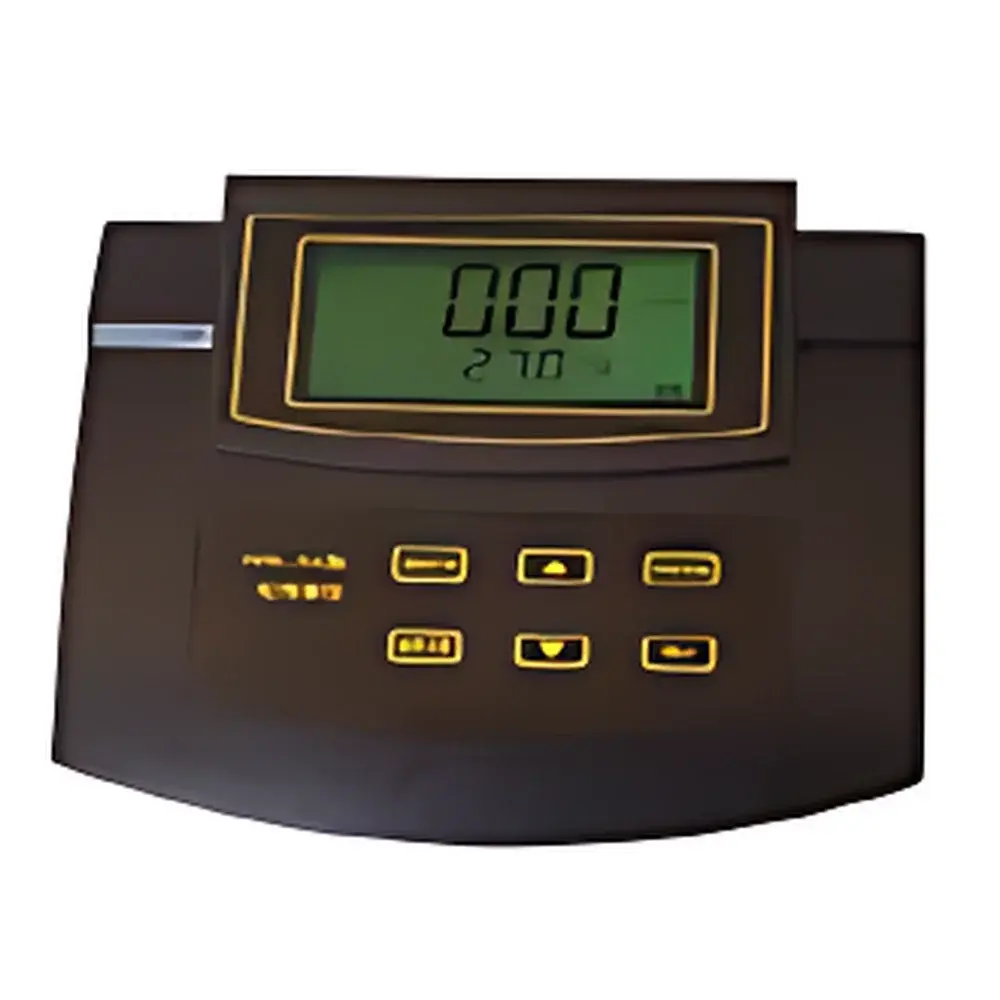
Conductivity Meter DDS-11A
| Origin | Jiangsu, China |
|---|---|
| Manufacturer Type | Authorized Distributor |
| Origin Category | Domestic (China) |
| Model | DDS-11A |
| Price | Upon Request |
| Measurement Range | 0–10,000 µS·cm⁻¹ (4 auto-ranging decades) |
| Basic Error | ±1.5% FS ±1 digit |
| Temperature Compensation | 5–50 °C (ref. 25 °C) |
| Temp. Display Range | 0–60 °C |
| Electrode | DJS-1 plastic-bodied conductivity cell |
| Cell Constant | 1.0 cm⁻¹ |
| Dimensions | 170 × 130 × 50 mm (L×W×H) |
| Weight | 0.3 kg |
| Power Supply | 6 V DC, 300 mA (center-positive barrel connector) |
Overview
The DDS-11A Conductivity Meter is a benchtop laboratory-grade instrument engineered for precise and reliable measurement of electrical conductivity in aqueous solutions. It operates on the principle of two-electrode AC conductometry, applying a low-frequency alternating current across a defined electrode gap to minimize polarization effects and electrode fouling. The instrument calculates solution conductivity (κ) using the relationship κ = G × Kcell, where G is the measured conductance and Kcell is the calibrated cell constant—here fixed at 1.0 cm⁻¹ via the integrated DJS-1 plastic-bodied conductivity cell. Designed for routine QC, environmental monitoring, and process support applications, the DDS-11A delivers stable readings across four auto-switching decades (0–10,000 µS·cm⁻¹), with temperature compensation referenced to 25 °C—a standard requirement for comparability in regulatory and method-driven workflows (e.g., ASTM D1125, ISO 7888).
Key Features
- Four-decade automatic range selection (0–9.99, 10–99.9, 100–999, 1,000–10,000 µS·cm⁻¹) with seamless switching and auto-digit positioning for unambiguous interpretation.
- Integrated temperature sensor with simultaneous digital display of both conductivity value and solution temperature (0–60 °C), enabling real-time thermal correction per IEC 60746-3 guidelines.
- Programmable temperature coefficient (α) and manual cell constant entry (default: 1.0 cm⁻¹), supporting calibration traceability and adaptation to non-standard electrodes or specialized media.
- 3½-digit LCD display with high-contrast segmentation; dual-parameter readout (conductivity + temperature) eliminates need for external thermometers or manual lookup tables.
- Compact, lightweight chassis (170 × 130 × 50 mm; 0.3 kg) optimized for shared lab benches and mobile field carts; robust plastic housing resists chemical splashes and mechanical abrasion.
- Low-power DC operation (6 V, 300 mA, center-positive) ensures compatibility with universal lab power supplies and battery-backed adapters—ideal for off-grid or portable deployment.
Sample Compatibility & Compliance
The DDS-11A is validated for use with low-to-moderate ionic strength aqueous samples—including municipal wastewater, boiler feedwater, pharmaceutical rinse solutions, fermentation broths, and environmental surface waters. Its DJS-1 electrode (1.0 cm⁻¹) is suitable for solutions ranging from deionized water (≥1 MΩ·cm resistivity) to brackish effluents (<10 mS·cm⁻¹). While not certified for USP or ASTM D5391 ultra-pure water validation, it meets general-purpose requirements under ISO/IEC 17025 for in-house method verification when operated within specified ambient conditions (5–50 °C, ≤85% RH, minimal magnetic interference). The instrument’s error specification (±1.5% FS ±1 digit) aligns with Class B tolerances per EN 27888 for routine environmental monitoring instrumentation.
Software & Data Management
The DDS-11A is a standalone analog-digital hybrid instrument with no embedded microcontroller or data logging capability. All measurements are displayed in real time and must be manually recorded. However, its stable analog front-end and consistent output behavior make it compatible with third-party analog-to-digital acquisition systems (e.g., LabVIEW-compatible DAQ modules or RS-232/USB interface adapters via optional signal conditioning hardware). For regulated environments requiring audit trails, users may integrate the meter into validated paper-based or electronic lab notebook (ELN) workflows compliant with GLP and FDA 21 CFR Part 11—provided procedural controls govern calibration frequency, electrode maintenance logs, and environmental condition documentation.
Applications
- Environmental laboratories: Monitoring conductivity trends in river, lake, and groundwater samples as an indicator of total dissolved solids (TDS) and salinity.
- Pharmaceutical manufacturing: Verifying rinse water purity during equipment cleaning validation (non-quantitative pass/fail screening).
- Power generation facilities: Tracking condensate and demineralizer effluent quality prior to turbine feedwater introduction.
- Educational institutions: Teaching fundamental electrochemical principles—including Ohm’s law in electrolytic solutions, temperature dependence of ion mobility, and cell constant determination.
- Food & beverage QA: Assessing consistency of brine solutions, syrup dilutions, and cleaning-in-place (CIP) chemical concentrations.
- Academic research: Supporting kinetic studies of hydrolysis, dissolution, or ion-exchange processes where relative conductivity changes serve as proxies for reaction progress.
FAQ
Does the DDS-11A support calibration verification with NIST-traceable standards?
Yes—users may perform two-point calibration using certified KCl reference solutions (e.g., 1413 µS·cm⁻¹ at 25 °C) per manufacturer instructions. Full traceability requires documented standard lot numbers, storage conditions, and expiration dates.
Can the DJS-1 electrode be replaced with other cell constants?
The instrument accepts manual Kcell input; however, physical replacement with non-DJS-1 electrodes requires mechanical adaptation and independent verification of geometry-related errors.
Is temperature compensation linear or nonlinear?
The DDS-11A applies linear temperature compensation using a user-configurable α coefficient (typically 2.0–2.2 %/°C for NaCl solutions), consistent with industry-standard approximations for moderate ionic strength.
What maintenance is required for long-term accuracy?
Regular electrode cleaning with dilute detergent or 0.1 M HNO₃, rinsing with deionized water, and periodic recalibration against fresh standards are essential. Storage in moistened tissue prevents ceramic junction drying.



