
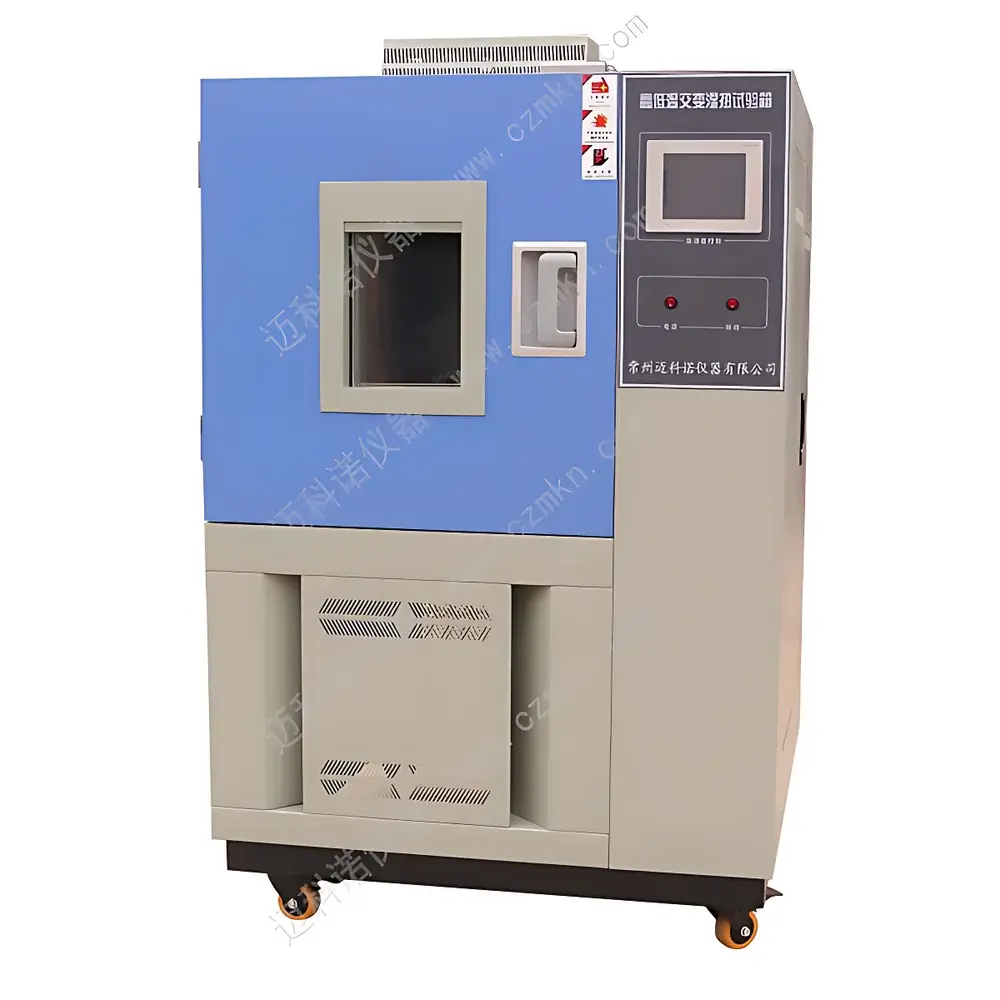
Micono GDWJ-010 High-Low Temperature Cycling Environmental Test Chamber
| Origin | Zhejiang, China |
|---|---|
| Manufacturer Type | Authorized Distributor |
| Origin Category | Domestic (PRC) |
| Model | GDWJ-010 |
| Temperature Range | −20/−40/−60 °C to 100 °C (configurable variants A/B/C) |
| Temperature Uniformity | ≤ ±2 °C |
| Temperature Fluctuation | ≤ ±0.5 °C |
| Heating Rate | ≥ 2–3 °C/min |
| Cooling Rate | ≤ 1 °C/min |
| Internal Chamber Dimensions | 400 × 500 × 500 mm (W×D×H) |
| Insulation | Ultra-fine glass fiber + rigid polyurethane foam |
| Heating System | Nickel-chromium alloy finned electric heater (stainless steel) |
| Cooling System | Multi-stage diaphragm-type evaporator (finned, segmented) |
| Air Circulation | Single-circuit, extended-shaft low-noise stainless steel centrifugal impeller |
| Refrigeration Method | Single-stage or cascade (dual-compressor), air-cooled or water-cooled |
| Compressor | Hermetic French Tecumseh unit |
| Controller | Fuji Electric or Honeywell programmable PID controller |
| Sensor | PT100 platinum resistance thermometer |
| Safety Protections | Leakage current protection, overtemperature cutoff, fast-acting fuse, compressor high-pressure shutdown |
| Standard Accessories | Double-glazed observation window (250 × 300 mm), Ø25 mm test port, two adjustable sample shelves, interior LED lighting |
| Power Supply | 380 V ±10%, 50 Hz, 3-phase 4-wire |
Overview
The Micono GDWJ-010 High-Low Temperature Cycling Environmental Test Chamber is an engineered solution for evaluating the thermal resilience and functional stability of industrial components and materials under controlled, dynamic temperature stress. Designed in accordance with fundamental principles of environmental simulation, it subjects test specimens to precisely regulated alternating high- and low-temperature profiles—enabling accelerated life testing, qualification verification, and conformance assessment per internationally recognized environmental test standards. Its core architecture integrates a BTC (Balance Temperature Control) methodology, wherein heating and refrigeration subsystems operate in coordinated equilibrium to maintain setpoint accuracy without overshoot or oscillation. This ensures stable thermal environments essential for repeatable, traceable test outcomes in R&D, quality assurance, and production validation workflows.
Key Features
- Stainless steel inner chamber (SUS304 grade) with corrosion-resistant exterior cladding—either brushed SUS304 stainless steel or powder-coated Baosteel cold-rolled steel.
- BTC-based temperature control system delivering high reproducibility and long-term stability; automatically selects active refrigeration circuit based on setpoint to optimize energy use and thermal response.
- High-efficiency insulation combining ultra-fine glass fiber and rigid polyurethane foam (≥80 mm thickness), minimizing heat leakage and supporting rapid thermal transitions.
- Modular refrigeration architecture: configurable single-stage or cascade dual-compressor systems, compatible with both air- and water-cooled condenser options for site-specific installation flexibility.
- PT100-class precision temperature sensing paired with imported Fuji or Honeywell PID controllers—supporting programmable ramp-soak cycles, multi-step profiles, and real-time deviation monitoring.
- Robust safety infrastructure including independent overtemperature cutoff, compressor high-pressure interlock, ground-fault circuit interruption, and thermally rated fast-blow fusing.
- Human-centric design elements: double-glazed observation window with internal LED illumination, Ø25 mm cable/port access, and corrosion-resistant silicone door gasket rated for continuous operation from −60 °C to 100 °C.
Sample Compatibility & Compliance
The GDWJ-010 accommodates a broad spectrum of non-hazardous solid and assembled samples—including PCB assemblies, automotive ECUs, aerospace avionics modules, polymer housings, battery packs, and optical sensors—within its 0.1 m³ working volume. It is fully compliant with GB/T 10589–2008 (formerly GB 10592–89), GB/T 2423.1–2023 (Cold Test), GB/T 2423.2–2023 (Dry Heat Test), GJB 150.3A–2009 (Low Temperature), GJB 150.4A–2009 (High Temperature), IEC 60068-2-1, IEC 60068-2-2, MIL-STD-810H Method 502.7, and ISO 16750-4. While not certified to GLP or FDA 21 CFR Part 11 out-of-the-box, its data logging capability (via optional RS485/Modbus or Ethernet interface) supports integration into validated laboratory information management systems (LIMS) where audit-trail requirements apply.
Software & Data Management
The standard controller provides local cycle programming, real-time curve display, and alarm history logging. Optional software packages enable PC-based remote monitoring, automated report generation (PDF/CSV), and compliance-ready test documentation—including timestamped temperature traces, setpoint deviations, and event logs. All data are stored with UTC timestamps and user-accessible metadata (operator ID, test ID, chamber ID). For regulated environments, optional firmware upgrades support electronic signature capture and 21 CFR Part 11–compliant audit trails when deployed with validated IT infrastructure.
Applications
This chamber serves critical roles across multiple sectors: validating thermal cycling endurance of automotive infotainment units per ISO 16750-4; verifying solder joint integrity in electronics per JEDEC JESD22-A104; assessing material embrittlement in polymer composites under repeated cryogenic exposure; qualifying military-grade connectors per MIL-STD-810H; and supporting academic research in phase-change behavior of phase-change materials (PCMs). Its −60 °C to 100 °C range and ≤±0.5 °C stability make it suitable for both storage-condition simulation and accelerated aging protocols requiring tight thermal tolerances.
FAQ
What temperature ranges does the GDWJ-010 support, and how are variants designated?
The GDWJ-010 is available in three base configurations: GDWJ-010A (−20 °C to 100 °C), GDWJ-010B (−40 °C to 100 °C), and GDWJ-010C (−60 °C to 100 °C). Variant selection is determined at order entry and reflected in the serial number.
Is the chamber suitable for testing lithium-ion batteries?
Yes—when operated within specified ambient conditions and equipped with appropriate venting and containment accessories (not included), it complies with UN 38.3 thermal test requirements for transport qualification. Battery-specific safety protocols must be implemented externally.
Can the controller be integrated into a central lab automation network?
Standard models include RS485 Modbus RTU; optional Ethernet/IP or OPC UA gateways enable seamless integration with SCADA, MES, or LIMS platforms.
What is the warranty coverage and service response time?
Micono provides a 12-month parts-and-labor warranty from shipment date. On-site technical support is available within 5 business days in major industrial zones across mainland China; remote diagnostics and firmware updates are provided without charge during warranty period.
Does the chamber meet IP rating or explosion-proof requirements?
No—it is designed for general-purpose environmental testing in non-hazardous locations only. Custom intrinsically safe or ATEX-compliant variants require engineering consultation and are subject to separate certification timelines.



