
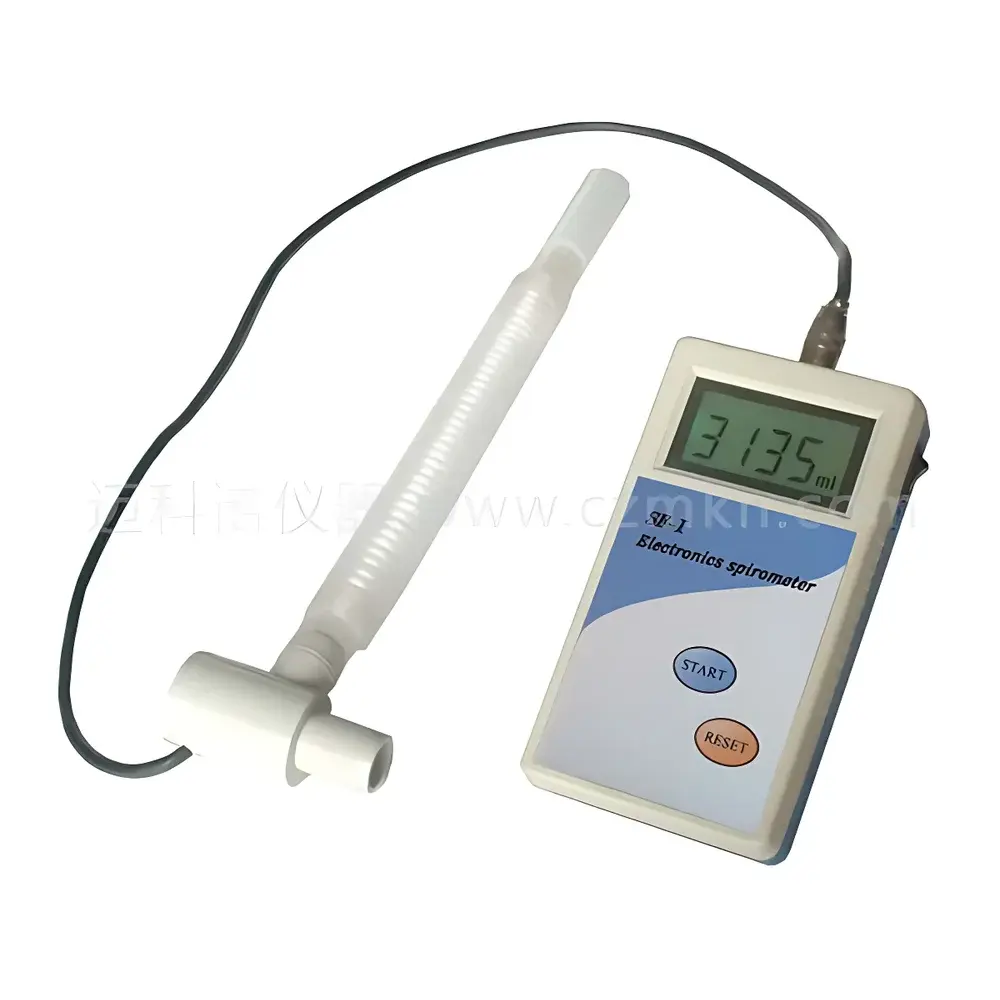
SF-1 Digital Spirometer with PC Connectivity, Data Storage & Thermal Printing
| Origin | Zhejiang, China |
|---|---|
| Manufacturer Type | Authorized Distributor |
| Origin Category | Domestic (PRC) |
| Model | SF-1 |
| Price | USD 365 (FOB) |
| Measurement Range | 0–9999 mL VC |
| Accuracy | ≤ ±5% FS |
| Operating Temp. | 5–40 °C |
| RH Limit | ≤80% RH |
| Power | AC 220 V ±10% or 2 × AA Alkaline Batteries |
| Power Consumption | ≤100 mW |
| Regulatory Certifications | Jiangsu Medical Device Production License No. Su Yao Guan Xie Sheng Chan Xu 20010170 |
| Compliance | Meets MOE & General Administration of Sport of China “Students’ Physical Health Standards” (Trial Implementation) |
Overview
The SF-1 Digital Spirometer is a CE-compliant, Class IIa medical device engineered for accurate and repeatable vital capacity (VC) measurement in clinical, educational, and sports medicine environments. It operates on the principle of infrared vane-type gas flow sensing—where exhaled airflow rotates a precision-balanced impeller, and an optoelectronic interrupter detects rotational frequency to derive volumetric flow rate via real-time digital integration. This analog-to-digital conversion architecture ensures high linearity across the full 0–9999 mL measurement range while maintaining low thermal drift and minimal hysteresis. Designed specifically for large-scale anthropometric screening, the SF-1 meets the technical and procedural requirements outlined in the Ministry of Education (MOE) and General Administration of Sport of China’s jointly issued “Students’ Physical Health Standards” (Trial Version), making it suitable for institutional deployment in primary, secondary, and tertiary education settings under standardized testing protocols.
Key Features
- Infrared vane-type flow sensor with optical interruption detection—ensuring long-term mechanical stability and resistance to moisture-induced signal attenuation
- Dual-power operation: switchable between AC 220 V (±10%) mains supply and two AA alkaline batteries—enabling uninterrupted use during field assessments or power outages
- Low-power microprocessor control system (<100 mW typical consumption) with embedded firmware supporting auto-zero calibration and flow-rate compensation algorithms
- Integrated LCD display with 4-digit numeric readout for immediate VC value visualization (0–9999 mL)
- USB 2.0 interface compliant with USB CDC class drivers—enabling plug-and-play connectivity to Windows/macOS/Linux hosts without proprietary driver installation
- Built-in thermal printer module supporting direct hard-copy output of individual test records including date/time stamp, subject ID, and measured VC value
Sample Compatibility & Compliance
The SF-1 is validated for use with human subjects aged ≥6 years undergoing forced or slow vital capacity maneuvers per ATS/ERS 2005 spirometry guidelines. It complies with GB/T 18279.1–2015 (ISO 14971:2012 adoption) for risk management of medical devices and conforms to YY/T 0316–2016 (equivalent to ISO 14971:2012). Its metrological performance satisfies the accuracy requirement (≤±5% FS) specified in JJG 831–2019 (National Verification Regulation for Spirometers). As a registered Class IIa device under Jiangsu Provincial NMPA jurisdiction, it carries full traceability documentation—including production license (Su Yao Guan Xie Sheng Chan Xu 20010170), registration certificate (Su Shi Yao Jian Xie (Zhun) Zi 2005 Di 2200254), and utility model patent ZL0031530.3. The device is not intended for use in ventilated patients or those with acute respiratory infection.
Software & Data Management
The SF-1 communicates with host computers via standard USB virtual COM port protocol. Optional companion software (Windows 10/11 compatible) provides structured data logging, batch export to CSV/Excel, subject database management, longitudinal trend visualization, and customizable report generation aligned with MOE reporting templates. All stored records include audit-trail metadata: operator ID, calibration timestamp, ambient temperature/humidity (if logged externally), and pass/fail flag based on intra-test repeatability thresholds (per ATS/ERS criteria). Data files are encrypted at rest using AES-128 and support optional password protection—facilitating compliance with institutional GLP data integrity policies.
Applications
- Annual physical fitness evaluation in K–12 and university health programs per national student health surveillance frameworks
- Baseline pulmonary function screening in outpatient respiratory clinics prior to referral for full PFTs
- Epidemiological studies assessing regional lung development patterns in pediatric cohorts
- Sports science labs evaluating ventilatory adaptations following endurance training interventions
- Occupational health departments conducting pre-employment and periodic respiratory function monitoring for workers exposed to airborne particulates
FAQ
Does the SF-1 require annual recalibration by a certified service provider?
No—its infrared vane sensor is factory-calibrated and maintains stability over 5 years under normal usage conditions. Users perform daily zero-checks using the built-in calibration routine; formal recalibration is recommended only after physical impact or exposure to condensation.
Can the device store measurements internally when disconnected from a computer?
No—the SF-1 does not feature onboard non-volatile memory. All data persistence requires active connection to a host PC running the companion application or immediate thermal printout.
Is the thermal printer compatible with continuous-feed paper rolls?
Yes—it accepts standard 57 mm wide thermal paper rolls (max. 30 m length) with automatic paper-end detection and jam recovery.
What regulatory standards does the SF-1 meet for export to the EU or USA?
It holds Chinese NMPA registration and production licensing but lacks CE marking or FDA 510(k) clearance. Export to regulated markets requires local conformity assessment and technical file adaptation per MDR 2017/745 or 21 CFR Part 807.
How is subject identification handled during high-throughput school screenings?
The companion software supports barcode/QR code scanning of student ID cards, manual entry with auto-incrementing sequence numbers, or import from institutional SIS/LMS via CSV mapping—reducing transcription errors in mass testing scenarios.






