
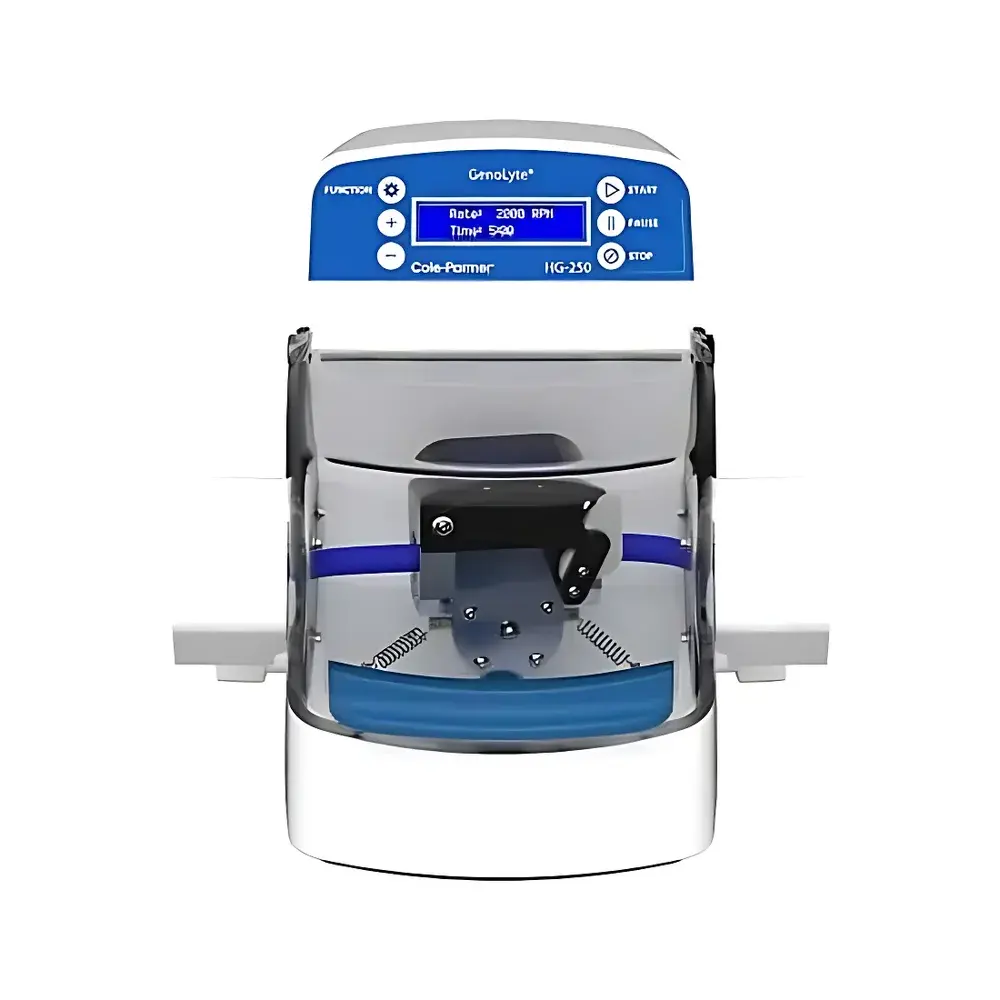
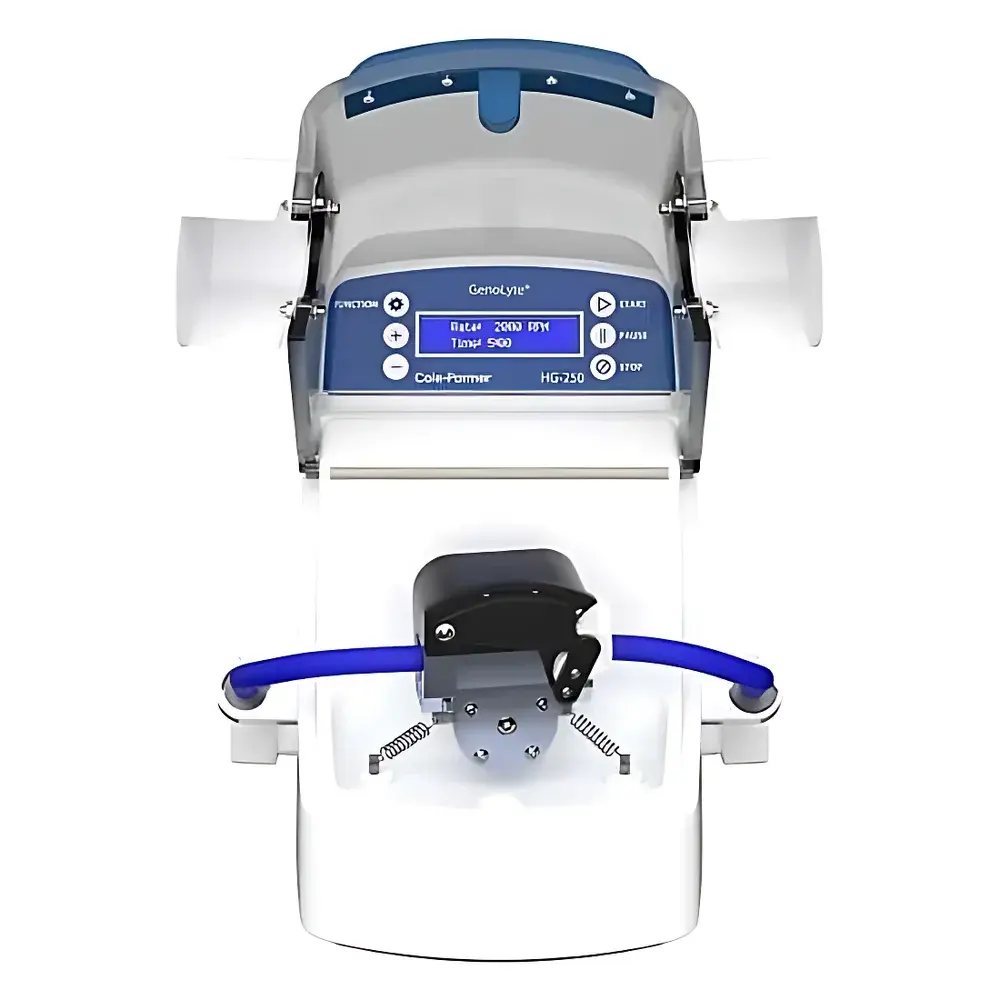
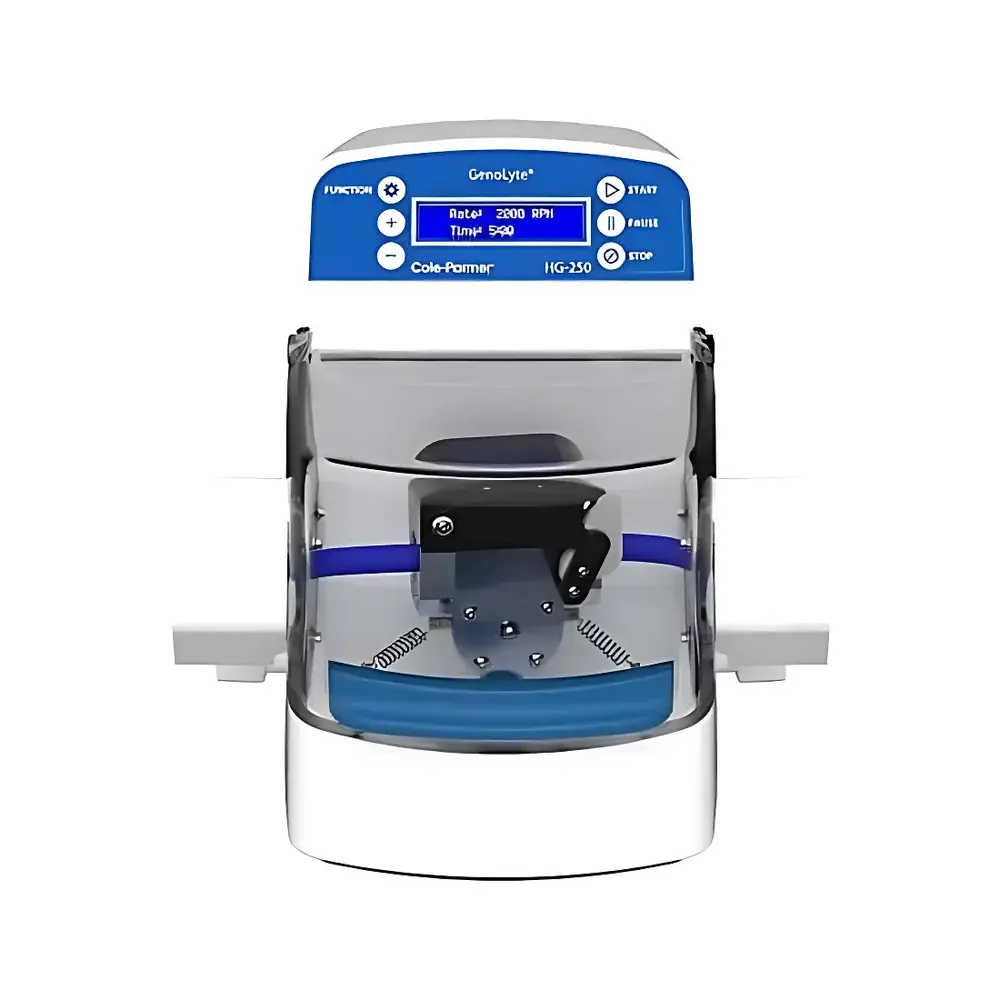
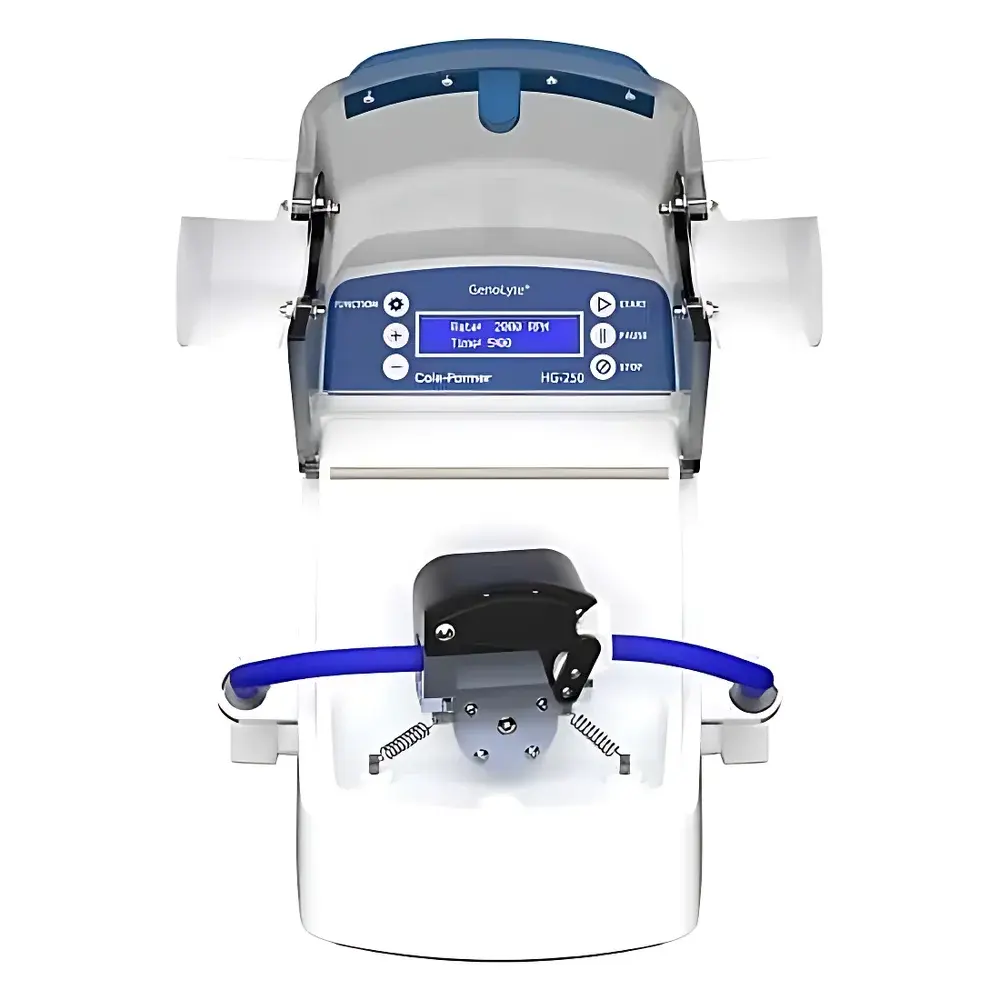
Cole-Parmer GenoLyte HG-250 Cryogenic Tissue Grinder (Formerly SPEX 1200C)
| Brand | Cole-Parmer |
|---|---|
| Origin | USA |
| Manufacturer Type | Authorized Distributor |
| Origin Category | Imported |
| Model | HG-250 |
| Price | Upon Request |
| Cooling Range | 0–10 °C (requires external recirculating chiller) |
| Vibration Mode | Multi-angle horizontal oscillation |
| Dimensions (W×D×H) | 20.5 × 38 × 30 cm |
| Weight | 11 kg |
| Power Supply | 230 V AC |
| Motor | 1/7 HP |
| Oscillation Frequency | 2000–3000 cycles/min |
| Standard Adapter | Three 2 mL microcentrifuge tube holders |
Overview
The Cole-Parmer GenoLyte HG-250 Cryogenic Tissue Grinder (formerly SPEX 1200C) is a precision-engineered, benchtop mechanical homogenizer designed for reproducible, low-temperature disruption of biological tissues and plant materials. It operates on the principle of high-frequency multi-angle horizontal oscillation—generating controlled kinetic energy transfer to grinding beads within sealed microcentrifuge tubes—thereby enabling efficient cell lysis while minimizing thermal degradation and nucleic acid shearing. Unlike manual mortar-and-pestle methods or high-shear rotor-stator systems, the HG-250 maintains sample integrity through active temperature regulation (0–10 °C), achieved via integration with an externally connected recirculating chiller (not included). This thermal control is critical for preserving labile biomolecules—including DNA, RNA, proteins, and metabolites—during homogenization, making the system suitable for downstream applications in molecular biology, genomics, and proteomics workflows.
Key Features
- Integrated cryogenic operation: Compatible with standard recirculating chillers to maintain sample temperatures between 0 °C and 10 °C throughout processing—essential for heat-sensitive analytes.
- Multi-angle horizontal oscillation mechanism: Delivers uniform energy distribution across all sample positions, ensuring consistent bead motion and reduced inter-sample variability.
- Digital timer and speed control: Enables precise programming of run time (0–99 min) and oscillation frequency (2000–3000 cycles/min), supporting method standardization and protocol reproducibility.
- Ergonomic, transparent lid with safety interlock: Provides full visual access to sample loading area while preventing unintended operation; automatically disables motor when lid is open.
- Modular 2 mL tube adapter: Accommodates three standard microcentrifuge tubes simultaneously, with secure clamping orientation optimized for rapid loading/unloading without tools.
- Compact footprint and robust construction: 20.5 × 38 × 30 cm dimensions and 11 kg mass ensure stability during high-frequency operation while fitting seamlessly into regulated laboratory environments.
Sample Compatibility & Compliance
The HG-250 is validated for homogenizing a broad spectrum of biological matrices—including mammalian tissues (liver, brain, muscle), plant materials (leaves, stems, seeds, roots), microbial pellets, and fibrous samples—when used with appropriate grinding media (e.g., stainless steel, zirconia, or ceramic beads). Its design conforms to general laboratory safety standards for Class II mechanical equipment (IEC 61010-1) and supports compliance with Good Laboratory Practice (GLP) and Good Manufacturing Practice (GMP) requirements when integrated into documented SOPs. While the instrument itself does not carry FDA 21 CFR Part 11 certification, its digital timer and repeatable operational parameters facilitate audit-ready process documentation when paired with compliant LIMS or ELN platforms.
Software & Data Management
The HG-250 operates via a dedicated front-panel interface with no embedded software or network connectivity. All operational parameters—including runtime, oscillation frequency, and start/stop commands—are set manually using physical controls. This architecture eliminates firmware dependencies, reduces cybersecurity exposure, and ensures long-term operational continuity without software updates or licensing. For laboratories requiring electronic recordkeeping, users may log settings and run metadata manually in compliant electronic notebooks or integrate timing signals via external programmable logic controllers (PLCs) where traceability is mandated.
Applications
- Routine nucleic acid isolation: Mechanical lysis of tissues prior to column-based or magnetic-bead-based DNA/RNA extraction protocols.
- Proteomic sample preparation: Disruption of tough tissues (e.g., cardiac muscle, cartilage) under cold conditions to preserve native protein conformation and post-translational modifications.
- Metabolite extraction: Homogenization of plant and microbial samples for untargeted LC-MS or GC-MS metabolomics workflows.
- Microbiome research: Efficient lysis of Gram-positive bacteria and fungal cells using high-density beads in chilled buffer systems.
- Biobanking and clinical sample processing: Scalable, operator-independent tissue pulverization compatible with ISO 20387-compliant biorepository workflows.
FAQ
Is a recirculating chiller included with the HG-250?
No—the HG-250 requires an external recirculating chiller capable of delivering coolant at 0–10 °C. Recommended models include Cole-Parmer PC-300 or equivalent units with ≥1 L/min flow rate and ±0.5 °C temperature stability.
What tube formats are supported beyond 2 mL microcentrifuge tubes?
The standard configuration supports only three 2 mL tubes. Adapters for other formats (e.g., 0.5 mL or 7 mL tubes) are not available from Cole-Parmer and are not validated for use with this platform.
Can the HG-250 be used for dry grinding or non-biological samples?
It is engineered exclusively for wet-matrix biological homogenization. Dry grinding, abrasive powders, or corrosive solvents are outside its design scope and may compromise seal integrity or motor longevity.
Does the instrument provide data logging or USB export capability?
No—it features no internal memory, timestamping, or digital output interface. All operational records must be maintained externally per institutional SOPs.
What maintenance is required for long-term reliability?
Routine inspection of the rubber dampening mounts, periodic cleaning of the sample chamber with 70% ethanol, and annual verification of oscillation amplitude and frequency accuracy using a calibrated tachometer are recommended per manufacturer guidelines.



