
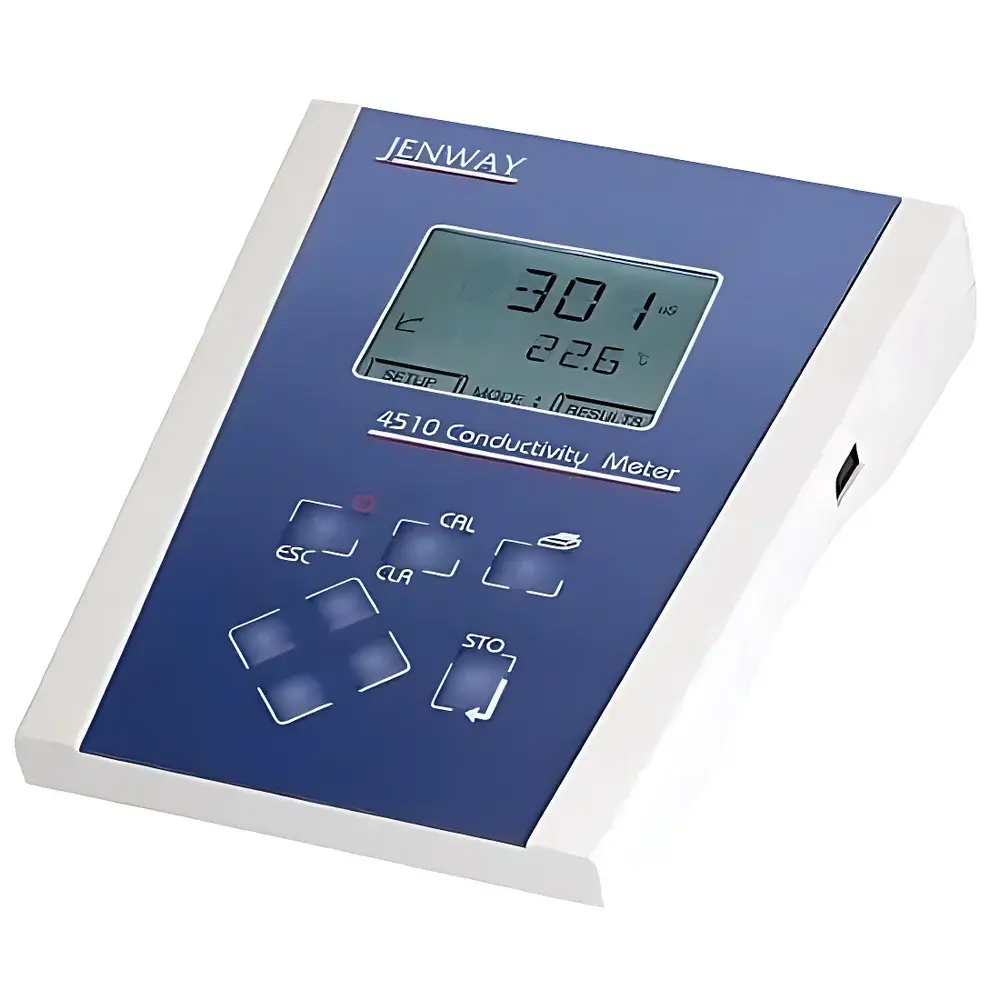
Jenway 4510 Benchtop Conductivity Meter
| Brand | Jenway |
|---|---|
| Origin | United Kingdom |
| Model | 4510 |
| Form Factor | Benchtop |
| Conductivity Range | 0–1999 mS/cm (6 auto-ranging scales) |
| TDS Range | 0–1999 g/L |
| Temperature Range | –10 to 105 °C |
| Conductivity Accuracy | ±0.5% ±2 digits |
| TDS Accuracy | ±0.5% ±2 digits |
| Temperature Accuracy | ±0.5 °C |
| Temperature Resolution | 0.1 °C |
| Conductivity Resolution | 0.01 µS/cm to 1 mS/cm |
| TDS Resolution | 0.01 mg/L to 1 g/L |
| Cell Constant Range | 0.010–19.999 cm⁻¹ |
| Temperature Coefficient | 0.00–4.00 %/°C |
| Reference Temperatures | 18 °C, 20 °C, or 25 °C |
| Auto Standard Recognition | 10 µS/cm, 84 µS/cm, 1413 µS/cm, 12.88 mS/cm |
| Data Storage | 32 readings |
| Interface | RS232 (7-pin DIN), analog output |
| Power | 9 V AC ±10%, 50/60 Hz |
| Dimensions (L×W×D) | 210 × 250 × 55 mm |
| Weight | 850 g |
Overview
The Jenway 4510 Benchtop Conductivity Meter is a precision-engineered electrochemical instrument designed for reliable, repeatable measurement of electrical conductivity and total dissolved solids (TDS) in aqueous solutions across academic, industrial, and quality control laboratories. Based on the fundamental principle of conductance measurement—where conductivity (κ) is derived from the reciprocal of electrical resistance (R) normalized by cell geometry (cell constant K)—the 4510 employs a four-electrode AC excitation method to minimize polarization effects and electrode fouling. Its dual-parameter display simultaneously presents conductivity (or TDS) and temperature, enabling real-time thermal compensation without manual intervention. The instrument supports automatic temperature compensation (ATC) across a broad operational range (–10 to 105 °C), with user-selectable reference temperatures (18 °C, 20 °C, or 25 °C) and adjustable linear temperature coefficients (0.00–4.00 %/°C), ensuring compliance with standard calibration protocols defined in ISO 7888 and ASTM D1125.
Key Features
- Auto-ranging conductivity measurement across six decades (0.01 µS/cm to 1999 mS/cm), with resolution dynamically optimized per range
- Integrated ATC using a built-in NTC thermistor probe (K = 1.0, supplied as part of standard configuration 451001)
- Automatic recognition of four certified conductivity standards (10 µS/cm, 84 µS/cm, 1413 µS/cm, 12.88 mS/cm) to reduce calibration error and operator dependency
- Endpoint detection algorithm that stabilizes readings prior to data capture, enhancing measurement reproducibility
- Configurable cell constant input (0.010–19.999 cm⁻¹) for use with interchangeable electrodes—including two- and four-electrode cells—supporting applications from ultrapure water to concentrated brines
- RS232 serial interface (7-pin DIN connector) with bidirectional communication for direct connection to printers or laboratory PCs; compatible with legacy LIMS and custom data acquisition software
- Onboard memory storing up to 32 timestamped measurements with conductivity, TDS, temperature, and date/time metadata
Sample Compatibility & Compliance
The Jenway 4510 is validated for use with a wide spectrum of aqueous samples, including potable water, wastewater effluents, boiler feedwater, pharmaceutical buffers, and electroplating baths. Its robust electrode architecture—paired with an optional K = 1.0 glass conductivity cell (Jenway P/N 027 013)—ensures stable performance under varying ionic strength and viscosity conditions. While the instrument does not include GLP-compliant audit trail functionality out-of-the-box, its RS232 data export capability enables integration into regulated environments where raw measurement logs are archived externally for FDA 21 CFR Part 11 compliance. Calibration verification can be performed against NIST-traceable standards, supporting adherence to ISO/IEC 17025 requirements for testing laboratories.
Software & Data Management
Data generated by the 4510 is accessible via ASCII-formatted RS232 transmission at standard baud rates (e.g., 9600 bps, 8N1), allowing seamless ingestion into spreadsheet applications, statistical process control (SPC) platforms, or enterprise laboratory information management systems (LIMS). No proprietary software is required; however, third-party terminal emulators (e.g., Tera Term, PuTTY) may be used to configure logging intervals and initiate batch transfers. All stored readings retain full contextual metadata—including measured parameter, unit, temperature, and calibration status—facilitating traceability during internal audits or regulatory inspections. Analog output (0–1 V or 4–20 mA, configurable) supports integration with PLC-based monitoring systems in continuous process environments.
Applications
- Environmental monitoring: Routine assessment of surface water conductivity as an indicator of salinity, pollution load, or anthropogenic contamination
- Pharmaceutical manufacturing: Verification of purified water (PW) and water-for-injection (WFI) resistivity per USP and EP 2.2.38
- Food & beverage QA/QC: Batch consistency checks for brine solutions, syrup concentrations, and dairy processing rinses
- Academic teaching labs: Hands-on instruction in solution chemistry, electrolyte behavior, and colligative property relationships
- Industrial cooling water management: Trend analysis of cycle concentration ratios and early detection of scaling or corrosion potential
FAQ
Does the Jenway 4510 support GLP-compliant data integrity features such as electronic signatures or audit trails?
No—the 4510 does not incorporate embedded GLP functionality. However, its RS232 data export enables external archiving with time-stamped, immutable records suitable for review under GMP or ISO 17025 frameworks.
Can I use non-Jenway conductivity probes with the 4510?
Yes, provided the probe is compatible with a 7-pin DIN connector and supports the same AC frequency and voltage specifications; users must manually enter the correct cell constant for accurate quantification.
What is the maximum allowable sample temperature for continuous measurement?
The instrument’s temperature sensor and electronics are rated for sustained operation up to 105 °C; however, probe compatibility (e.g., glass cell thermal limits) should be verified separately per manufacturer specifications.
How often should the 4510 be calibrated in routine use?
Daily calibration is recommended for critical applications; for less demanding environments, calibration before each analytical session—verified against at least two standards spanning the expected measurement range—is sufficient to maintain ±0.5% accuracy.
Is the RS232 interface optically isolated?
No—the 4510’s RS232 port is electrically coupled and requires proper grounding when interfacing with sensitive PC hardware or industrial controllers; use of an isolated USB-to-RS232 adapter is advised in electrically noisy environments.







