
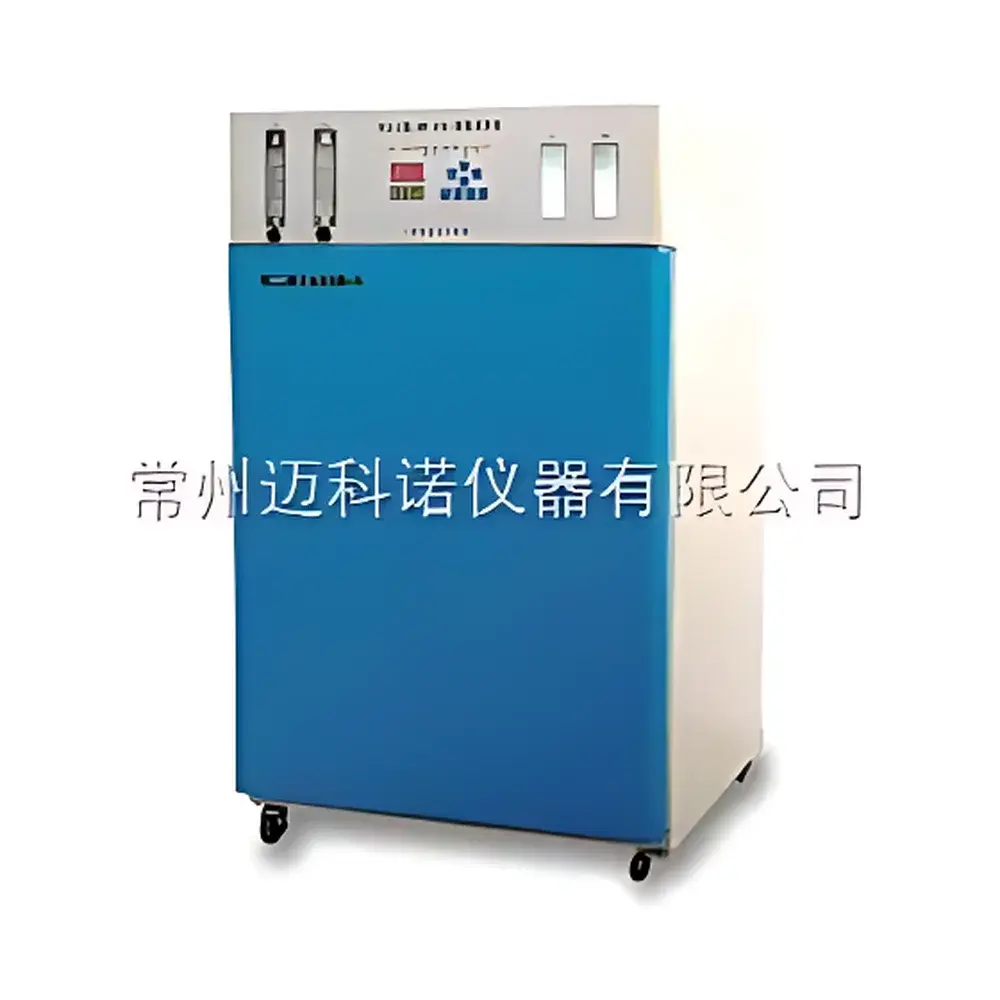
MKN CHP-160 Water-Jacketed CO₂ Incubator
| Brand | MKN |
|---|---|
| Model | CHP-160 |
| Type | Water-jacketed CO₂ incubator |
| Chamber Volume | 160 L |
| Temperature Control Range | Ambient +5°C to 60°C |
| Temperature Accuracy | ±0.3°C at 37°C |
| Temperature Resolution | 0.1°C |
| CO₂ Concentration Range | 0–20% (v/v) |
| CO₂ Accuracy | ±0.1% (v/v) |
| CO₂ Uniformity | ±0.1% at 5% setpoint |
| CO₂ Recovery Time | ≤1.2 × setpoint (min) |
| Heating Method | Water jacket |
| Humidification Method | Natural evaporation |
| Power Consumption | 950 W |
| Working Environment | 5–35°C, 220 V / 50 Hz |
| Interior Dimensions (W×D×H) | 500×500×650 mm |
| Exterior Dimensions (W×D×H) | 650×610×990 mm |
| Standard Shelving | 2 stainless steel trays |
| Construction | Stainless steel inner chamber with seamless argon arc welding, rounded interior corners |
Overview
The MKN CHP-160 Water-Jacketed CO₂ Incubator is a precision-engineered environmental chamber designed for reliable, long-term cultivation of mammalian cells, primary tissues, hybridomas, and sensitive microbial strains under tightly controlled physiological conditions. It operates on the principle of dual-regulation—simultaneous feedback control of CO₂ concentration (via infrared sensor) and temperature (via PID-controlled water jacket)—to maintain stable pH (via bicarbonate buffer systems) and thermal homogeneity essential for reproducible in vitro growth. Unlike forced-air incubators, the water-jacketed architecture provides superior thermal inertia and resistance to external ambient fluctuations, making it especially suitable for unattended overnight or multi-day experiments in academic core facilities, biopharmaceutical QC labs, and GLP-compliant cell banking environments.
Key Features
- Water-jacketed thermal system: Fully insulated stainless steel water jacket surrounding the chamber ensures minimal temperature drift (<±0.3°C at 37°C) and high energy efficiency—reducing power demand by up to 30% compared to air-jacketed equivalents during extended operation.
- Dual-stage CO₂ gas filtration: Integrated 0.2 µm hydrophobic particulate filter and catalytic CO₂ scrubber remove airborne contaminants and trace organics prior to gas injection, minimizing risk of mycoplasma or endotoxin introduction into cultures.
- Condensation-suppressing heated glass door: Independently controlled door heating circuit prevents fogging and surface condensation, enabling uninterrupted visual monitoring without compromising internal humidity or CO₂ stability.
- Robust chamber construction: Electropolished 304 stainless steel interior fabricated via full-penetration argon arc welding; radius-rounded corners (R≥15 mm) eliminate crevices and support ISO 14644-1 Class 5 cleanroom-compatible cleaning protocols.
- Multi-level safety architecture: Redundant over-temperature cut-off, CO₂ deviation alarm (audible/visual), door-open alert, and real-time sensor diagnostics logged to non-volatile memory for audit trail compliance.
Sample Compatibility & Compliance
The CHP-160 accommodates standard tissue culture formats—including T-25 to T-225 flasks, 6–96-well plates, Petri dishes, roller bottles, and cryovial racks—without airflow turbulence or localized desiccation. Its natural evaporation humidification maintains ≥95% RH at 37°C/5% CO₂ (measured per ASTM E2912-22), supporting moisture-sensitive applications such as embryoid body formation and organoid differentiation. The unit complies with IEC 61010-1:2010 for laboratory equipment safety and supports validation documentation per ISO 13485 and FDA 21 CFR Part 11 when paired with optional data logging accessories. All firmware and calibration records are traceable to NIST-traceable reference standards.
Software & Data Management
Equipped with an embedded microprocessor controller featuring a 4.3-inch TFT LCD interface, the CHP-160 provides real-time digital display of chamber temperature, CO₂ concentration, elapsed run time, and system status codes. Optional RS-485 Modbus RTU output enables integration into centralized lab infrastructure (e.g., LabVantage, Siemens Desigo, or custom SCADA). Event logs—including all parameter changes, alarm triggers, and door openings—are timestamped and stored for ≥30 days onboard. When configured with the MKN DataBridge Module (sold separately), users gain secure HTTPS-based remote access, automated PDF report generation, and electronic signature support aligned with ALCOA+ data integrity principles.
Applications
- Mammalian cell line expansion for monoclonal antibody production and viral vector manufacturing
- Primary neuronal and mesenchymal stem cell maintenance under low-oxygen priming conditions
- Long-term co-culture assays involving epithelial–fibroblast or tumor–immune cell interactions
- Regulatory microbiological testing per USP , , and EP 2.6.12 in pharmaceutical quality control
- Plant protoplast regeneration and callus induction requiring precise CO₂ modulation
FAQ
What is the recommended calibration frequency for the CO₂ sensor?
Annual calibration against certified NIST-traceable gas standards is advised; field verification using a portable NDIR analyzer is recommended quarterly.
Can the incubator operate at CO₂ concentrations below 1%?
Yes—the IR sensor maintains linear response down to 0.2% CO₂, validated per ISO 8573-1:2010 Annex B for low-concentration accuracy.
Is autoclaving of internal components supported?
No—however, the chamber may be sterilized via vaporized hydrogen peroxide (VHP) cycles compatible with ISO 14644-3 Class 5 decontamination protocols.
Does the unit meet electromagnetic compatibility (EMC) requirements for hospital environments?
Yes—it conforms to EN 61326-1:2013 for laboratory use and EN 60601-1-2:2015 for clinical research settings.
What is the mean time between failures (MTBF) for the water-jacket heating system?
Based on accelerated life testing, MTBF exceeds 25,000 operational hours under continuous 37°C/5% CO₂ conditions.





