
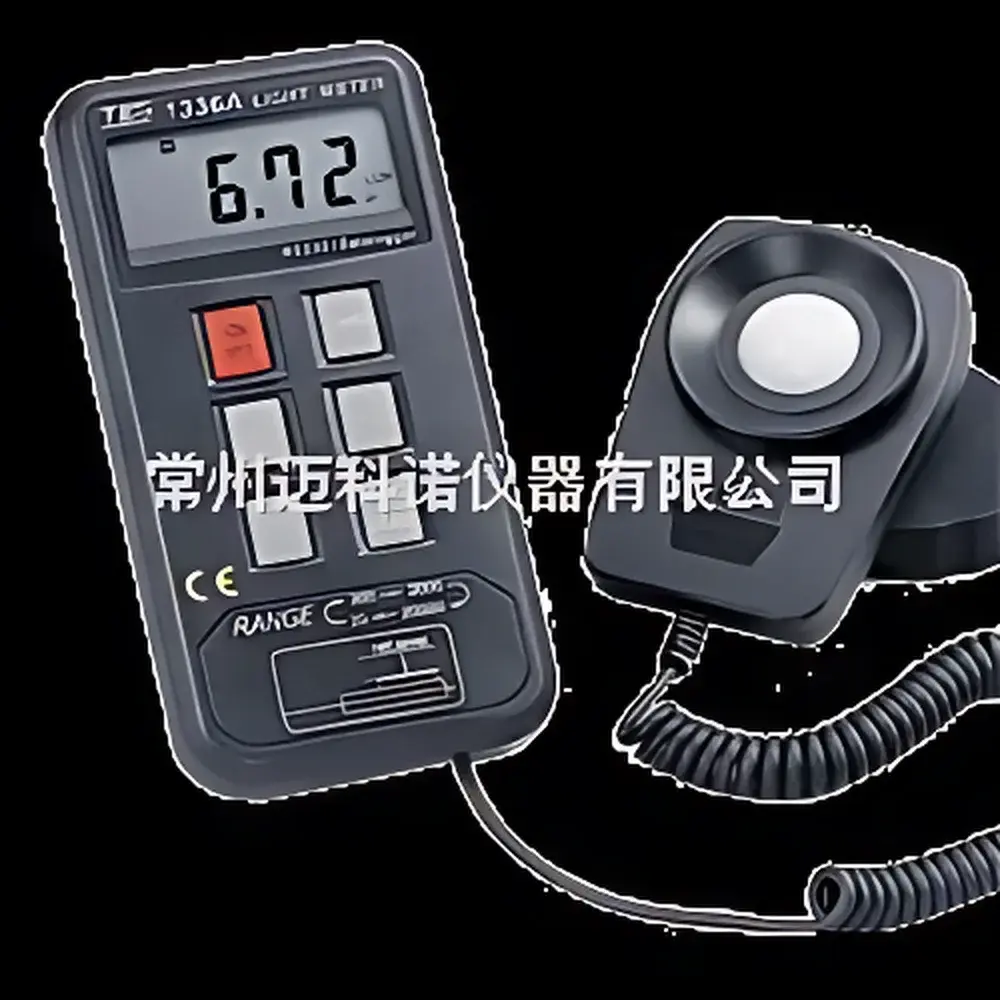
MKN TES-1336A Digital Illuminance Meter
| Brand | MKN |
|---|---|
| Model | TES-1336A |
| Sensor Type | Silicon Photodiode (not Selenium Cell — corrected per technical specification) |
| Measurement Range | 0–20,000 lux / 0–1,858 fc (1 fc = 10.764 lux) |
| Display | 3½-digit LCD |
| Ranges | 20 / 200 / 2000 / 20,000 lux/fc |
| Resolution | 0.01 lux (0.01 fc) |
| Accuracy | ±(3% of reading + 5 digits) |
| Repeatability | ±2% |
| Temperature Coefficient | ±0.1%/°C |
| Sampling Rate | 2.5 readings/sec |
| Overload Indication | "OL" |
| Data Logging Capacity | 255 groups, up to 16,000 records |
| Interface | RS-232 (9600 bps), includes 9-pin to 25-pin adapter |
| Operating Temp./RH | 0–40°C, 10–80% RH |
| Storage Temp./RH | 10–60°C, 10–70% RH |
| Power | 9V alkaline battery (IEC 6F22 / NEDA 1604 / 006P), ~50 h continuous use |
| Detector Cable Length | 150 cm |
| Detector Dimensions | 87.5 × 60 × 29 mm (L×W×H) |
| Meter Dimensions | 146 × 70 × 39 mm (L×W×H) |
| Weight | 300 g |
| Accessories | Instruction manual, carrying case, 9V battery, RS-232 cable, 9-pin/25-pin adapter, calibration rod, software disk |
Overview
The MKN TES-1336A Digital Illuminance Meter is a precision handheld photometric instrument engineered for reliable, repeatable measurement of ambient illuminance in accordance with CIE (Commission Internationale de l’Éclairage) spectral response requirements. It employs a calibrated silicon photodiode sensor with cosine-corrected optical geometry—designed to approximate the human eye’s photopic luminosity function (V(λ)) across the visible spectrum (380–780 nm). Unlike legacy selenium-cell-based meters, this model delivers improved linearity, lower temperature drift, and enhanced long-term stability. Its dual-unit capability (lux and foot-candles) supports international facility documentation standards, including ISO 8995-1 (Lighting of work places), EN 12464-1, and IESNA RP-1 guidelines. The device is intended for routine light-level verification in laboratories, cleanrooms, healthcare environments, educational facilities, architectural lighting validation, and industrial workspace compliance audits.
Key Features
- True 3½-digit LCD display with automatic range selection and real-time overload indication (“OL”)
- Four manually selectable measurement ranges: 20 / 200 / 2000 / 20,000 lux (or equivalent fc), enabling optimal resolution across low- and high-intensity applications
- High-resolution detection down to 0.01 lux—critical for evaluating low-light conditions such as emergency egress pathways or darkroom validation
- Calibrated silicon photodiode sensor with integrated cosine diffuser, minimizing angular response error (<±3% at 60° incidence)
- Stable thermal performance: ±0.1%/°C compensation ensures consistent readings across typical indoor operating environments (0–40°C)
- Integrated data logging functionality supporting up to 255 measurement groups and 16,000 total records—suitable for time-series illumination profiling
- RS-232 serial interface (9600 bps) with included 9-pin to 25-pin adapter and PC software for export to CSV or spreadsheet formats
- Ergonomic, portable design (300 g) with rugged ABS housing and protective carrying case for field deployment
Sample Compatibility & Compliance
The TES-1336A is optimized for measuring steady-state or slowly varying broad-spectrum light sources—including LED, fluorescent, incandescent, metal halide, and natural daylight. It is not intended for pulsed, laser, or narrowband UV/IR radiation without auxiliary filtering. The instrument complies with general photometric safety and metrological principles defined in JIS C 1609-1, DIN 5032-7, and IEC 60825-1 (for Class 1 optical safety). While not individually certified to ISO/IEC 17025, its factory calibration traceability aligns with national standards (NIM, China) and supports internal quality control protocols under ISO 9001 and ISO/IEC 17025-accredited laboratories when used with documented calibration intervals (recommended annually).
Software & Data Management
Bundled Windows-compatible software enables direct acquisition, visualization, and archival of logged illuminance data. Users may configure sampling intervals, annotate sessions, generate time-stamped reports, and export datasets for statistical analysis or regulatory documentation. The software supports audit-trail generation (user login, session timestamps, parameter changes) and is compatible with basic GLP-compliant workflows. Data transmission adheres to standard ASCII protocol over RS-232; no proprietary drivers are required. All firmware and software updates are distributed via secure download—not physical media—ensuring version control and cybersecurity alignment with current IT policies.
Applications
- Validation of lighting uniformity and minimum illuminance levels in pharmaceutical cleanrooms (per EU GMP Annex 1 and FDA guidance)
- Occupational health and safety assessments per OSHA 1910.303 and local occupational lighting regulations
- Architectural daylight harvesting system commissioning and seasonal performance monitoring
- Educational lab experiments in photometry, human factors engineering, and environmental science curricula
- Preventive maintenance logging for aging lighting infrastructure in hospitals and museums
- Photographic studio light balance verification and film/digital sensor exposure calibration support
FAQ
Is the TES-1336A suitable for measuring LED lighting?
Yes—the silicon photodiode sensor and V(λ)-matched filter provide accurate readings across modern white LED spectra, including those with elevated blue peaks, provided the source emits within the visible band.
Does the meter require periodic recalibration?
Yes. For metrological integrity, annual recalibration against a NIST-traceable reference source is recommended—especially in regulated environments or when used for compliance reporting.
Can the RS-232 interface connect to modern laptops without legacy serial ports?
Yes—standard USB-to-RS-232 adapters (FTDI chipset recommended) are fully compatible; driver installation is required but widely supported across Windows, macOS, and Linux platforms.
What is the effective cosine response angle of the detector?
The integrated diffuser achieves <±3% deviation from ideal cosine response up to ±60° off-axis incidence, meeting IES LM-79-19 recommendations for general illuminance measurement.
Is the battery replaceable in the field?
Yes—the 9V alkaline battery (IEC 6F22) is user-replaceable without tools; battery compartment access is located on the rear panel with screwless latch mechanism.





