
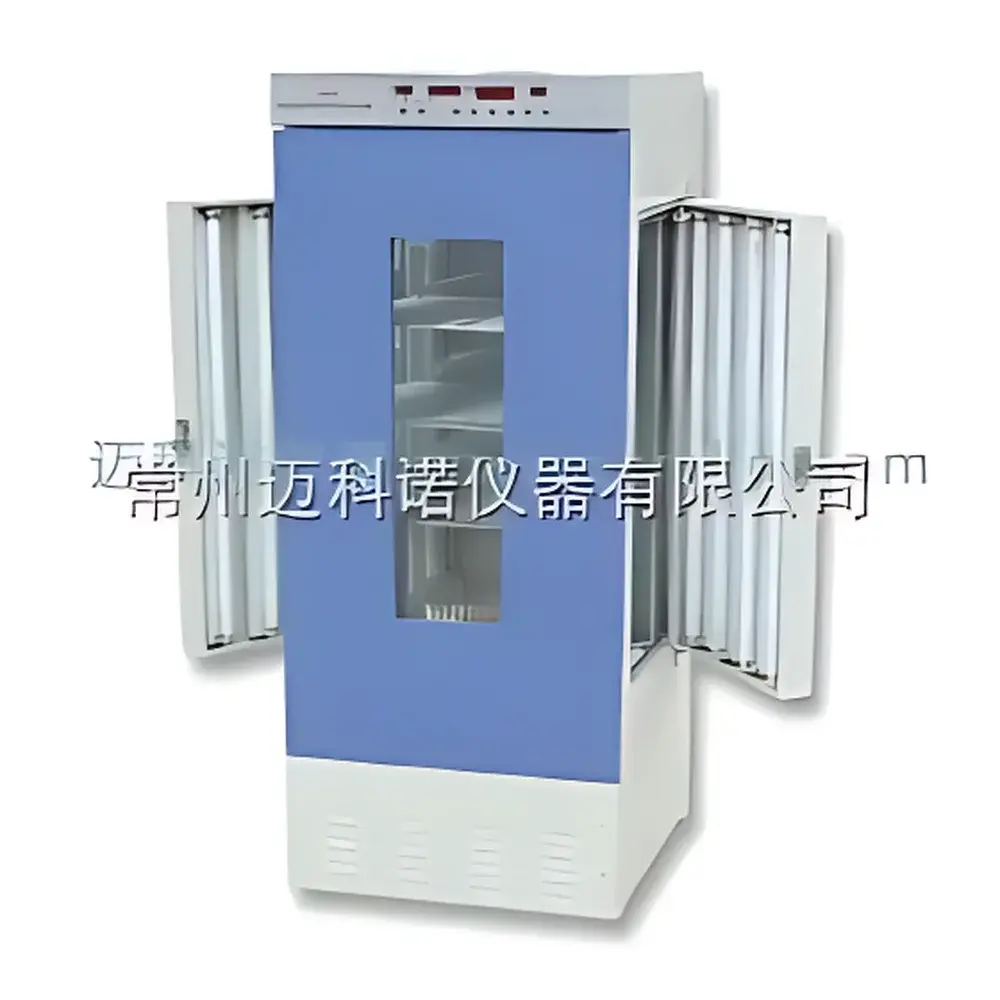
MKN GPX-250 Digital Illuminated Plant Growth Chamber
| Brand | MKN |
|---|---|
| Model | GPX-250 |
| Capacity | 250 L |
| Power Supply | AC 220 V ±10%, 50 Hz ±2% |
| Temperature Range | 10–50 °C (with full illumination), 5–50 °C (dark) |
| Temperature Control Accuracy | ±1 °C |
| Temperature Uniformity | ±1 °C |
| Illuminance | ≥5000 lx |
| Operating Ambient Temperature | 0–40 °C |
| Operating Ambient Relative Humidity | ≤85% |
| Construction | Powder-coated carbon steel exterior, stainless steel interior chamber |
| Insulation | Polyurethane foam |
| Lighting | Replaceable energy-efficient lamps with dual side-access doors |
| Air Circulation | Patented forced-air convection system |
| Safety Features | Compressor delay start and power interruption protection |
Overview
The MKN GPX-250 Digital Illuminated Plant Growth Chamber is a precision-engineered environmental control system designed for reproducible, long-term plant physiology studies, seed germination trials, photobiological assays, and standardized biological incubation under controlled light and temperature conditions. It operates on the principle of active thermal regulation combined with uniform photosynthetic photon flux delivery—enabling stable simulation of diurnal light/dark cycles and climatic gradients essential for controlled-environment agriculture (CEA), ecophysiology, and regulatory-compliant BOD or stability testing. Unlike generic incubators, the GPX-250 integrates bidirectional thermoelectric + compressor-based heating and cooling, coupled with calibrated broad-spectrum illumination, to maintain tight setpoint adherence across its 250 L working volume—critical for ISO 17025-accredited laboratories conducting GLP-aligned plant growth experiments.
Key Features
- Microprocessor-based PID temperature controller with LED digital display ensures real-time monitoring and ±1 °C setpoint accuracy and uniformity across the entire chamber volume.
- Dual-side hinged access doors facilitate rapid lamp replacement without disturbing chamber integrity or calibration—compatible with standard T8 or LED grow tubes meeting PAR (Photosynthetically Active Radiation) spectral requirements.
- Forced-air circulation architecture with optimized duct geometry minimizes vertical and horizontal thermal gradients, achieving <±1 °C spatial consistency at multiple validation points per ICH Q5C and ASTM E2876 protocols.
- High-density polyurethane insulation (≥50 mm thickness) provides thermal resistance exceeding R-12 (SI: ~2.1 m²·K/W), reducing energy consumption while maintaining stability during ambient fluctuations up to 40 °C.
- Stainless steel interior chamber (304 grade) resists corrosion from humidity, nutrient aerosols, and routine disinfectants—supporting ISO 14644-1 Class 8 cleanroom-compatible operation when paired with HEPA-filtered air options.
- Integrated compressor protection circuitry includes 3-minute delay restart logic and brownout detection, extending service life and ensuring compliance with IEC 61000-4-11 immunity standards.
Sample Compatibility & Compliance
The GPX-250 accommodates standard plant growth vessels—including Petri dishes, Magenta boxes, hydroponic trays, and multi-tiered shelving configurations—without compromising airflow or illumination homogeneity. Its 250 L internal volume supports concurrent parallel trials per OECD 208 (Terrestrial Plant Test) or US EPA OPPTS 850.4400 (Seed Germination Test) guidelines. The chamber meets CE marking requirements under the Low Voltage Directive (2014/35/EU) and Electromagnetic Compatibility Directive (2014/30/EU). While not inherently 21 CFR Part 11 compliant, audit-ready data logging (via optional RS-485 interface) enables traceable temperature and illumination history for FDA-regulated botanical research and pharmacognosy workflows.
Software & Data Management
The GPX-250 operates via embedded firmware with non-volatile memory for storing up to 99 programmable profiles—each defining ramp/soak temperature sequences, light-on/off timing, and duration. Optional PC connectivity (RS-485 to USB adapter) allows integration with third-party SCADA platforms or custom Python-based acquisition scripts. Logged data exports as CSV files with timestamps, supporting retrospective analysis in MATLAB, JMP, or validated LIMS environments. All parameter changes are timestamped and user-ID tagged when connected to networked authentication systems—facilitating ALCOA+ (Attributable, Legible, Contemporaneous, Original, Accurate, Complete, Consistent, Enduring, Available) data integrity principles.
Applications
- Standardized seed germination and early seedling development studies per ISTA and AOSA protocols.
- Phytochemical induction experiments requiring precise photoperiod control (e.g., anthocyanin biosynthesis under blue-red LED spectra).
- Biochemical oxygen demand (BOD5) incubation at 20 °C ±0.5 °C in accordance with ISO 5815-1 and APHA Standard Methods 5210B.
- Microbial culture maintenance under low-light stress conditions for antibiotic production screening.
- Environmental stress response modeling—including drought, chilling, and high-irradiance treatments—for crop resilience phenotyping.
- Educational laboratory use in undergraduate botany, ecology, and biotechnology curricula requiring ISO/IEC 17025-aligned instrumentation.
FAQ
What is the maximum illumination uniformity achievable across the working chamber?
Illuminance variation remains within ±15% of nominal 5000 lx at all shelf levels when measured per CIE S 023/E:2012 spatial mapping guidelines.
Can the GPX-250 be validated for GxP environments?
Yes—when equipped with external calibrated probes (e.g., NIST-traceable PT100 sensors) and operated with documented IQ/OQ/PQ protocols, it supports GMP Annex 11 and WHO TRS 961 qualification pathways.
Is remote monitoring supported out of the box?
No native Ethernet or Wi-Fi module is included; however, the RS-485 port enables integration with industrial gateways (e.g., Siemens Desigo CC or Ignition SCADA) for cloud-based telemetry.
What lamp types are compatible with the side-access lighting system?
T8 fluorescent tubes (36 W, 6500 K CCT) and retrofit LED modules (24–30 W, 400–700 nm full-spectrum output) meeting IEC 62471 photobiological safety classification RG0.
Does the unit include humidity control?
No—humidity is passively maintained via ambient exchange and chamber sealing; for active RH regulation, integration with external humidification/dehumidification modules is recommended.




