
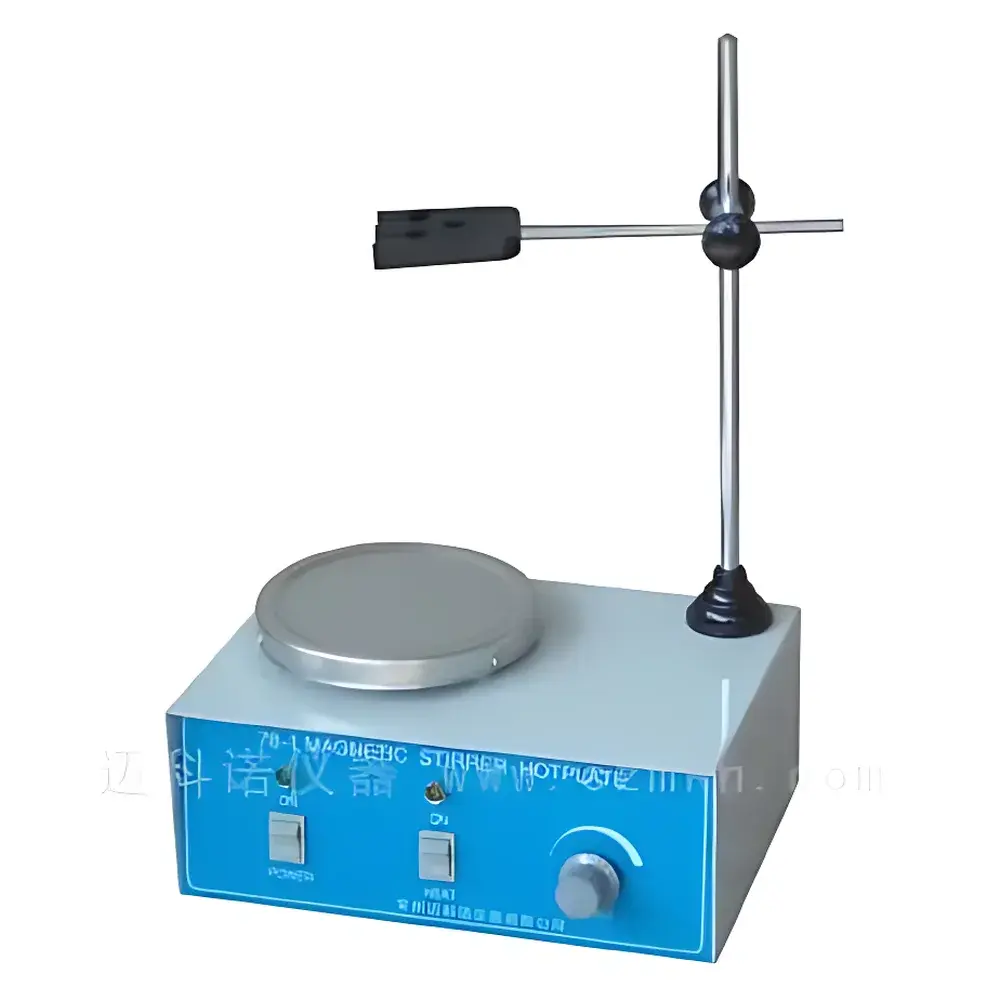
MKN 78-1 Magnetic Hotplate Stirrer
| Brand | MKN |
|---|---|
| Model | 78-1 |
| Power Supply | 220 V ±10%, 50 Hz ±2% |
| Max. Stirring Volume | 3000 mL |
| Speed Range | 0–2000 rpm (continuously adjustable) |
| Heating Power | 200 W |
| Motor Power | 25 W |
| Stirring Plate Material | Stainless Steel |
| Stir Bar Compatibility | PTFE-coated or PTFE/glass encapsulated magnetic stir bars |
| Operating Environment | Indoor laboratory, ambient temperature 5–40 °C, relative humidity ≤80% RH |
Overview
The MKN 78-1 Magnetic Hotplate Stirrer is an engineered solution for precise, reproducible liquid mixing and controlled thermal conditioning in analytical, quality control, and research laboratories. It operates on the principle of magnetic coupling: a rotating permanent magnet beneath the heated ceramic or stainless steel plate induces synchronous rotation of a magnetic stir bar immersed in the sample vessel. This contactless drive mechanism eliminates mechanical shaft seals and bearing wear—ensuring long-term reliability, low maintenance, and contamination-free operation. Integrated resistive heating provides uniform surface temperature distribution across the plate, enabling simultaneous stirring and temperature stabilization—a critical requirement for dissolution testing, buffer preparation, reagent synthesis, and kinetic studies where thermal homogeneity directly affects reaction rates and measurement fidelity.
Key Features
- Brushless DC motor delivering smooth, vibration-minimized rotation from 0 to 2000 rpm with continuous analog speed control—optimized for both low-viscosity solvents and moderately viscous aqueous or organic solutions.
- Stainless steel heating plate offering corrosion resistance, mechanical durability, and consistent thermal conductivity—designed to withstand repeated exposure to mild acids, bases, and organic solvents encountered in routine lab workflows.
- Thermally stable platform supporting sealed vessels (e.g., capped Erlenmeyer flasks, screw-top bottles) without compromising mixing efficiency—enabling inert-atmosphere reactions or volatile solvent handling under controlled conditions.
- PTFE-compatible stir bar interface: accommodates standard cylindrical, oval, and cross-shaped stir bars with fluoropolymer coatings or glass-encapsulated cores—ensuring chemical inertness up to 250 °C and resistance to abrasion during prolonged agitation.
- Compact benchtop footprint (approx. 160 × 140 × 100 mm) with integrated heat-sink design—minimizing peripheral thermal radiation and supporting safe multi-unit deployment in high-density lab environments.
Sample Compatibility & Compliance
The MKN 78-1 supports volumetric ranges from 20 mL to 3000 mL in standard laboratory glassware (e.g., beakers, flasks, graduated cylinders), provided vessel geometry allows adequate stir bar mobility and thermal contact with the plate surface. It is not intended for use with metal containers, vacuum-sealed systems, or highly exothermic reactions exceeding 200 W sustained thermal load. While not certified to IEC 61010-1 for hazardous location use, the unit complies with general safety requirements for Class I, Pollution Degree 2 laboratory equipment. Its construction and operational parameters align with common institutional SOPs governing GLP-compliant sample preparation and USP dissolution apparatus auxiliary functions—though it does not constitute a regulated dissolution tester itself.
Software & Data Management
As a manually operated analog instrument, the MKN 78-1 does not incorporate digital controllers, data logging, or software interfaces. Speed and heating output are adjusted via front-panel rotary dials with tactile feedback and calibrated visual indicators. This architecture ensures electromagnetic compatibility (EMC) stability in proximity to sensitive instrumentation (e.g., balances, pH meters, spectrophotometers) and eliminates firmware-related validation burdens under FDA 21 CFR Part 11 or ISO/IEC 17025 frameworks. For laboratories requiring audit-trail documentation, external digital thermometers or tachometers may be employed alongside standard operating procedures to record setpoints and observed performance at defined time intervals.
Applications
- Preparation of homogeneous calibration standards and reference solutions in environmental, pharmaceutical, and clinical chemistry labs.
- Heating-assisted dissolution of solid-phase reagents (e.g., salts, polymers, APIs) prior to filtration or spectroscopic analysis.
- Controlled-temperature mixing during titration setup, buffer equilibration, and mobile phase degassing in HPLC workflows.
- Supporting enzymatic assays where substrate dispersion and thermal stabilization at 25–60 °C are prerequisites for kinetic reproducibility.
- Routine maintenance of culture media, nutrient broths, and wash buffers in microbiology and cell biology laboratories.
FAQ
Can the MKN 78-1 be used with plastic or disposable containers?
Yes—provided the container base is flat, non-magnetic, and thermally stable up to 120 °C; however, optimal heat transfer and stir bar responsiveness are achieved with borosilicate glassware.
Is overheat protection built into the unit?
No autonomous thermal cutoff is included; users must monitor plate temperature manually or employ an external contact thermometer—especially when operating near maximum power for extended durations.
What stir bar size is recommended for 2000 mL volumes?
A 40–50 mm elliptical or cross-shaped PTFE-coated stir bar is typically effective; selection should prioritize rotational stability over peak speed, particularly with viscosities above 50 mPa·s.
Does the device meet RoHS or CE marking requirements?
While constructed using RoHS-conformant materials, the unit lacks formal CE marking due to its classification as a non-automated, non-medical, non-explosive environment device under current EU directives.
Can multiple units be operated simultaneously on the same circuit?
Yes—provided the aggregate load remains below 80% of the circuit’s rated capacity (e.g., ≤1.92 kW on a 2.4 kW / 10 A @ 240 V circuit); voltage drop mitigation is advised for installations with >3 units per branch.



