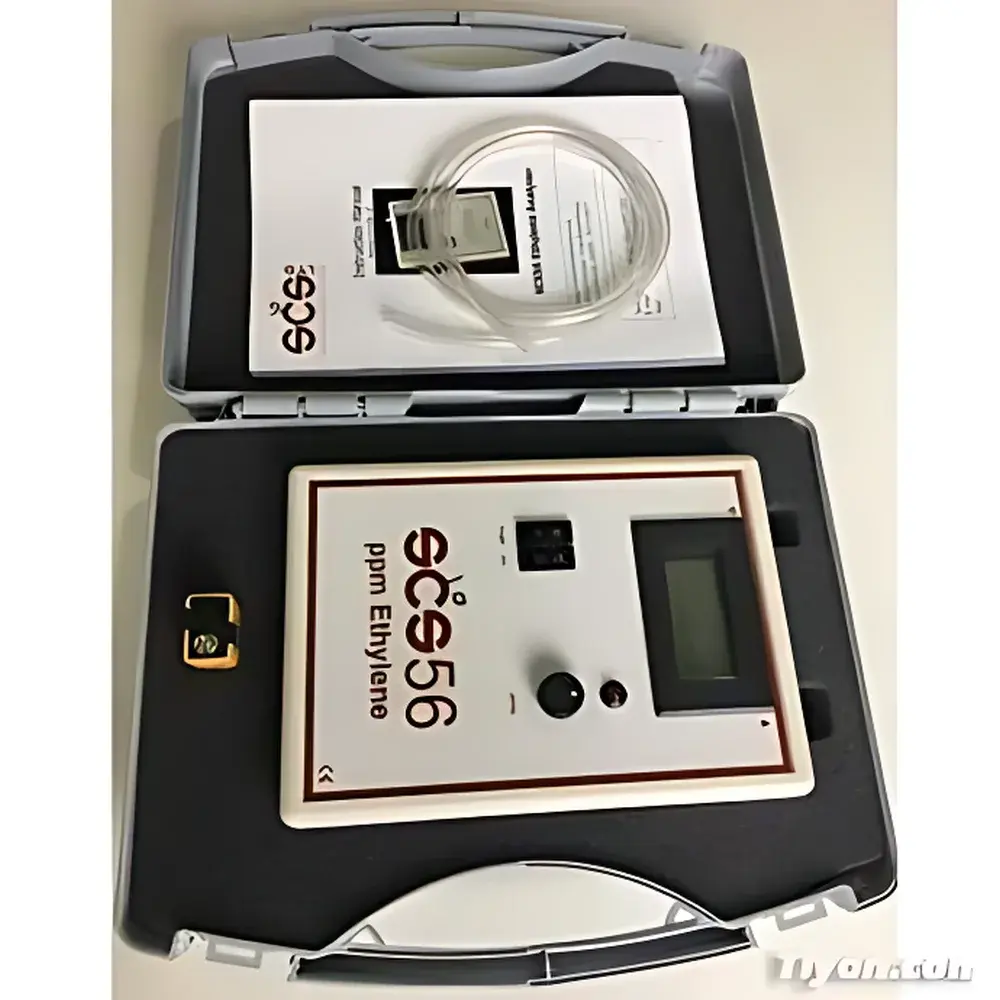
SCS SCS56 Portable Ethylene Analyzer
| Brand | SCS |
|---|---|
| Origin | United Kingdom |
| Model | SCS56 |
| Measurement Range | 0–100 ppm |
| Resolution | 0.2 ppm |
| Response Time (90%) | ≤60 s |
| Sample Flow Rate | 0.8 L/min |
| Power Supply | 9 V alkaline battery (MN1604 / PP3) |
| Battery Life | >20 h continuous operation |
| Dimensions | 190 × 135 × 60 mm |
| Sensor Cross-Sensitivity | CO: 40%, Ethanol: 72%, H₂S: 220%, MEK: 3%, CO₂: 0%, H₂: 0%, NH₃: 0% |
| Operating Environment | Ambient light/dark conditions with visual display |
Overview
The SCS SCS56 Portable Ethylene Analyzer is a dedicated electrochemical gas detection instrument engineered for quantitative measurement of ethylene (C₂H₄) concentration in agricultural storage, post-harvest physiology, and controlled atmosphere (CA) environments. It operates on the principle of selective amperometric sensing, where ethylene undergoes oxidation at a catalytic working electrode, generating a current proportional to gas concentration. Unlike non-specific metal-oxide or PID-based sensors, the SCS56 employs a proprietary electrochemical cell optimized for low-concentration ethylene detection in complex biological matrices—enabling reliable assessment of fruit ripening status, CA room ventilation efficacy, and ethylene scrubber performance. Its 0.2 ppm resolution meets the sensitivity requirements for monitoring ethylene thresholds critical to climacteric fruit physiology (e.g., apple, banana, tomato), where concentrations as low as 0.1–1.0 ppm significantly influence respiration rate and softening kinetics.
Key Features
- Portable, handheld design with integrated sampling pump and real-time digital display for field-deployable operation in cold stores, CA chambers, and packing houses.
- Electrochemical sensor with documented cross-sensitivity profile—validated against CO, ethanol, H₂S, and common atmospheric interferents per ISO 12039 and ASTM D6205 test protocols.
- On-board data logging capability (optional firmware upgrade) supports GLP-compliant record retention for quality assurance audits.
- Self-calibrating architecture: periodic sensor activation via internal circuitry maintains baseline stability over extended deployment cycles (typical drift <2% FS/month).
- Robust mechanical housing rated IP54 for dust and splash resistance, suitable for humid post-harvest environments.
- Low-power electronics optimized for 9 V PP3 battery operation—enabling >20 hours of continuous sampling without external power.
Sample Compatibility & Compliance
The SCS56 is validated for use with ambient air samples containing up to 100% relative humidity and particulate load typical of fruit storage facilities. It is not intended for use in explosive atmospheres (ATEX/IECEx zones), petrochemical process streams, or natural gas pipelines due to elevated H₂S and hydrocarbon interference risks. The analyzer complies with EN 50104 (gas detectors for toxic gases) for electrical safety and electromagnetic compatibility (EMC Directive 2014/30/EU). While not certified for medical device use, its measurement uncertainty (±5% of reading ±0.1 ppm) aligns with ISO 5725-2 repeatability criteria for routine agricultural QC applications. Regulatory documentation—including Declaration of Conformity and sensor calibration certificates—is supplied with each unit.
Software & Data Management
Data output is provided via RS-232 serial interface (optional USB adapter available), supporting direct integration into LabVIEW, MATLAB, or custom SCADA systems for centralized environmental monitoring. Firmware version 2.1+ enables timestamped CSV export with audit trail metadata (operator ID, location tag, calibration date). For regulated environments (e.g., USDA GAP-certified packing facilities), optional 21 CFR Part 11-compliant software modules provide electronic signature support, user access control, and immutable data archiving—fully traceable through instrument serial number and sensor lot code.
Applications
- Real-time monitoring of ethylene buildup in refrigerated warehouses and controlled-atmosphere storage rooms for apples, pears, kiwifruit, and avocados.
- Validation of ethylene scrubber efficiency (e.g., potassium permanganate or catalytic oxidation units) during commissioning and routine maintenance.
- Post-harvest research: correlation of ethylene emission rates with ACC oxidase activity, respiration quotient (RQ), and firmness loss in longitudinal ripening trials.
- Quality control in fresh-cut produce processing lines where ethylene cross-contamination must be minimized.
- Calibration verification of fixed-mount ethylene analyzers using NIST-traceable standard gas mixtures (e.g., 1 ppm C₂H₄ in synthetic air).
FAQ
Can the SCS56 be used in natural gas or refinery settings?
No. Due to high cross-sensitivity to hydrogen sulfide (220%) and hydrocarbons, it is unsuitable for petrochemical applications per IEC 60079-29-1 guidelines.
What is the recommended calibration frequency?
Factory calibration is valid for 12 months; field verification with 1 ppm ethylene standard gas is advised before each daily shift in critical storage operations.
Does the instrument require zero-gas exposure between measurements?
No. The electrochemical cell features automatic zero compensation during standby; however, ambient air purging for 60 seconds is recommended prior to high-accuracy readings.
Is the battery replaceable in the field?
Yes. The MN1604 (PP3) 9 V alkaline battery is user-replaceable without tools; battery compartment is sealed to IP54 rating.
How is sensor longevity affected by high-H₂S environments?
Prolonged exposure (>10 ppm H₂S for >2 hours) may cause irreversible electrode poisoning; use only in environments where H₂S is confirmed below 0.5 ppm.
Related Products