
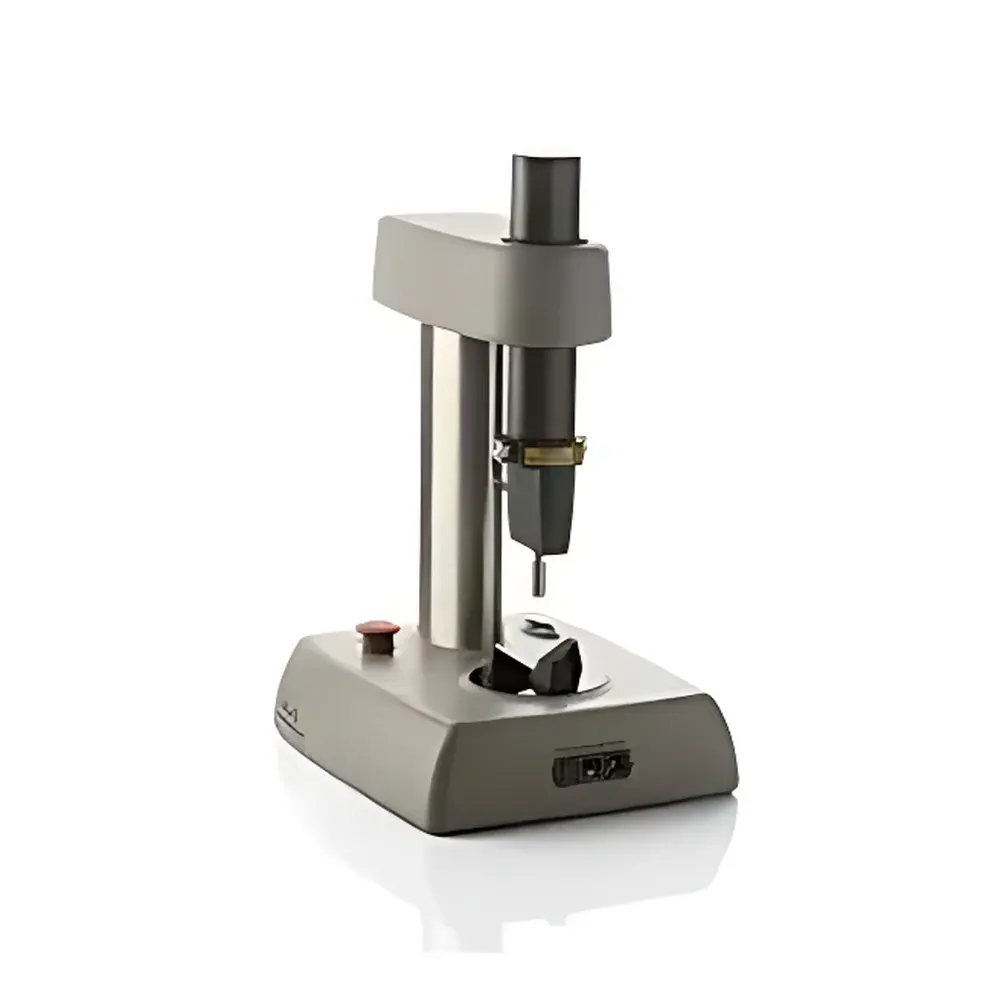
Tlyon FTA Fruit Texture Analyzer
| Brand | Tlyon |
|---|---|
| Origin | South Africa |
| Model | FTA |
| Force Measurement Range | 0–15 kg (GS-15) / 0–25 kg (GS-25) |
| Force Resolution | 0.02 kg / 0.04 lb / 0.2 N |
| Probe Speed | 5–35 mm/s |
| Weight Capacity | 30–14,000 g (GS-15) / 30–20,000 g (GS-25) |
| Diameter Measurement Range | 12–100 mm |
| Max Sample Diameter | 120 mm |
| Repeatability | ±0.5% (GS-15) / ±0.4% (GS-25) |
| Power Supply | 110 V or 220 V AC, 50/60 Hz |
| Power Consumption | 100 W (GS-15) / 120 W (GS-25) |
| Interface Options | RS-232, USB, optional EFM, barcode scanner, LCD/keyboard module |
Overview
The Tlyon FTA Fruit Texture Analyzer is a precision-engineered instrumental system designed for objective, standardized quantification of mechanical properties in fresh and processed fruits. Based on the fundamental principle of controlled-force penetration testing—where a calibrated cylindrical probe (typically 8 mm or 11 mm diameter) is driven at a defined speed into the fruit tissue—the FTA measures peak resistance force (hardness), deformation depth, and time-dependent response profiles. This method aligns with internationally recognized texture evaluation protocols including ASTM F3192-19 (Standard Guide for Instrumental Texture Testing of Fruits and Vegetables) and ISO 11348-2 (Sensory analysis—Methodology—General guidance for texture profile analysis). Unlike subjective manual penetrometers, the FTA eliminates operator-induced variability through motorized probe actuation, real-time velocity regulation, and digital signal acquisition synchronized with load-cell transduction. Its architecture supports traceable, repeatable measurements across diverse cultivars—including apple, pear, peach, nectarine, plum, citrus, kiwifruit, melon, tomato, mango, and olive—enabling consistent quality assessment throughout harvest, storage, ripening, and post-harvest processing workflows.
Key Features
- Motor-driven probe with electronically regulated speed (5–35 mm/s), ensuring compliance with standardized test conditions per USP & ISO guidelines
- High-precision dual-range load cell (GS-15: 0–15 kg; GS-25: 0–25 kg) with resolution of 0.02 kg and repeatability better than ±0.5%
- Integrated multi-parameter acquisition: simultaneous capture of hardness (kg, lb, N), penetration depth (mm/in), weight (g), and equatorial diameter (mm)
- Modular accessory interface supporting optional EFM-based dimensional sensors, calibrated weighing modules, and standalone LCD/keyboard display units
- Configurable test parameters via PC software: probe speed, pre-test dwell time, trigger threshold, maximum penetration depth, zero calibration sequence
- Compliance-ready data handling: timestamped raw output with audit trail capability; export to CSV, Excel (.xlsx), Word (.docx), and Access (.accdb) formats
- Robust industrial-grade chassis (≈12 kg), designed for laboratory, packinghouse, and field-deployable use without recalibration between environments
Sample Compatibility & Compliance
The FTA accommodates whole, halved, or sectioned fruits up to 120 mm in maximum dimension. Its probe geometry and force range are optimized for mesocarp-dominated tissues (e.g., apple cortex, kiwifruit flesh, tomato pericarp) while remaining compatible with denser structures such as olive pulp and mango endocarp. All measurement protocols conform to GLP-aligned documentation standards, supporting FDA 21 CFR Part 11-compliant electronic records when used with validated software configurations. The system meets CE marking requirements for electromagnetic compatibility (EN 61326-1) and low-voltage safety (EN 61010-1). Optional barcode integration enables sample-level traceability linked to LIMS or ERP systems—critical for QC/QA reporting in certified packing facilities operating under GLOBALG.A.P., BRCGS Food Safety, or IFS Logistics standards.
Software & Data Management
The proprietary Tlyon FTA Control Suite provides a Windows-based interface for test method definition, real-time waveform visualization, and batch result aggregation. Each measurement session logs force–displacement curves with millisecond temporal resolution, allowing post-acquisition analysis of yield point, elastic modulus, and work-of-penetration. Software-configurable pass/fail limits support automated sorting decisions in grading applications. Audit trails record user ID, parameter settings, calibration status, and environmental timestamps—fully compliant with ALCOA+ principles (Attributable, Legible, Contemporaneous, Original, Accurate, Complete, Consistent, Enduring, Available). Data exports retain full metadata, enabling seamless import into statistical process control (SPC) platforms such as Minitab, JMP, or custom Python/R analytics pipelines.
Applications
- Ripeness monitoring during cold chain logistics and shelf-life studies
- Pre-harvest maturity indexing to optimize picking windows
- Post-harvest quality assurance in packhouses and distribution centers
- Varietal comparison and breeding program phenotyping
- Formulation development for minimally processed fruit products
- Regulatory compliance testing for export certification (e.g., USDA, EU Commission Regulation No. 1308/2013)
- Research into enzymatic softening kinetics and cell wall degradation mechanisms
FAQ
What standards does the FTA comply with for fruit texture testing?
The FTA implements methodologies aligned with ASTM F3192-19, ISO 11348-2, and USP <1059> on mechanical testing of botanical materials. Its force calibration traceability follows ISO/IEC 17025-accredited procedures.
Can the FTA be used without a computer connection?
Yes—optional LCD/keyboard modules enable fully autonomous operation with on-device display of hardness, diameter, and weight values, plus local parameter configuration.
Is calibration required before each use?
No. The system features automatic zeroing routines and factory-calibrated load cells with documented uncertainty budgets; periodic verification using NIST-traceable weights is recommended every 6 months.
Does the FTA support GMP/GLP documentation requirements?
When deployed with validated software and controlled access protocols, it supports 21 CFR Part 11-compliant electronic signatures, audit trails, and secure data archiving.
What is the maximum fruit size the FTA can accommodate?
The instrument accepts samples up to 120 mm in diameter; optional fixtures allow stable positioning of irregularly shaped specimens including oblate or elongated cultivars.




