
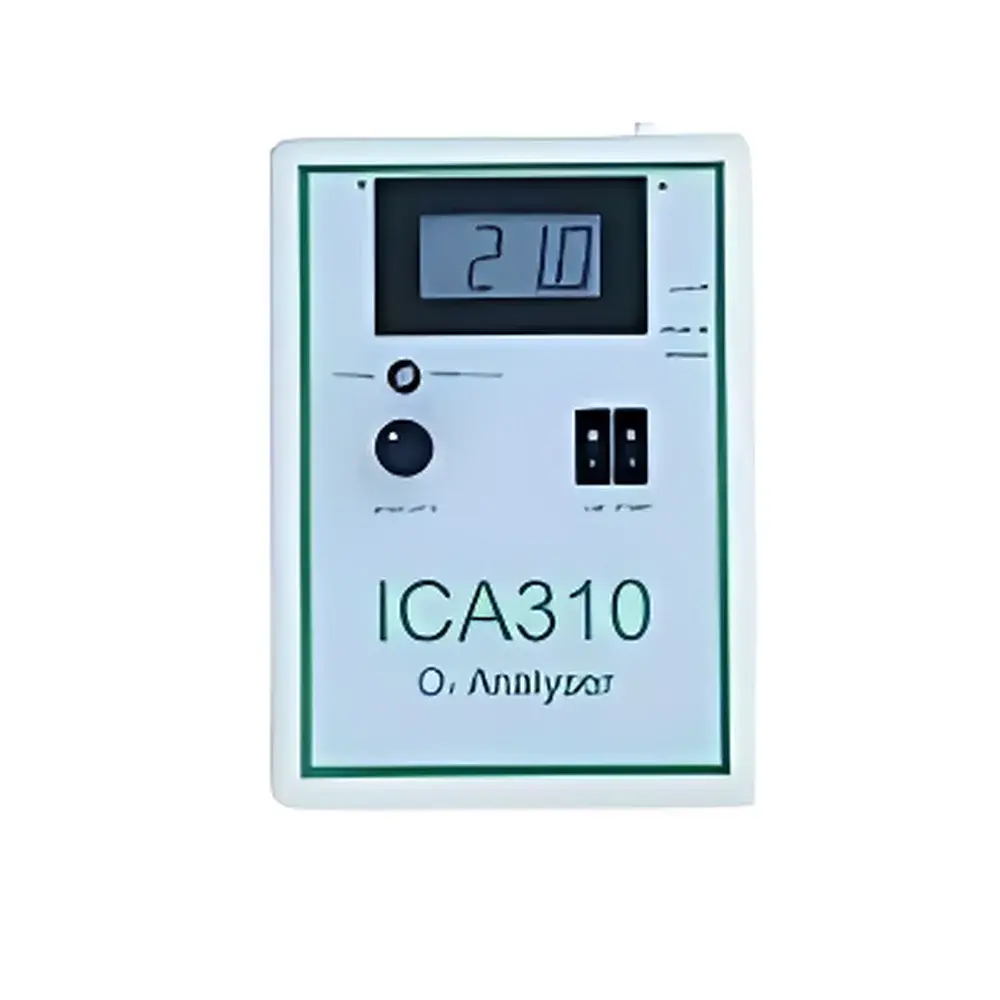
ICA ICA310 Oxygen Analyzer
| Brand | ICA |
|---|---|
| Origin | United Kingdom |
| Model | ICA310 |
| Measurement Range (High) | 10–25% O₂, Repeatability: ±0.1%, Resolution: 0.1% |
| Measurement Range (Low) | 0–10% O₂, Repeatability: ±0.02%, Resolution: 0.01% |
| Response Time (99%) | ≤20 s |
| Sampling Flow Rate | 0.7 L/min |
| Battery | NiMH rechargeable, 30+ hours runtime, 4-year service life |
| Dimensions | 190 × 135 × 60 mm |
| Data Logger Option | 32,000 readings, programmable interval from 1 s to 12 hrs/read |
| Power Options | Internal battery + AC adapter (universal plug options available) |
| USB Interface | Optional data transfer module for PC connectivity |
Overview
The ICA ICA310 Oxygen Analyzer is a portable, electrochemical-based gas analyzer engineered for high-precision measurement of oxygen concentration in low-oxygen environments typical of post-harvest physiology, controlled-atmosphere storage, and plant respiration studies. It operates on a galvanic fuel cell principle—requiring no external power to generate signal—ensuring stable baseline performance and long-term calibration integrity. Unlike paramagnetic or zirconia-based analyzers, the ICA310’s electrochemical sensor delivers inherently selective O₂ response with minimal cross-sensitivity to CO₂, CO, H₂, ethylene, and other common hydrocarbon gases encountered in agricultural and horticultural settings. Its dual-range architecture automatically switches between high-resolution (0.01%) mode below 10% O₂ and standard resolution (0.1%) above 10% O₂—enabling accurate quantification across both hypoxic storage conditions (e.g., apple CA rooms at 1.5–3% O₂) and ambient-air reference measurements (20.9% O₂). The integrated miniature diaphragm pump ensures consistent sample draw at 0.7 L/min, while built-in particulate and chemical filtration protects sensor integrity during extended field deployment.
Key Features
- Dual-range electrochemical O₂ sensor with automatic range switching at 10% O₂ threshold
- Resolution of 0.01% O₂ in 0–10% range; 0.1% O₂ in 10–25% range
- Repeatability of ±0.02% (0–10% O₂) and ±0.1% (10–25% O₂)
- Response time (t₉₉) ≤20 seconds—optimized for dynamic respiration assays and rapid atmosphere transitions
- Onboard air calibration function adjustable for barometric pressure drift and sensor aging compensation
- Rechargeable NiMH battery (30+ hours continuous operation; 4-year functional lifespan)
- One-button pump control with audible and visual status indicators
- Optional USB data interface for real-time streaming or batch download to Windows-based analysis software
- Configurable internal data logger supporting up to 32,000 timestamped readings (sampling interval: 1 second to 12 hours)
Sample Compatibility & Compliance
The ICA310 is validated for direct measurement of headspace gases from sealed containers, flow-through cuvettes, and static storage chambers used in plant physiology research—including but not limited to fruit ripening chambers, seed viability assays, and root-zone hypoxia experiments. Its robust inlet filtration system tolerates particulate-laden air and moderate humidity without condensation risk. The instrument complies with IEC 61000-4 electromagnetic compatibility standards and meets CE marking requirements for portable laboratory instrumentation. While not certified for hazardous area use (ATEX/IECEx), it is routinely deployed in ISO 17025-accredited labs performing method validation per ASTM D6348 (standard test method for determining oxygen in gaseous samples) and aligned with FAO/WHO guidelines for controlled-atmosphere storage monitoring. Sensor replacement is user-serviceable without recalibration tools—each new cell ships with factory calibration certificate traceable to NPL (National Physical Laboratory, UK).
Software & Data Management
The optional USB data processor enables direct connection to Windows PCs running ICA’s proprietary LogView v3.x software (compatible with Windows 10/11, 64-bit). This application supports real-time graphing, multi-channel overlay (when paired with optional CO₂ or temperature modules), automated report generation (PDF/CSV), and audit-trail-enabled data export compliant with GLP documentation requirements. All logged data include embedded timestamps, battery voltage, pump status, and calibration event markers. For integration into larger experimental platforms, ASCII serial output (RS-232 over USB virtual COM port) allows seamless interfacing with LabVIEW, MATLAB, or custom Python-based acquisition scripts—facilitating synchronization with photosynthesis systems (e.g., LI-6400XT) or environmental controllers.
Applications
- Controlled-atmosphere (CA) storage monitoring for apples, pears, kiwifruit, and onions
- In situ root-zone O₂ profiling in hydroponic and aeroponic systems
- Post-harvest respiration rate determination under variable O₂ tensions
- Seed dormancy and germination studies involving hypoxic preconditioning
- Validation of modified-atmosphere packaging (MAP) integrity for fresh-cut produce
- Field-deployable assessment of soil gas composition in flooded rice paddies or compacted soils
- Educational use in plant physiology laboratories for hands-on respiratory biochemistry instruction
FAQ
Does the ICA310 require periodic factory recalibration?
No—field calibration using ambient air is sufficient for most applications. A full two-point calibration (zero + span) is only recommended annually or after sensor replacement.
Can the instrument operate continuously while charging?
Yes—the internal NiMH battery charges passively during AC adapter use, enabling uninterrupted operation during long-term chamber monitoring.
Is the sensor affected by high CO₂ concentrations commonly found in CA rooms?
No—electrochemical O₂ sensors in the ICA310 exhibit negligible interference from CO₂ up to 20% v/v, as confirmed by independent testing per ISO 12039 Annex B.
What is the recommended maintenance schedule for the inlet filter?
Inspect before each field deployment; replace every 6 months under typical agricultural use or immediately after exposure to dusty or high-humidity environments.
How is data integrity ensured during extended logging sessions?
All stored readings include CRC-16 checksums and internal clock synchronization; power-loss recovery preserves last valid record and resumes logging upon reboot.





