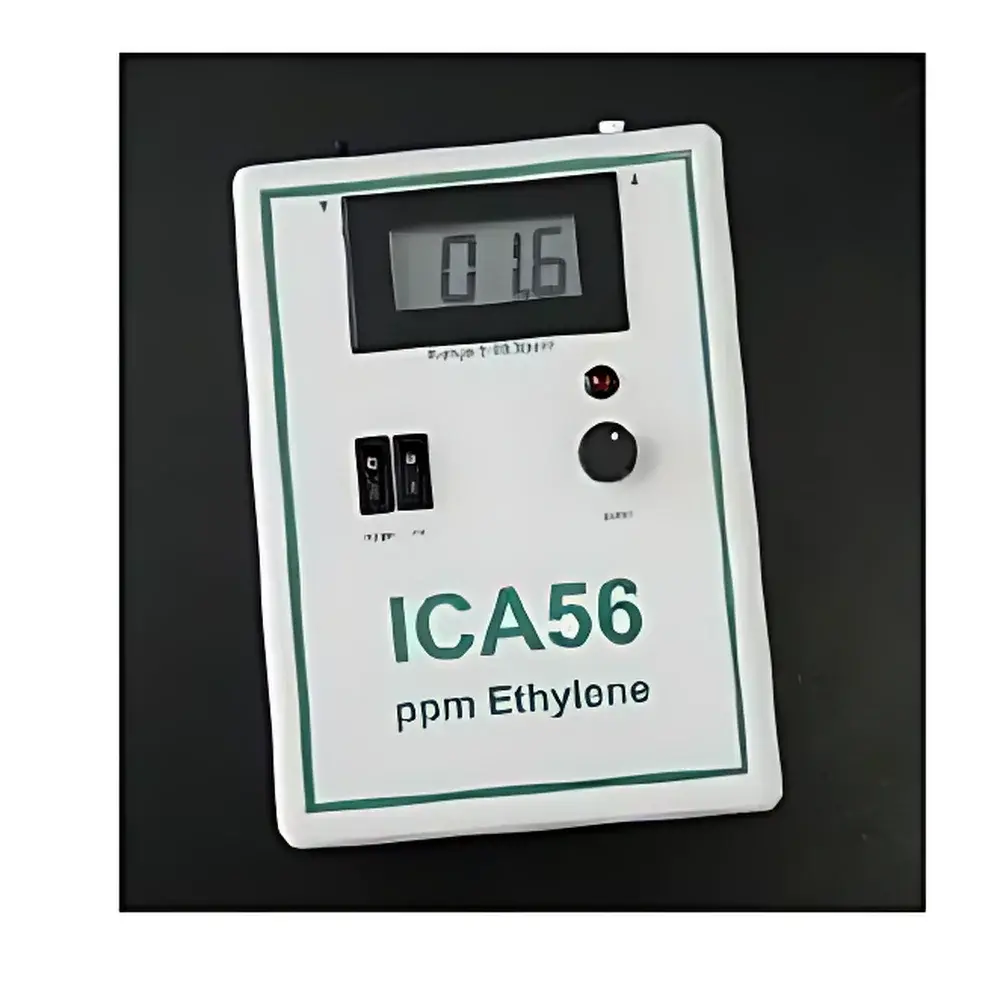
ICA56 Ethylene Analyzer
| Brand | ICA |
|---|---|
| Origin | United Kingdom |
| Manufacturer Type | Authorized Distributor |
| Import Status | Imported |
| Model | ICA56 |
| Measurement Range | 0–100 ppm |
| Resolution | 0.2 ppm (sensor), 0.1 ppm (accuracy) |
| Response Time | t₉₀ ≤ 60 s |
| Sample Flow Rate | 0.8 L/min |
| Power Supply | 9 V alkaline battery (MN1604 / PP3) |
| Battery Life | ≥20 h (pump operation), 1.5–2 years (sensor stabilization) |
| Dimensions | 190 × 135 × 60 mm |
| Cross-Sensitivity | CO: 40%, Ethanol: 72%, H₂S: 220%, MEK: 3%, CO₂: 0%, H₂: 0%, NH₃: 0% |
Overview
The ICA56 Ethylene Analyzer is a field-deployable, electrochemical gas detection instrument engineered for precise, real-time quantification of ethylene (C₂H₄) in ambient and controlled-environment settings. It operates on the principle of selective amperometric sensing, where ethylene undergoes oxidation at a catalytic working electrode, generating a current linearly proportional to gas concentration within the 0–100 ppm range. Unlike broad-spectrum hydrocarbon sensors, the ICA56 employs a proprietary electrode formulation and integrated chemical filter stack to suppress interference from common background gases—demonstrating zero cross-sensitivity to CO₂ and H₂, critical for agricultural storage and post-harvest physiology applications. Its compact form factor, integrated sampling pump, and onboard data logging make it suitable for longitudinal monitoring in fruit ripening chambers, cold stores, greenhouses, and plant growth facilities where ethylene accumulation directly impacts senescence, abscission, and stress signaling.
Key Features
- Electrochemical sensor with 0.2 ppm resolution and ±0.1 ppm accuracy across full 0–100 ppm measurement span
- Integrated diaphragm pump delivering stable 0.8 L/min sample flow; optimized for consistent mass transfer to sensor surface
- On-device LCD display with direct ppm readout and real-time trend visualization
- Internal microSD card logging (capacity not specified; compatible with standard FAT32-formatted cards) for timestamped concentration records
- Low-power architecture enabling >20 hours of continuous operation on a single 9 V alkaline (MN1604/PP3) battery
- Ruggedized ABS housing (190 × 135 × 60 mm) rated for laboratory and field use; no external power supply required
- Auto-zeroing function activated via periodic sensor refresh cycles, maintaining baseline stability over extended deployments
Sample Compatibility & Compliance
The ICA56 is validated for gaseous-phase analysis of ethylene in air, nitrogen, and CO₂-enriched atmospheres typical of controlled atmosphere (CA) storage and modified atmosphere packaging (MAP) research. It complies with ISO 11357-5 for polymer degradation gas analysis methodology and aligns with ASTM D618 for environmental conditioning of plastic specimens where ethylene off-gassing is monitored. While not certified to ATEX or IECEx standards for hazardous area use, its design meets general-purpose safety requirements per IEC 61010-1 for laboratory electrical equipment. Cross-sensitivity profiles—particularly the high response to H₂S (220%) and ethanol (72%)—necessitate pre-screening of sample matrices; users must implement gas-phase scrubbers (e.g., activated carbon + lead acetate filters) when operating in environments containing these interferents. Zero response to CO₂ and H₂ ensures reliable deployment in respiration studies and fermentation headspace analysis.
Software & Data Management
Data export is facilitated via microSD card removal and PC-based CSV parsing; no proprietary software suite is required. Logged files include UTC timestamps, raw sensor voltage, temperature-compensated ppm values, and pump status flags. The device supports GLP-compliant recordkeeping: each measurement entry contains immutable metadata (device ID, battery voltage, sensor age estimate), enabling traceability in quality-controlled horticultural trials. Though not FDA 21 CFR Part 11 compliant out-of-the-box (lacking electronic signature and audit trail modules), the logged data structure conforms to ALCOA+ principles (Attributable, Legible, Contemporaneous, Original, Accurate, Complete, Consistent, Enduring, Available) when archived with appropriate institutional metadata protocols.
Applications
- Post-harvest physiology: Monitoring ethylene evolution during fruit ripening (e.g., bananas, tomatoes, apples) and evaluating 1-MCP treatment efficacy
- Controlled environment agriculture: Diagnosing ventilation inefficiencies in cold storage units and validating ethylene scrubber performance
- Plant stress phenotyping: Quantifying wound-induced ethylene bursts in leaf tissue assays and root hypoxia experiments
- Seed dormancy and germination studies: Correlating endogenous ethylene dynamics with dormancy release under light/temperature modulation
- Bioreactor off-gas analysis: Screening microbial ethylene production in engineered Pseudomonas or Rhizobium strains
- Quality assurance in floriculture: Ensuring ethylene levels remain below 0.05 ppm in cut-flower transit containers
FAQ
What is the recommended calibration frequency for the ICA56?
Calibration is advised before each critical measurement campaign using certified 10 ppm ethylene standard gas in air; zero calibration may be performed with filtered ambient air.
Can the ICA56 be used in high-humidity environments?
Yes—the sensor module includes hydrophobic membrane protection; however, condensation must be prevented via inlet desiccant or heated sampling lines if RH exceeds 90% for prolonged periods.
Does the device support analog output or external data acquisition?
No—the ICA56 provides standalone readout and SD logging only; it lacks RS-232, USB, or 4–20 mA interfaces.
How does sensor drift affect long-term measurements?
Electrochemical sensors exhibit gradual sensitivity loss; the manufacturer specifies a typical functional lifetime of 18–24 months under normal use, after which recalibration or sensor replacement is required.
Is the ICA56 suitable for soil headspace analysis?
Only when coupled with a gas-tight syringe or dynamic headspace sampler; direct insertion into soil is not supported due to mechanical and moisture exposure constraints.