
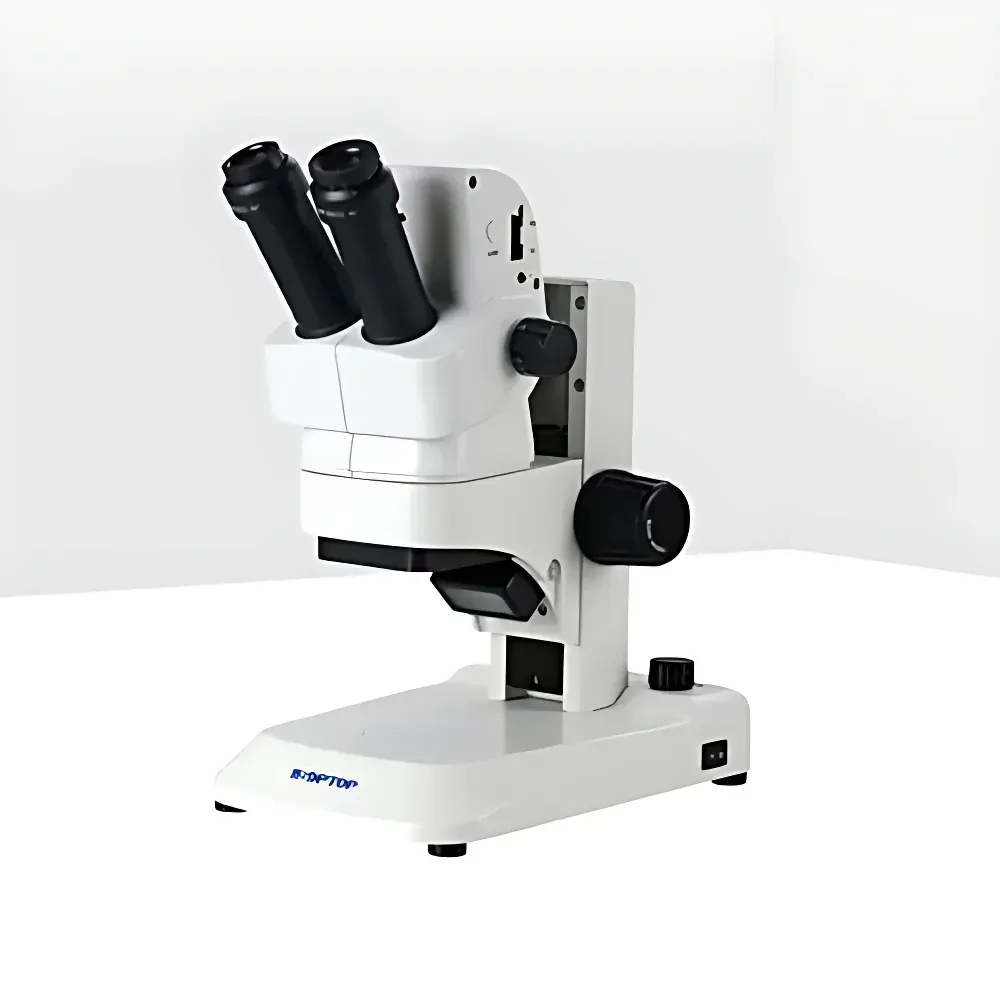
Jihepu EZ460D Continuous Zoom Stereo Microscope
| Brand | Jihepu |
|---|---|
| Origin | Shandong, China |
| Model | EZ460D |
| Total Magnification Range | 8×–35× |
| Zoom Ratio | 0.8×–3.5× |
| Field Diameter | 7 mm |
| Working Distance | 95 mm |
| Objective Type | Continuous Zoom Objective |
| Illumination | Dual LED (Top & Bottom), 5 W each |
| Depth of Field | 92 mm |
| Numerical Aperture Equivalent | 0.05–0.075 (calculated from effective focal length and working distance) |
| Integrated Imaging | 4 MP CMOS sensor (2688 × 1520 resolution) |
| Viewing Angle | 60° inclined binocular head |
| Interpupillary Adjustment Range | 50–75 mm |
| Focus Travel | 92 mm |
| Power Input | 100–240 V AC |
Overview
The Jihepu EZ460D Continuous Zoom Stereo Microscope is an ergonomically engineered optical instrument designed for routine inspection, quality control, electronics assembly, biological dissection, and educational microscopy applications requiring true stereoscopic visualization and real-time digital documentation. Based on the Greenough optical design principle—employing two separate, parallel optical paths—the EZ460D delivers natural depth perception and undistorted upright images without image inversion. Its continuously variable zoom system (0.8×–3.5×) enables seamless magnification transitions across the full 8×–35× total range when paired with wide-field eyepieces (10×, 15×, or 20×), eliminating discrete step changes that disrupt workflow continuity. The microscope features a fixed 95 mm working distance across the entire zoom range—a critical advantage for hands-on manipulation of samples under observation—and maintains consistent parfocality and telecentricity to ensure minimal focus shift during zooming.
Key Features
- 60° inclined binocular observation head with adjustable interpupillary distance (50–75 mm) and individual diopter compensation for both eyepieces, supporting extended user comfort during prolonged use.
- Integrated 4-megapixel CMOS imaging module (2688 × 1520 resolution) with onboard SD card slot (4 GB Kingston SD included), USB 2.0 interface, and composite analog video output (RCA) for direct connection to monitors or legacy recording systems.
- Dual independent 5 W high-intensity LED illumination system: top-light angle is fully adjustable (0°–90° tilt), bottom-light provides uniform transmitted illumination; both sources support continuous brightness control and simultaneous activation.
- Robust vertical arm stand with 92 mm coarse focus travel and friction-adjustable fine-focus mechanism, enabling precise Z-axis positioning even with heavy accessories or camera attachments.
- Optical path incorporates anti-reflective coated lenses and optimized light transmission design to maximize contrast and minimize chromatic aberration—critical for discerning fine surface textures and low-contrast biological structures.
Sample Compatibility & Compliance
The EZ460D accommodates a broad spectrum of opaque, translucent, and semi-transparent specimens—including PCBs, solder joints, botanical sections, entomological specimens, mineral fragments, and small mechanical components—without requiring sectioning or staining. Its 95 mm working distance permits use of standard tweezers, probes, and micro-manipulators within the field of view. While not certified to ISO/IEC 17025 or ASTM E2912 for metrological traceability, the system adheres to general laboratory equipment safety standards (IEC 61010-1) and supports GLP-compliant documentation workflows via timestamped image capture and SD-card-based audit trails. Optional calibration slide sets (NIST-traceable graticules) are available for semi-quantitative dimensional estimation.
Software & Data Management
The integrated imaging system operates in plug-and-play mode via USB 2.0 without proprietary drivers on Windows, macOS, or Linux platforms. Captured still images are saved in JPEG or BMP format directly to the removable SD card; no external software is required for basic acquisition. For advanced analysis, third-party microscopy software (e.g., ImageJ, Ocular, or Motic Images Plus) can access live video feed through UVC-compliant streaming. All stored files include embedded EXIF metadata (timestamp, magnification setting, illumination mode), facilitating traceable record-keeping in regulated environments where documentation integrity is essential per FDA 21 CFR Part 11 principles.
Applications
- Electronics manufacturing: solder joint inspection, component placement verification, and rework guidance under variable magnification.
- Academic teaching labs: comparative morphology studies, insect dissection, and plant anatomy demonstration with live digital projection capability.
- Materials science: surface defect identification (scratches, porosity, coating delamination) on metals, polymers, and composites.
- Jewelry and precision machining: gemstone grading, engraving verification, and micro-feature measurement using calibrated reticles.
- Forensic document examination: ink differentiation, paper fiber analysis, and indented writing recovery under oblique top lighting.
FAQ
Is the EZ460D compatible with third-party digital cameras?
Yes—via C-mount adapter (optional accessory), the trinocular port supports standard 1/3″ or 1/2″ sensor cameras.
Can the built-in LED illumination be replaced or upgraded?
The LEDs are soldered onto the housing PCB and not field-replaceable; however, their rated lifetime exceeds 20,000 hours at nominal brightness.
Does the microscope support measurement software integration?
Yes—when used with optional calibration slides and compatible third-party software, pixel-to-micron conversion and linear dimension annotation are supported.
What is the maximum usable field diameter at lowest magnification?
At 8× total magnification (0.8× objective + 10× eyepiece), the field diameter measures approximately 7 mm, consistent with standard stereo microscope specifications.
Is the focus mechanism backlash-free?
The coarse focus uses a dual-rack gear system with adjustable tension; while not zero-backlash, it exhibits <10 µm hysteresis under normal operational loads.





