
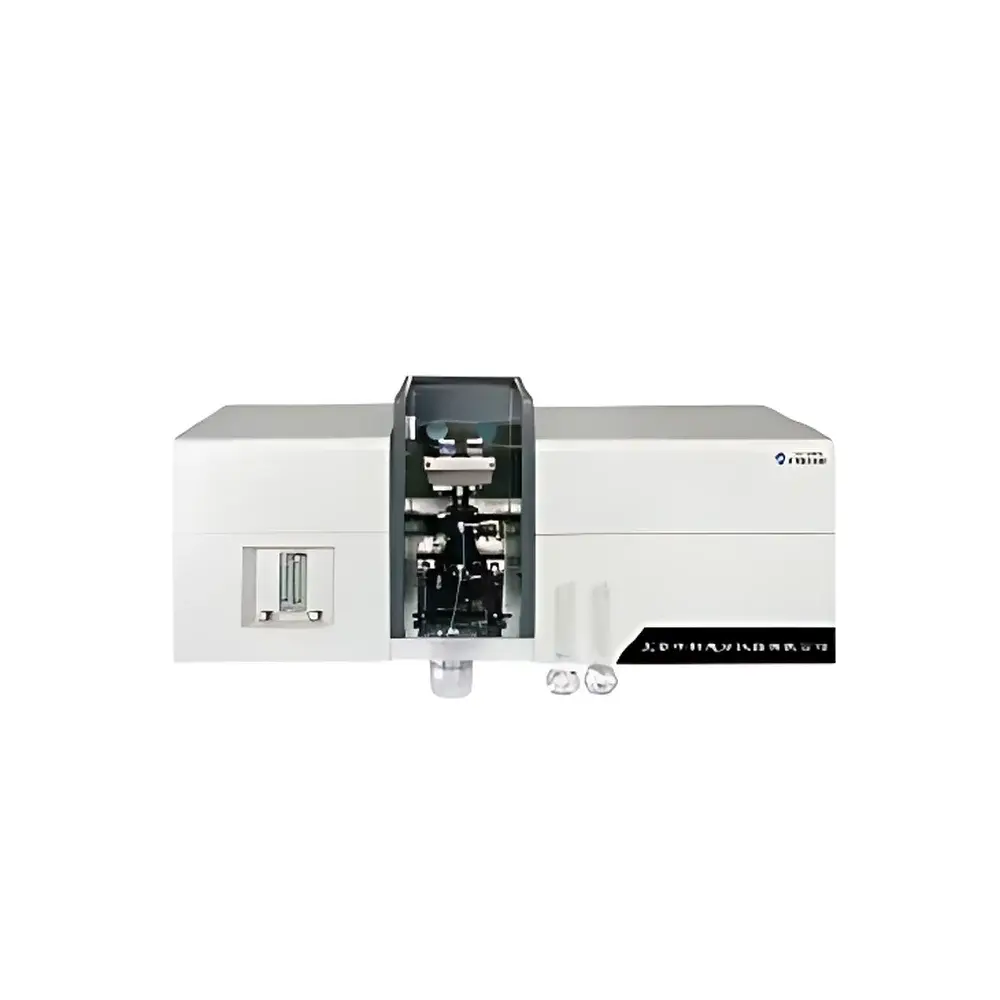
AA-720SFG Atomic Absorption Spectrometer
| Origin | Beijing, China |
|---|---|
| Manufacturer Type | Authorized Distributor |
| Origin Category | Domestic (PRC) |
| Model | AA-720SFG |
| Price Range | USD 7,000–14,000 |
| Instrument Type | Flame and Graphite Furnace AAS |
| Monochromator | Plane Grating |
| Optical System | Single-beam |
| Detector | Solid-state Photodetector |
| Background Correction | D₂ Lamp + Zeeman Correction |
| Resolution | Resolves Mn 279.5 nm and 279.8 nm doublet with valley intensity <20% |
| Sensitivity | 0.02 µg/mL per 1% absorption |
| Repeatability (RSD) | <0.8% |
| Detection Limit (Cu) | 0.003 µg/mL |
Overview
The AA-720SFG Atomic Absorption Spectrometer is a dual-mode benchtop instrument engineered for quantitative elemental analysis in environmental, clinical, pharmaceutical, and industrial quality control laboratories. It operates on the fundamental principle of atomic absorption spectroscopy (AAS), where ground-state free atoms in a flame or graphite furnace absorb characteristic radiation emitted by a hollow cathode lamp (HCL). The degree of absorption at a specific wavelength—determined by Beer-Lambert law—is directly proportional to the concentration of the analyte element in the sample. Designed for routine multi-element analysis, the AA-720SFG integrates flame atomization for higher-concentration samples (e.g., Ca, Mg, Na in water or food extracts) and electrothermal graphite furnace atomization for ultra-trace detection (e.g., Pb, Cd, As in biological tissues or drinking water). Its single-beam optical architecture, combined with an 1800-line/mm plane grating monochromator and Czerny-Turner mounting, ensures stable spectral dispersion across the full operational range of 190–900 nm.
Key Features
- Integrated flame and graphite furnace atomization modules—enabling flexible method selection without hardware reconfiguration
- Triple-lamp turret with automatic lamp positioning and energy optimization; two lamps remain preheated while one is active, minimizing warm-up delays between sequential analyses
- Dual background correction system: deuterium arc lamp correction (>60× correction factor) and Zeeman-effect correction (>60×), both compliant with ISO 11170 and ASTM D5863 for matrix interference mitigation
- Automated safety interlocks including real-time acetylene leak detection, flame-out shutdown, and gas pressure monitoring—fully aligned with EN 61010-1 and OSHA 1910.101 standards
- Variable spectral bandwidth selection (0.1, 0.2, 0.4, 1.0, 2.0 nm) via motorized slit control, supporting optimal resolution/sensitivity trade-offs per element
- High-stability optical path with low-drift (<0.002 A/30 min static, <0.006 A/30 min dynamic) and wavelength repeatability of ±0.05 nm
Sample Compatibility & Compliance
The AA-720SFG accommodates aqueous solutions, digested biological matrices, acidified environmental extracts, and diluted industrial process streams. Flame mode supports direct aspiration of samples up to 5 mL/min flow rate using a titanium alloy 100-mm burner head and corrosion-resistant plastic雾化室 (nebulizer chamber). Graphite furnace operation enables analysis of 5–30 µL volumes with integrated platform-assisted temperature programming. All analytical protocols adhere to regulatory frameworks including EPA Method 7000B (flame AAS), EPA Method 7010 (GFAAS), ISO 11170 (background correction validation), and USP for elemental impurities in pharmaceuticals. Instrument design supports GLP-compliant audit trails when used with validated software configurations.
Software & Data Management
The AA-720SFG runs on Windows XP/7-compatible native software featuring intuitive method setup, automated calibration curve generation (linear, quadratic, or forced-through-zero), and real-time signal integration. Software modules support peak-height and peak-area quantification for graphite furnace analysis, standard addition and internal standard correction, and automated RSD calculation across 1–30 replicate injections. Data export is natively supported to CSV, Excel (.xlsx), and Word (.docx) formats. While the base configuration does not include FDA 21 CFR Part 11-compliant electronic signatures or full audit trail functionality, the software architecture permits third-party validation for GMP environments under documented SOPs.
Applications
- Environmental testing: quantification of heavy metals (Pb, Cd, Cr, Ni) in soil leachates and wastewater per ISO 17294-2
- Clinical diagnostics: serum Zn, Cu, and Fe profiling using flame AAS with matrix-matched calibration
- Food safety: detection of toxic elements in infant formula and dietary supplements at sub-ppb levels via GFAAS
- Geochemical analysis: rapid screening of major and trace elements in rock digests using flame mode
- Pharmaceutical QC: verification of catalyst residues (e.g., Pd, Pt) in active pharmaceutical ingredients per ICH Q2(R2)
FAQ
What atomization techniques does the AA-720SFG support?
Flame atomization (using air-acetylene or nitrous oxide-acetylene gases) and electrothermal graphite furnace atomization.
Is the instrument compliant with international calibration standards?
Yes—wavelength accuracy (±0.10 nm), resolution (Mn 279.5/279.8 nm), and detection limits (Cu ≤0.003 µg/mL) meet ISO 8518 and ASTM E1997 requirements.
Can background correction be switched during analysis?
Yes—the software allows manual or method-driven selection between D₂ and Zeeman correction modes on a per-element basis.
What maintenance is required for long-term stability?
Regular cleaning of the nebulizer and burner head, annual PM calibration of photomultiplier gain and wavelength encoder, and quarterly verification of gas flow controllers.
Does the system support remote instrument control?
No native Ethernet or TCP/IP interface is included; operation is limited to local USB-connected Windows workstations.






