
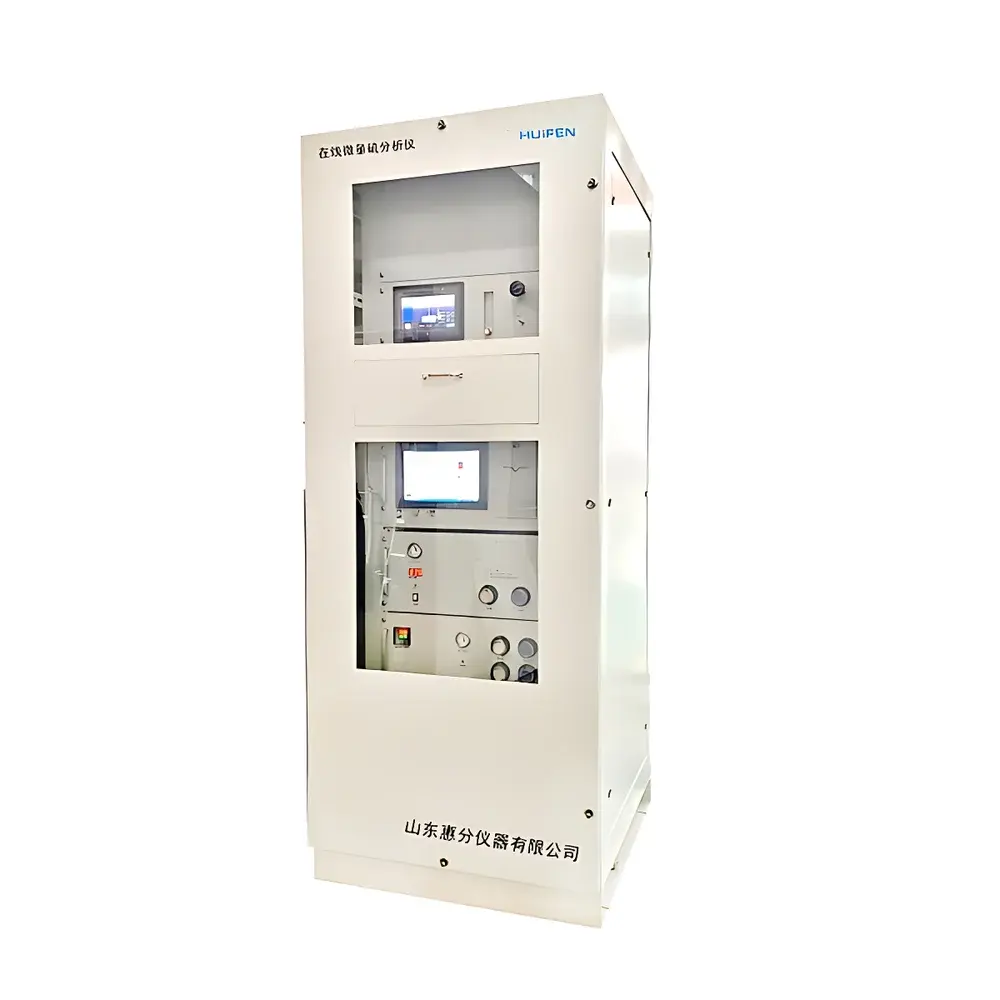
ZHONGKEHUIFEN HFG-961 Online Sulfur Compounds Monitoring System
| Brand | ZHONGKEHUIFEN |
|---|---|
| Origin | Beijing, China |
| Model | HFG-961 Online Sulfur Compounds Monitoring System |
| Temperature Control Range | Ambient + 3 °C to 450 °C |
| Oven Ramp Rate | 0.1–40 °C/min |
| Cool-down Time | ~8 min (450 °C to 50 °C) |
| Carrier Gas Flow Range & Control | 0–1200 mL/min |
| Carrier Gas Pressure Range & Control | 0–970 kPa |
| Injector Max Operating Temperature | 450 °C |
| Injector Pressure Setpoint Range | 0–970 kPa |
| Injector Total Flow Setpoint Range | 0–1200 mL/min |
| Detection Targets | H₂S, COS, CH₃SH, C₂H₅SH, CH₃SCH₃, CS₂, C₄H₄S (thiophene), C₂H₅SC₂H₅, (CH₃)₂S₂ |
| Detector | Flame Photometric Detector (FPD) |
| LOD | 0.01 ppm (as H₂S) |
| Repeatability | RSD ≤ 3% |
| Cycle Time | 15 min (compound-dependent) |
| Power Supply | 220 VAC, 50 Hz, < 4 kW |
| Operating Environment | −10 °C to 50 °C |
| Output Interfaces | RS232 / RS485 |
Overview
The ZHONGKEHUIFEN HFG-961 Online Sulfur Compounds Monitoring System is a dedicated, fully automated gas chromatographic platform engineered for continuous, real-time quantification of volatile sulfur compounds (VSCs) in ambient air and industrial emission streams. It operates on the principle of cryogenic preconcentration coupled with dual-column GC separation and selective detection via flame photometric detection (FPD). This architecture enables trace-level analysis of key odorants and toxicants—including hydrogen sulfide (H₂S), carbonyl sulfide (COS), methyl mercaptan (CH₃SH), dimethyl sulfide (CH₃SCH₃), carbon disulfide (CS₂), thiophene, and dimethyl disulfide—under unattended operation. Designed to meet regulatory compliance requirements specified in GB/T 14678, GB 3095–2012, GB 16297–1996, and GB 14554–1993, the system delivers reproducible, audit-ready data suitable for environmental monitoring stations, wastewater treatment plants, petrochemical facilities, and landfill off-gas control applications.
Key Features
- Integrated cryogenic trapping module with thermally desorbed adsorbent tubes optimized for sulfur compound retention and quantitative release at 250 °C
- High-inertness gas pathway: Silanized stainless-steel tubing and a low-dead-volume, high-cycle-life 10-port rotary valve (rated for ≥1 million actuations, inert surface finish)
- Dual-column GC configuration with backflush capability: Pre-column for rapid group separation and analytical column for high-resolution speciation; non-target high-boiling interferences are actively backflushed
- Modular detector interface supporting FPD with sulfur-selective response (394 nm emission), delivering sub-ppm detection limits (LOD = 0.01 ppm as H₂S) and ≤3% relative standard deviation (RSD) across repeated injections
- Flexible gas supply architecture: Onboard zero-air generator and hydrogen generator eliminate external cylinder dependency; all gas flows and pressures controlled via either mechanical valves or optional electronic pressure/flow controllers (EPC)
- Full automation: Vacuum-driven sampling train with integrated moisture removal, programmable cycle timing (standard 15-min analysis interval), and fault-tolerant sequence logic
Sample Compatibility & Compliance
The HFG-961 is validated for direct analysis of ambient air, stack gas, and process vent streams without sample dilution or derivatization. Its sampling manifold accommodates particulate filters and Nafion-based dryers to ensure water vapor removal prior to cryotrapping—critical for maintaining adsorbent integrity and minimizing FPD quenching. The system conforms to Chinese national standards for ambient air quality (GB 3095–2012), industrial emission control (GB 16297–1996), and odor regulation (GB 14554–1993). While not certified to ISO/IEC 17025 or EPA Method TO-15 out-of-the-box, its hardware architecture, calibration traceability (via certified gas standards), and data logging structure support method validation under GLP and GMP-aligned QA/QC frameworks. All critical parameters—including oven temperature, valve timing, detector gain, and flow setpoints—are logged with timestamps and user-accessible audit trails.
Software & Data Management
The proprietary HFG-961 control and analysis software runs on an embedded industrial PC housed within the 19-inch rack-mount cabinet. It provides real-time chromatogram visualization, automated peak integration using retention time locking, and multi-point calibration curve generation (linear or quadratic). Quantitative results are displayed as concentration time-series plots, with auto-calculated rolling averages (hourly, daily, monthly), pollution index metrics, and customizable reporting templates compliant with municipal and provincial environmental bureau submission formats. Data export supports CSV, PDF, and XML; secure remote access is enabled via encrypted Ethernet connection. The software includes full 21 CFR Part 11–compatible features: electronic signatures, role-based user permissions, immutable audit logs, and version-controlled method storage—all configurable without third-party middleware.
Applications
- Continuous emissions monitoring (CEM) of sulfur species from biogas upgrading units and anaerobic digesters
- Ambient air quality surveillance near refineries, pulp & paper mills, and sewage pumping stations
- Odor source identification and dispersion modeling support for regulatory compliance reporting
- Process optimization and catalyst health assessment in Claus sulfur recovery units
- Validation of scrubber efficiency and abatement system performance in VOC/SO₂ co-control installations
- Research-grade kinetic studies of sulfur compound formation pathways in thermal degradation processes
FAQ
What sulfur compounds does the HFG-961 detect and quantify?
It targets hydrogen sulfide (H₂S), carbonyl sulfide (COS), methyl mercaptan (CH₃SH), ethyl mercaptan (C₂H₅SH), dimethyl sulfide (CH₃SCH₃), carbon disulfide (CS₂), thiophene (C₄H₄S), diethyl sulfide (C₂H₅SC₂H₅), and dimethyl disulfide ((CH₃)₂S₂).
Is the system compatible with existing SCADA or DCS infrastructure?
Yes—it provides native 4–20 mA analog outputs, Modbus RTU over RS485, and TCP/IP Ethernet communication for seamless integration into plant-wide control systems.
How frequently does the system require maintenance or calibration?
Typical preventive maintenance intervals are every 3 months; calibration verification is recommended before each 8-hour shift or after any major environmental excursion (e.g., power loss, humidity spike). Full calibration with certified gas standards is advised every 30 days under continuous operation.
Can the HFG-961 operate in outdoor environments?
The main analyzer cabinet is rated for indoor use only; however, the sampling probe and heated sample line (optional) are designed for outdoor installation with IP65-rated enclosures and temperature-controlled tracing (−10 °C to 50 °C operational envelope).
Does the system support remote diagnostics and firmware updates?
Yes—via secure SSH or HTTPS web interface; diagnostic logs, chromatogram archives, and system health metrics are accessible remotely with appropriate credentials and network segmentation.






