
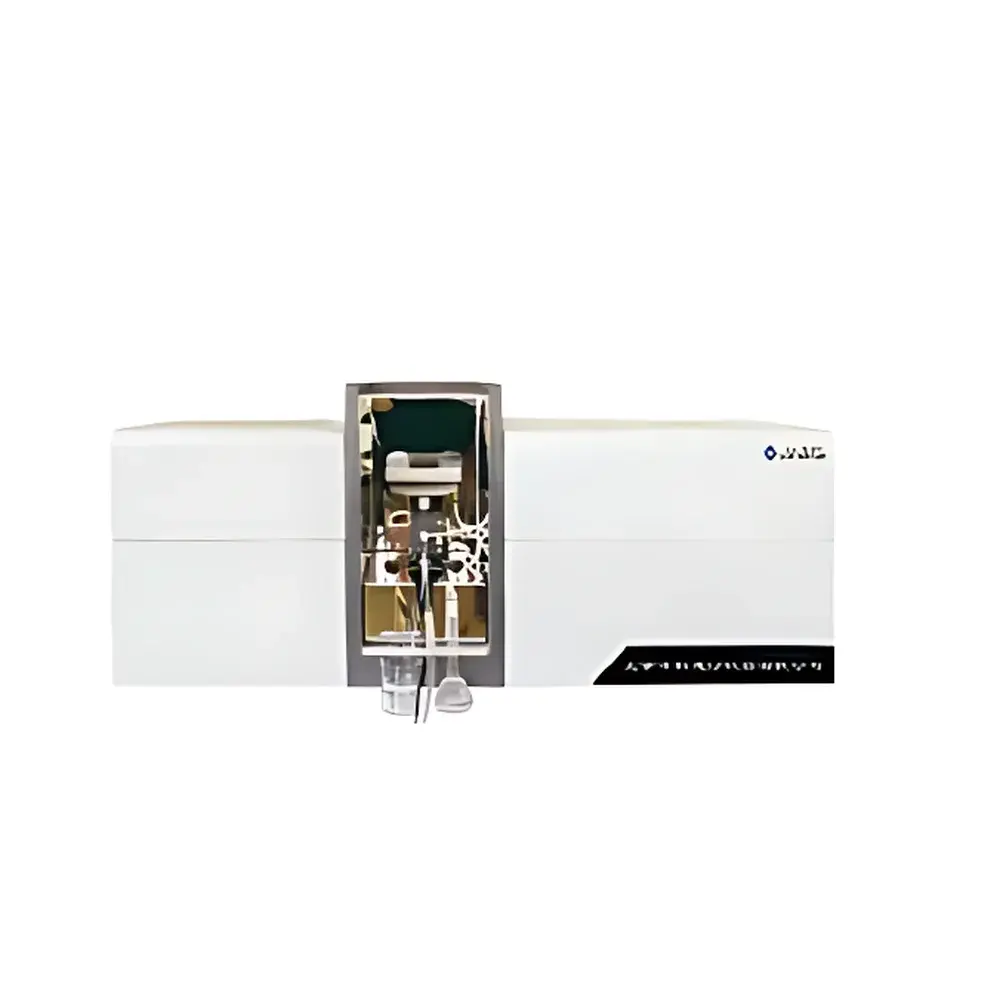
Zhongkehuifen AA-760AFG Fully Automated Flame and Graphite Furnace Atomic Absorption Spectrophotometer
| Brand | Zhongkehuifen |
|---|---|
| Origin | Beijing, China |
| Model | AA-760AFG |
| Instrument Type | Flame and Graphite Furnace AAS |
| Optical System | Dual-beam |
| Monochromator | Czerny-Turner with 1800 lines/mm grating |
| Wavelength Range | 190–900 nm |
| Spectral Bandwidth | 0.1/0.2/0.4/1.0/2.0 nm (auto-switching) |
| Wavelength Accuracy | ±0.10 nm |
| Wavelength Repeatability | 0.05 nm |
| Background Correction | D₂ lamp + Zeeman-effect correction |
| Resolution | Resolves Mn 279.5 nm and 279.8 nm with valley energy <20% |
| Sensitivity (Cu) | 0.02 µg/mL per 1% absorption |
| Detection Limit (Cu, flame) | 0.003 µg/mL |
| Detection Limit (Cd, GF-AAS) | <0.4 pg |
| RSD (flame) | <0.5% |
| RSD (graphite furnace) | <0.8% |
| Detector | Wide-spectrum photomultiplier tube (Hamamatsu) |
| Atomizer | Titanium alloy 100-mm burner (flame) |
| Safety | Acetylene leak detection, automatic gas cutoff, flame failure shutdown |
| Power | AC 220 V / 50 Hz / 150 VA |
| Dimensions | 1110 × 400 × 500 mm (W×D×H) |
| Net Weight | 55 kg |
| Operating Environment | 10–35 °C, ≤80% RH |
Overview
The Zhongkehuifen AA-760AFG is a dual-mode, fully automated atomic absorption spectrophotometer engineered for high-precision elemental quantification in environmental, clinical, pharmaceutical, and industrial quality control laboratories. It integrates flame atomic absorption spectroscopy (FAAS) and graphite furnace atomic absorption spectroscopy (GFAAS) into a single platform, enabling trace- to major-element analysis across matrices including water, soil digests, biological fluids, and metallurgical samples. The instrument operates on the fundamental principle of atomic absorption—measuring attenuation of narrow-line radiation from element-specific hollow cathode lamps as ground-state atoms in a high-temperature atomizer absorb photons at characteristic wavelengths. Its dual-beam optical architecture compensates for source intensity drift and electronic noise, ensuring baseline stability critical for low-concentration measurements. The system employs a Czerny-Turner monochromator with an 1800-line/mm holographic grating and full-wavelength auto-scanning capability, delivering consistent spectral resolution and peak identification without manual intervention.
Key Features
- Fully automated operation: 8-position lamp turret with programmable lamp selection, pre-heating, and positional optimization—reducing method setup time and operator dependency.
- Dual background correction: Simultaneous and selectable D₂-lamp and Zeeman-effect correction, each providing >60-fold background compensation for complex matrices with high spectral interference (e.g., seawater, digested sludge, serum).
- Optimized atomization systems: A corrosion-resistant titanium 100-mm burner ensures stable flame geometry and rapid thermal equilibration; the graphite furnace features constant-power temperature control, delivering uniform radial heating and reproducible thermal profiles for enhanced accuracy in ultra-trace analysis.
- Advanced optical design: All-reflective, aberration-corrected optics across 190–900 nm eliminate chromatic error and support high-fidelity spectral acquisition without wavelength-dependent focus adjustment.
- Robust safety architecture: Integrated acetylene leak detection, automatic fuel cutoff upon flameout or pressure anomaly, and real-time monitoring of gas flow, temperature, and electrical parameters compliant with ISO 22196 and IEC 61010-1 safety requirements.
Sample Compatibility & Compliance
The AA-760AFG accommodates liquid samples directly introduced via nebulization (FAAS) or micro-volume injection (GFAAS), supporting volumes from 5–50 µL with programmable drying, ashing, and atomization steps. It accepts standard 16-mm borosilicate glass tubes and graphite platforms compatible with certified reference materials (CRMs) such as NIST SRM 1643e (trace elements in water) and GBW(E) 080392 (soil). The system supports analytical workflows aligned with ASTM D1688 (copper in water), ISO 11885 (water quality—determination of selected elements by AAS), and USP (heavy metals). Its software audit trail, user access levels, and electronic signature functionality meet GLP and GMP documentation expectations under FDA 21 CFR Part 11 when deployed with validated configurations.
Software & Data Management
The instrument is controlled via Windows-based professional software (XP/7 compatible) offering intuitive method development, real-time signal visualization, and multi-point calibration with outlier rejection. Data processing includes standard curve fitting (linear, quadratic), standard addition, and internal standardization. Quantitative results are reported with calculated standard deviation (SD), relative standard deviation (RSD), and confidence intervals. Export formats include native .csv, Excel (.xlsx), and Word (.docx) for direct integration into LIMS environments. All instrument events—including lamp usage, gas pressures, temperature ramps, and background correction mode—are timestamped and logged for full traceability. Raw absorbance vs. time/space data files retain full spectral metadata for retrospective reprocessing.
Applications
- Environmental monitoring: Quantification of Pb, Cd, Cr, Ni, and As in drinking water, wastewater, and EPA Method 200.7-compliant digests.
- Clinical toxicology: Measurement of Cu, Zn, Fe, and Se in serum and whole blood using matrix-matched calibration and Zeeman background correction.
- Pharmaceutical QC: Heavy metal testing per ICH Q3D guidelines in active pharmaceutical ingredients (APIs) and excipients.
- Food safety: Determination of essential and toxic elements in infant formula, cereals, and seafood extracts following AOAC 984.27 protocols.
- Geochemical analysis: Multi-element screening of rock and sediment leachates with integrated flame/GF switching for dynamic concentration range coverage (ppb to % w/w).
FAQ
What atomization modes does the AA-760AFG support?
It supports both air-acetylene flame atomization and electrothermal graphite furnace atomization, with seamless software-controlled switching between modes.
Is the instrument compliant with regulatory data integrity standards?
Yes—the software provides configurable user roles, electronic signatures, and immutable audit trails meeting core requirements of FDA 21 CFR Part 11 and EU Annex 11 when operated in validated environments.
Can the system resolve closely spaced spectral lines for interference assessment?
Yes—it resolves the Mn 279.5 nm and 279.8 nm doublet with valley energy below 20%, satisfying resolution criteria defined in ASTM E1707 and ISO 11099.
What safety certifications apply to the flame system?
The gas control module complies with IEC 61010-1 for laboratory equipment and incorporates redundant flame sensors and pressure interlocks per EN 13861.
Does the graphite furnace support programmable temperature ramping?
Yes—users define up to 30-step heating programs (drying, pyrolysis, atomization, cleaning) with independent ramp rates, hold times, and gas flow modulation.




