
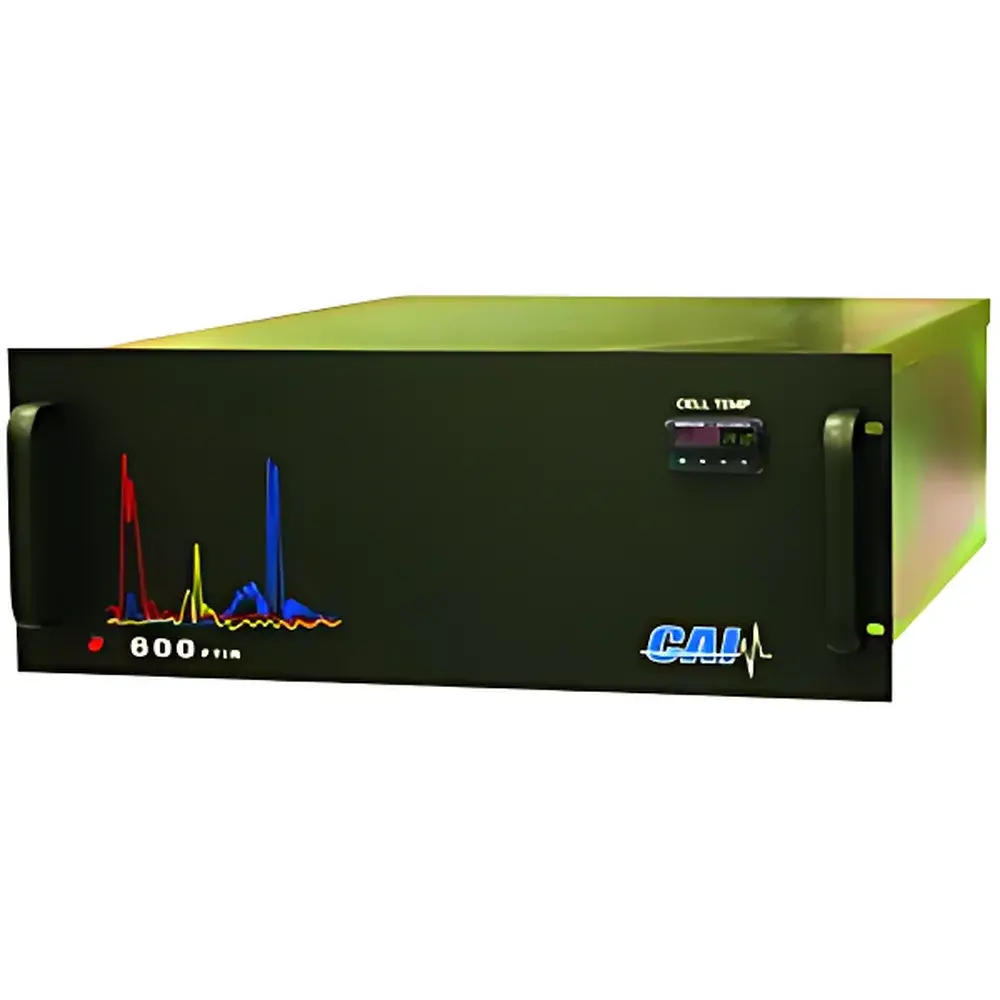
CAI 600FTIR Fourier Transform Infrared Gas Analyzer
| Brand | California Analytical Instruments (CAI) |
|---|---|
| Origin | USA |
| Model | 600FTIR |
| Instrument Principle | Infrared Absorption Spectroscopy |
| Type | Online Multicomponent Gas Analyzer |
| Response Time | 1–30 s |
| Repeatability | NH₃, SO₂, N₂O, NO, NO₂, CO, CO₂, C₂H₂ |
| Spectral Resolution | 0.8 cm⁻¹ |
| Spectral Range | 305–7500 cm⁻¹ |
| Scan Time | 1–300 s |
| Sample Cell Temperature | 50 °C or 150 °C (heated stainless steel 316) |
| Optical Path Length | 8.2 m (multipass) |
| Cell Volume | 200 mL |
| Detector | DTGS (Deuterated Triglycine Sulfate) |
| Sampling Flow Rate | 0.2–1 L/min |
| Environmental Operating Conditions | 5–40 °C, <80% RH (non-condensing) |
| Power Supply | 115/230 VAC ±10%, 50/60 Hz |
| Dimensions | 7.0″ H × 19″ W × 18″ D |
| Weight | ~45 lbs (20.4 kg) |
| Window Materials | KBr, ZnSe, CaF₂ |
| Inlet/Outlet | 1/4″ tubing |
| Purge Fitting | 1/4″ Swagelok compression |
| O-Ring Material | Fluoroelastomer (FKM) |
Overview
The CAI 600FTIR Fourier Transform Infrared Gas Analyzer is an online, real-time multicomponent gas analysis system engineered for high-stability, field-deployable operation in demanding environmental and industrial applications. Based on the physical principle of infrared absorption spectroscopy, the instrument exploits the unique vibrational-rotational transitions of asymmetric gaseous molecules—such as CO, CO₂, NO, NO₂, SO₂, NH₃, N₂O, CH₄, C₂H₂, and numerous VOCs—within the mid-infrared spectral region (305–7500 cm⁻¹). Unlike dispersive IR analyzers, the CAI 600FTIR employs a Michelson interferometer with permanently aligned gold-coated stainless steel corner-cube retroreflectors and wear-free bearings, ensuring long-term optical stability without recalibration drift. Its short-path, heated multipass sample cell (200 mL volume, 8.2 m effective path length, 316 stainless steel construction) enables robust operation under high-humidity or condensing conditions—eliminating the need for external drying or chilling stages. Critically, the system operates without liquid nitrogen (LN₂), removing cryogenic handling hazards, logistical constraints, and associated maintenance overhead typical of MCT-detector-based FTIR platforms.
Key Features
- LN₂-free operation using a thermoelectrically stabilized DTGS detector—reducing total cost of ownership and enhancing operational safety
- Heated sample cell configurable to 50 °C or 150 °C for hot/wet sampling, minimizing wall adsorption and condensation artifacts
- High optical throughput and signal-to-noise ratio enabled by gold-coated interferometer optics and precision-machined stainless steel cell
- 0.8 cm⁻¹ spectral resolution—sufficient for resolving overlapping bands of key combustion and process gases (e.g., NO/NO₂, CO/CO₂, NH₃/H₂O)
- Compact footprint (7″ × 19″ × 18″) and lightweight design (~45 lbs) for integration into mobile labs, stack-mounted CEMS enclosures, or skid-mounted process analyzers
- Robust mechanical architecture: sealed optical bench, vibration-damped housing, and fluorocarbon O-rings compatible with aggressive process streams
- Configurable optical windows (KBr, ZnSe, CaF₂) optimized for transmission across different spectral sub-bands and chemical resistance requirements
Sample Compatibility & Compliance
The CAI 600FTIR is validated for continuous measurement of up to 30+ gas species simultaneously—including regulated pollutants (SO₂, NOₓ, CO, NH₃), greenhouse gases (CO₂, CH₄, N₂O), and volatile organic compounds (C₂H₂, C₂H₄, C₃H₆, HCHO, C₇H₈)—in complex matrices such as flue gas, biogas, diesel exhaust, fermentation off-gas, and landfill emissions. Its heated sample interface and chemically resistant wetted materials (316 SS, FKM seals, inert window options) support compliance with EPA Methods 320 and PS-15, EN 15267-3, and ISO 12039 for continuous emission monitoring systems (CEMS). The analyzer meets electromagnetic compatibility (EMC) requirements per IEC 61326-1 and operates within ambient specifications compliant with IEC 60721-3-3 (Class 3K3). While not intrinsically rated, it may be installed in hazardous areas when housed in appropriate purged or pressurized enclosures per ATEX/IECEx guidelines.
Software & Data Management
Control, acquisition, and quantification are performed via CAI’s proprietary OPUS-based software suite running on Windows OS (XP or later). The platform implements Partial Least Squares (PLS) multivariate calibration models trained on reference spectra from NIST-traceable gas standards, enabling accurate concentration determination even in spectrally congested mixtures. All raw interferograms and single-beam spectra are archived with full metadata (time stamp, cell temperature, flow rate, detector voltage). Audit trails—including user logins, method changes, calibration updates, and result exports—are maintained in accordance with FDA 21 CFR Part 11 requirements when configured with electronic signature and role-based access controls. Data output supports Modbus TCP, OPC UA, and ASCII file export for integration into DCS, SCADA, or LIMS environments. Optional remote diagnostics and firmware update capability enable predictive maintenance planning.
Applications
- Continuous Emission Monitoring Systems (CEMS) for power plants, cement kilns, and incinerators per MACT and NSPS regulations
- SCR/SNCR ammonia slip monitoring at catalyst inlet and outlet—critical for optimizing reagent injection and minimizing secondary aerosol formation
- Process gas analysis in chemical synthesis, petrochemical cracking, and syngas production
- VOC abatement efficiency verification in thermal oxidizers and carbon adsorption units
- Biogas and landfill gas composition tracking (CH₄, CO₂, H₂S, siloxanes) for energy recovery optimization
- Real-time diesel and gasoline engine exhaust characterization during transient dynamometer testing
- Agricultural emission studies (NH₃, N₂O, CH₄) from manure management and fertilizer application
- Greenhouse gas flux measurements in eddy covariance and chamber-based field research
- Fermentation off-gas profiling for biopharmaceutical and biofuel production control
- Industrial hygiene and workplace air quality monitoring for toxic and combustible gases
FAQ
Does the CAI 600FTIR require liquid nitrogen cooling?
No. It uses a thermoelectrically stabilized DTGS detector, eliminating LN₂ dependency and associated safety and logistical constraints.
Can the analyzer operate under high-humidity or wet-gas conditions?
Yes. The heated sample cell (50 °C or 150 °C) and hydrophobic window options prevent condensation and maintain spectral fidelity in hot/wet streams.
What is the minimum detectable concentration for common gases like NO or NH₃?
Detection limits are method-dependent and calibrated per application; typical sub-ppm LODs are achievable for NO, NH₃, and SO₂ using PLS modeling and optimal path-length configuration.
Is the system compliant with EPA or EU regulatory frameworks for CEMS?
It satisfies core performance criteria of EPA PS-15 and EN 15267-3 when deployed with validated calibration protocols and integrated into certified CEMS architectures.
How frequently does the instrument require calibration or maintenance?
Zero/span checks are recommended daily or per operational protocol; full multigas calibration every 3–6 months depending on exposure severity; no routine optical alignment or interferometer servicing required due to permanent mechanical stabilization.







