
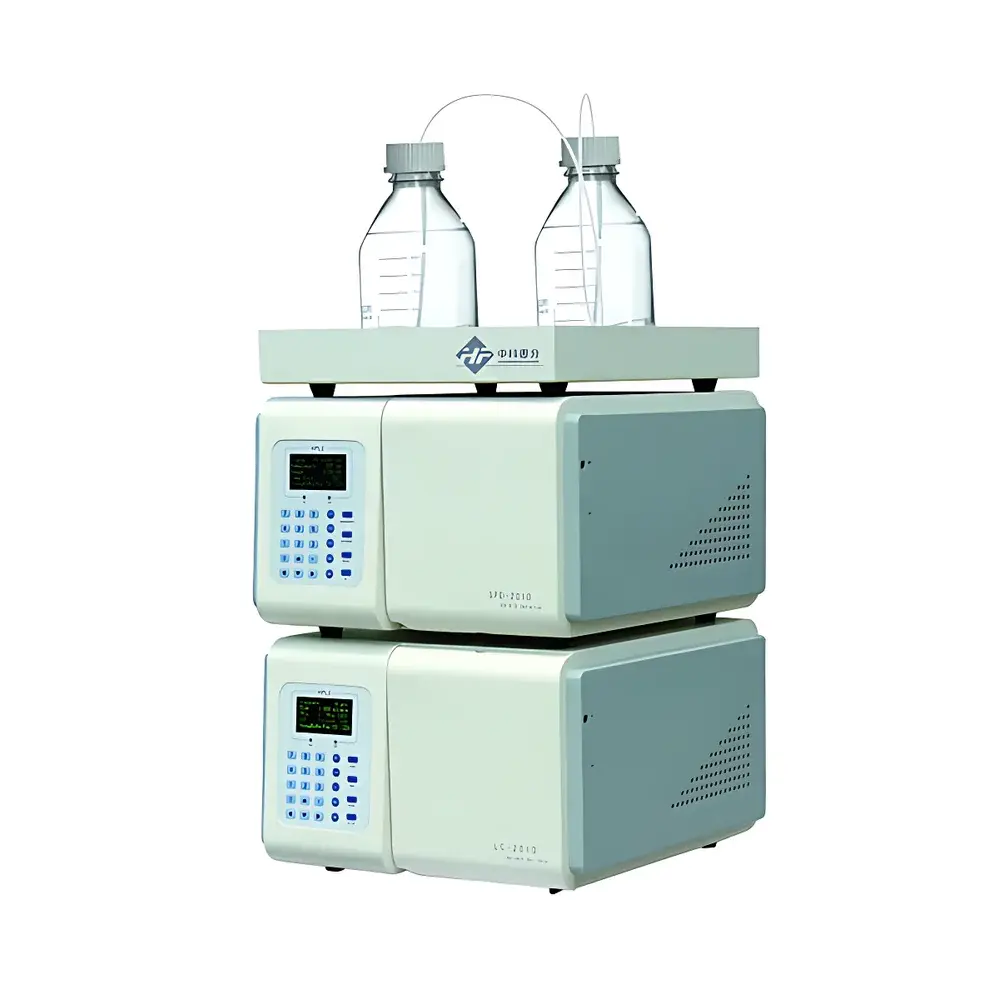
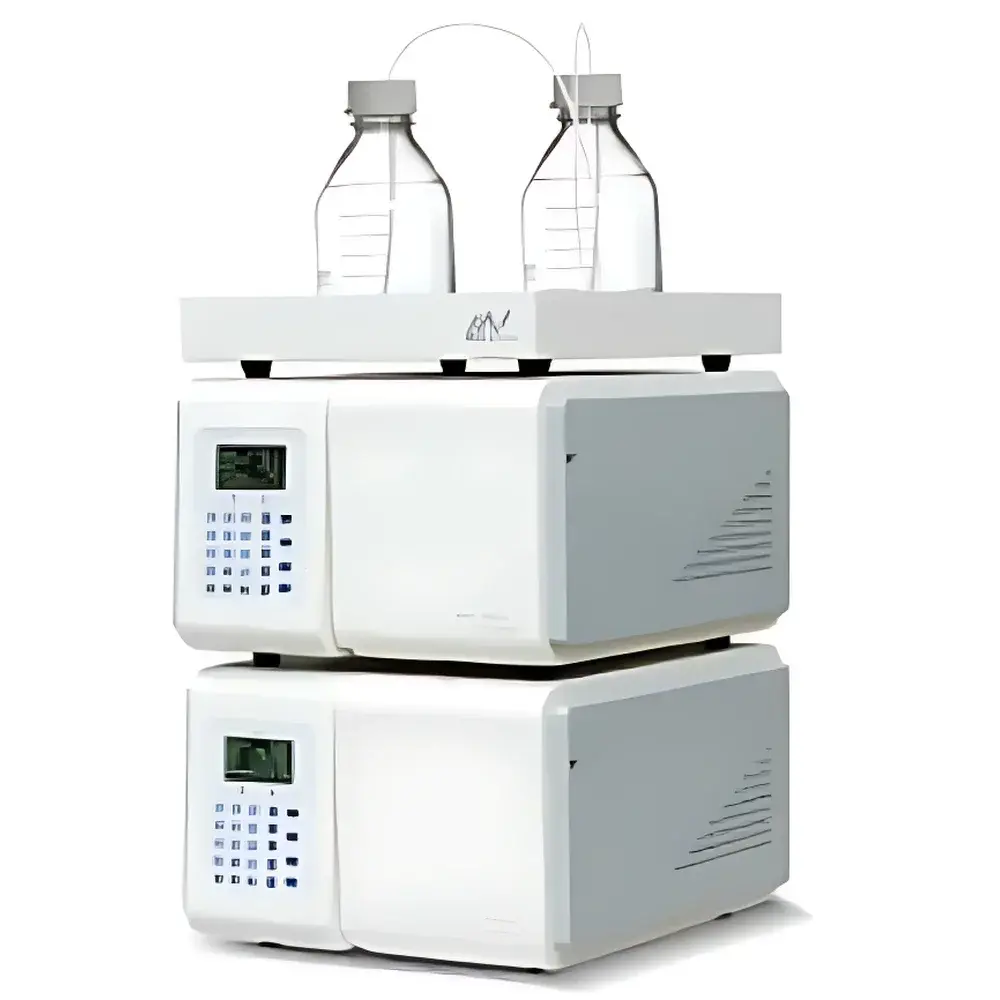
ZHONGKEHUIFEN LC-2010 High-Performance Liquid Chromatograph
| Brand | ZHONGKEHUIFEN |
|---|---|
| Origin | Beijing, China |
| Manufacturer Type | Authorized Distributor |
| Regional Classification | Domestic (China) |
| Model | LC-2010 |
| Price Range | USD 1,400 – 7,200 |
| Instrument Type | Conventional HPLC System |
| Flow Rate Range | 0.001–9.999 mL/min |
| Maximum Pressure | 40 MPa |
| Injection Port Capacity | 1 position |
| Injection Volume Range | Up to 20 µL |
| Column Oven Temperature Range | Ambient +10°C to 80°C |
| UV-Vis Wavelength Range | 190–700 nm |
| Data Acquisition Rate | 10 Hz |
Overview
The ZHONGKEHUIFEN LC-2010 is a robust, benchtop high-performance liquid chromatograph engineered for routine analytical applications in quality control, pharmaceutical testing, environmental monitoring, and academic research laboratories. Based on classical reversed-phase and normal-phase HPLC principles, the system employs isocratic or gradient elution via dual-piston reciprocating high-pressure pumps, delivering precise solvent delivery under controlled backpressure conditions up to 40 MPa. Its modular architecture supports future expansion to binary or quaternary gradient configurations without hardware replacement. The integrated UV-Vis detector utilizes a holographic concave grating and dual-beam optical path to ensure spectral accuracy across the full 190–700 nm range, enabling reliable quantification of aromatic compounds, pharmaceutical actives, and organic pollutants with high baseline stability and low noise characteristics.
Key Features
- High-precision dual-piston constant-flow pump with automatic solvent compressibility compensation and self-flushing pump head—eliminates manual priming and reduces downtime.
- Floating plunger seal technology extends seal lifetime to ≥5,000 operational hours with zero leakage under sustained pressure.
- Programmable flow rate resolution down to 0.001 mL/min over a 0.001–9.999 mL/min range; flow accuracy ≤±1% (1.000 mL/min, 8.5 MPa, water, 25°C); RSD ≤0.25% for flow stability.
- UV-Vis detector featuring wavelength reproducibility ±0.01 nm and accuracy ±1 nm; spectral bandwidth 6 nm; baseline noise ≤2×10⁻⁵ AU (methanol, 1 mL/min, 254 nm, 20°C); drift ≤4×10⁻⁴ AU/hr (same conditions, 40-min equilibration).
- Rheodyne 7725i manual injection valve with 20 µL loop capacity ensures high reproducibility (RSD <0.5% for peak area) and long-term mechanical reliability.
- Column oven with temperature control from ambient +10°C to 80°C (±0.5°C stability) accommodates method transfer and retention time optimization.
- Embedded microcontroller-based control system with non-volatile memory—retains all method parameters and instrument settings after power loss.
- Modular design allows seamless integration of additional modules including gradient mixer, fraction collector, or external autosampler.
Sample Compatibility & Compliance
The LC-2010 is compatible with standard 3.9–4.6 mm ID analytical columns packed with C18, C8, phenyl, amino, cyano, or silica phases. It supports mobile phases ranging from aqueous buffers (e.g., phosphate, acetate) to aggressive organic solvents (acetonitrile, methanol, THF), provided corrosion-resistant wetted materials (e.g., sapphire piston seals, stainless-steel fluidic paths) are specified. While not pre-certified for regulated environments, the system’s architecture aligns with core elements of FDA 21 CFR Part 11 requirements when operated with compliant data acquisition software: audit trail capability, electronic signature support, and user-access-level controls can be implemented at the software layer. Method validation parameters—including linearity, LOD/LOQ, precision, and robustness—meet typical expectations for USP , EP 2.2.46, and ISO/IEC 17025-compliant laboratories conducting non-GMP QC testing.
Software & Data Management
The LC-2010 operates with vendor-supplied Windows-based chromatography data system (CDS) software supporting real-time signal acquisition at 10 Hz, peak integration using tangent skim or Gaussian deconvolution algorithms, calibration curve generation (linear, quadratic, or weighted), and customizable report templates. Raw data files adhere to open ASCII formats (e.g., .txt, .csv) for third-party analysis interoperability. Software features include automatic lamp usage tracking (hours and ignition cycles), method parameter validation checks, and system suitability test (SST) reporting per pharmacopeial guidelines. For laboratories requiring electronic records compliance, optional add-ons provide 21 CFR Part 11-compliant audit trails, role-based access control, and digital signature enforcement—fully traceable and exportable in PDF/A format.
Applications
- Pharmaceutical QC: Assay of active pharmaceutical ingredients (APIs), related substances testing, and dissolution profile analysis per USP monographs.
- Food & Beverage: Detection of preservatives (benzoates, sorbates), artificial colors, mycotoxins (aflatoxin B1), and pesticide residues in extracts.
- Environmental Analysis: Quantification of PAHs, PCBs, phenolic compounds, and herbicides (e.g., atrazine, glyphosate derivatives) in water and soil matrices.
- Academic Research: Separation and characterization of natural product extracts, polymer additives, and synthetic intermediates.
- Chemical Manufacturing: In-process monitoring of reaction mixtures and purity assessment of fine chemicals.
FAQ
Is the LC-2010 suitable for GMP-regulated environments?
It can be deployed in GMP settings when paired with validated CDS software supporting 21 CFR Part 11 compliance, IQ/OQ documentation packages, and periodic performance verification per ASTM E2656 or equivalent protocols.
Can the system be upgraded to gradient operation?
Yes—the modular chassis and pump firmware support retrofitting with a low-dead-volume gradient mixer and secondary pump module without replacing the base unit.
What maintenance intervals are recommended for the UV lamp and pump seals?
The deuterium lamp is rated for ≥1,500 hours; the floating-seal pump assembly requires no scheduled replacement before 5,000 hours under typical use conditions. Routine checks of check valves and purge valve integrity are advised every 3 months.
Does the detector support post-run spectral scanning?
No—the current configuration provides fixed-wavelength or time-programmed wavelength switching only; full-spectrum PDA functionality is not included but may be available via optional detector upgrade.
Is remote monitoring or network connectivity supported?
Standard Ethernet or RS-232 interfaces enable connection to local lab networks; remote desktop access and centralized instrument management require third-party middleware or custom IT integration.





