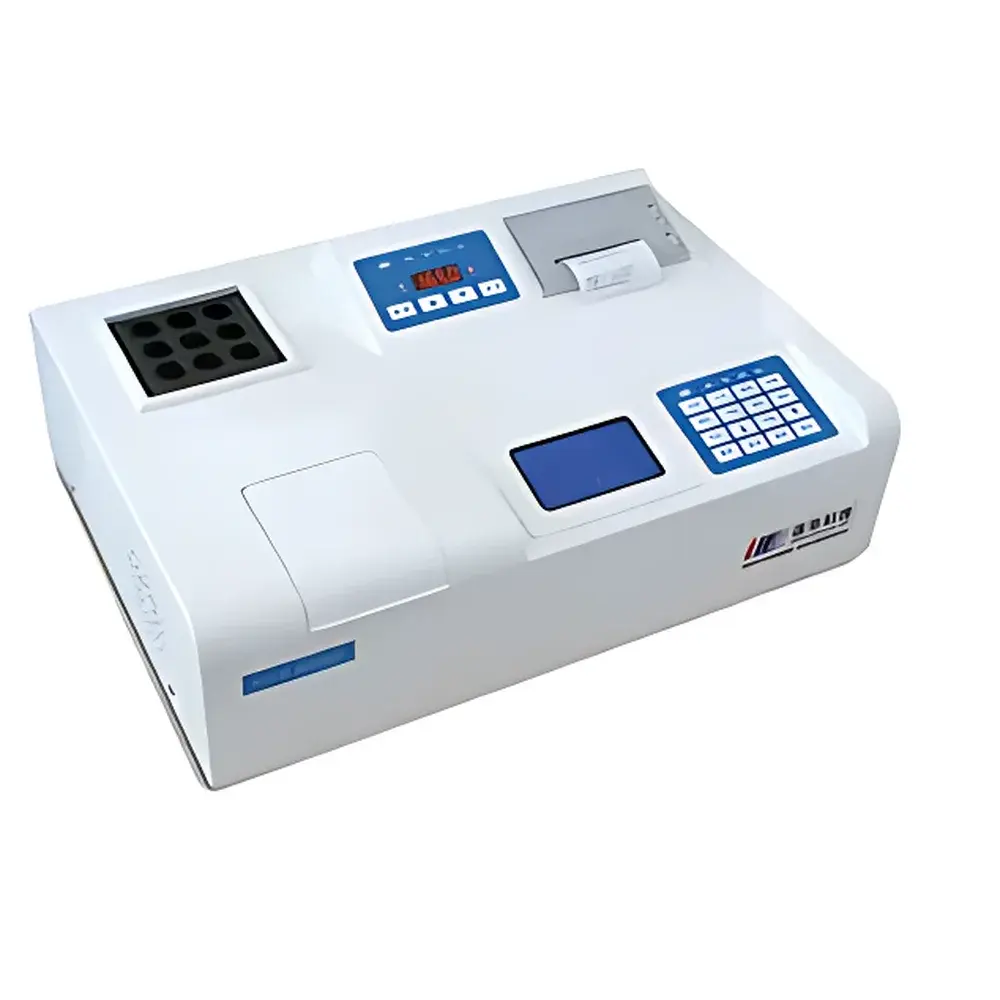
Zhongkehuifen 5B-3A Integrated Smart COD Analyzer
| Brand | Zhongkehuifen |
|---|---|
| Origin | Shanghai, China |
| Manufacturer Type | Authorized Distributor |
| Model | 5B-3A |
| Detection Range | 20–1500 mg/L COD |
| Digestion Temperature | 165 °C ±1.0 °C |
| Digestion Time | 10 min |
| Measurement Time | 20 min for up to 9 samples |
| Chloride Interference Tolerance | ≤1000 mg/L (standard), ≤4000 mg/L (with high-chloride correction) |
| Repeatability | ≤0.03% RSD |
| Optical Stability | 0.01 A / 5 min |
| Built-in Calibration Curves | 20 (user-editable and savable) |
| Data Storage Capacity | 1000 records (including parameter ID, timestamp, and value) |
| Display | Integrated LCD |
| Connectivity | RS232 or USB for data export |
| Printer | Built-in thermal printer |
Overview
The Zhongkehuifen 5B-3A Integrated Smart COD Analyzer is a compact, all-in-one spectrophotometric system engineered for rapid, reliable chemical oxygen demand (COD) determination in accordance with Standard Methods for the Examination of Water and Wastewater (Method 5220 D) and ISO 6060. It integrates a precision digestion block, optical measurement module, microprocessor-based control unit, and thermal printer into a single benchtop platform. The instrument employs the dichromate oxidation method under acidic, high-temperature conditions, followed by spectrophotometric quantification of Cr3+ at 610 nm — a well-established, reference-grade approach for COD assessment. Designed for routine environmental monitoring labs, municipal wastewater facilities, and industrial QC departments, the 5B-3A delivers standardized performance without requiring manual curve calibration or post-analysis conversion calculations. Its fixed 165 °C digestion temperature and 10-minute dwell time comply with EPA-approved digestion protocols for moderate-to-high strength samples, while its dual chloride interference thresholds enable robust operation across diverse matrix types — from surface water to heavily chlorinated industrial effluents.
Key Features
- Integrated architecture eliminates inter-unit alignment errors and reduces footprint — digestion, measurement, and reporting occur within one calibrated enclosure.
- Built-in temperature-controlled digestion block maintains ±1.0 °C stability at 165 °C, verified per ASTM E220 for thermal uniformity across all 9 reaction positions.
- Pre-loaded library of 20 programmable calibration curves; users may modify slope/intercept values, assign custom identifiers, and save revisions with timestamped versioning.
- Automatic zero-point correction and baseline drift compensation ensure long-term photometric integrity; optical stability meets <0.01 A drift over 5 minutes (per ISO 9001 calibration verification criteria).
- Onboard thermal printer supports immediate hardcopy output of current measurements, historical datasets (with full metadata: sample ID, date/time, operator code, curve used), and calibration logs.
- Dual chloride tolerance modes: default mode (≤1000 mg/L Cl−) and high-chloride correction mode (≤4000 mg/L Cl−), implemented via algorithmic absorbance offset adjustment aligned with APHA-recommended interference mitigation practices.
Sample Compatibility & Compliance
The 5B-3A accommodates standard 16 mm OD glass reaction tubes (supplied) and is validated for use with domestic and industrial aqueous matrices including raw and treated wastewater, reclaimed water (reuse standards per ISO 16075), surface water, and process effluents. All solid-phase reagents supplied are certified to meet ACS reagent grade specifications for potassium dichromate, silver sulfate, and mercury sulfate. Instrument firmware and data handling workflows support audit-ready documentation: each stored record includes immutable timestamps, user-assigned sample codes, active curve ID, and measured absorbance values — satisfying basic GLP traceability requirements. While not 21 CFR Part 11–certified out-of-the-box, the system’s data export functionality (via RS232/USB) enables integration into validated LIMS environments where electronic signatures and change control are enforced.
Software & Data Management
Data management occurs entirely onboard via non-volatile flash memory capable of retaining 1000 complete measurement records — each containing COD concentration (mg/L), digestion temperature/time, optical reading (A), curve index, and UTC timestamp. Export is supported in CSV format for spreadsheet analysis or LIMS ingestion. No proprietary software installation is required; exported files conform to IEC 62443-3-3 Annex A guidance for industrial data interchange. Firmware updates are performed via USB drive using signed binary packages, preserving configuration integrity during revision cycles. All calibration modifications are logged with operator ID (if enabled) and change reason fields, supporting internal QA review per ISO/IEC 17025 Clause 7.7.
Applications
- Routine compliance monitoring of municipal wastewater treatment plant influent/effluent per national discharge permits (e.g., China’s GB 8978–1996, EU Urban Wastewater Directive Annex I).
- Industrial pretreatment verification for electroplating, textile dyeing, and petrochemical facilities where chloride-rich streams require robust interference handling.
- Environmental field labs conducting rapid screening of river, lake, and reservoir water quality during seasonal surveys.
- Educational laboratories teaching standard COD methodology with minimal consumables training overhead and built-in procedural safeguards.
- Third-party testing organizations performing batch-certified analyses under CNAS accreditation scope (equivalent to ISO/IEC 17025).
FAQ
Does the 5B-3A require external calibration standards for daily use?
No — the instrument operates with factory-calibrated optical path and pre-validated digestion kinetics. Daily verification uses a single NIST-traceable COD standard (100 mg/L), and results are compared against stored reference values to confirm system readiness.
Can the built-in curves be exported or backed up externally?
Curve parameters (slope, intercept, wavelength, R²) are embedded in exported CSV reports but cannot be individually extracted or modified off-device; however, full configuration backups are supported via USB firmware update interface.
Is the digestion block compatible with alternative tube formats?
The heater block is mechanically optimized for 16 mm OD round-bottom glass tubes (15 mL capacity). Use of non-standard tubes voids thermal uniformity certification and invalidates reported precision claims.
How is data security handled for multi-user environments?
User-level access is limited to measurement execution and print functions; no password protection or role-based permissions are implemented. For regulated environments, data must be exported and managed externally per organizational IT policy.
What maintenance intervals are recommended?
Optical window cleaning every 500 measurements; digestion block thermocouple validation annually using a calibrated dry-block calibrator; full performance verification per ISO/IEC 17025 every 6 months when used for accredited testing.
Related Products