
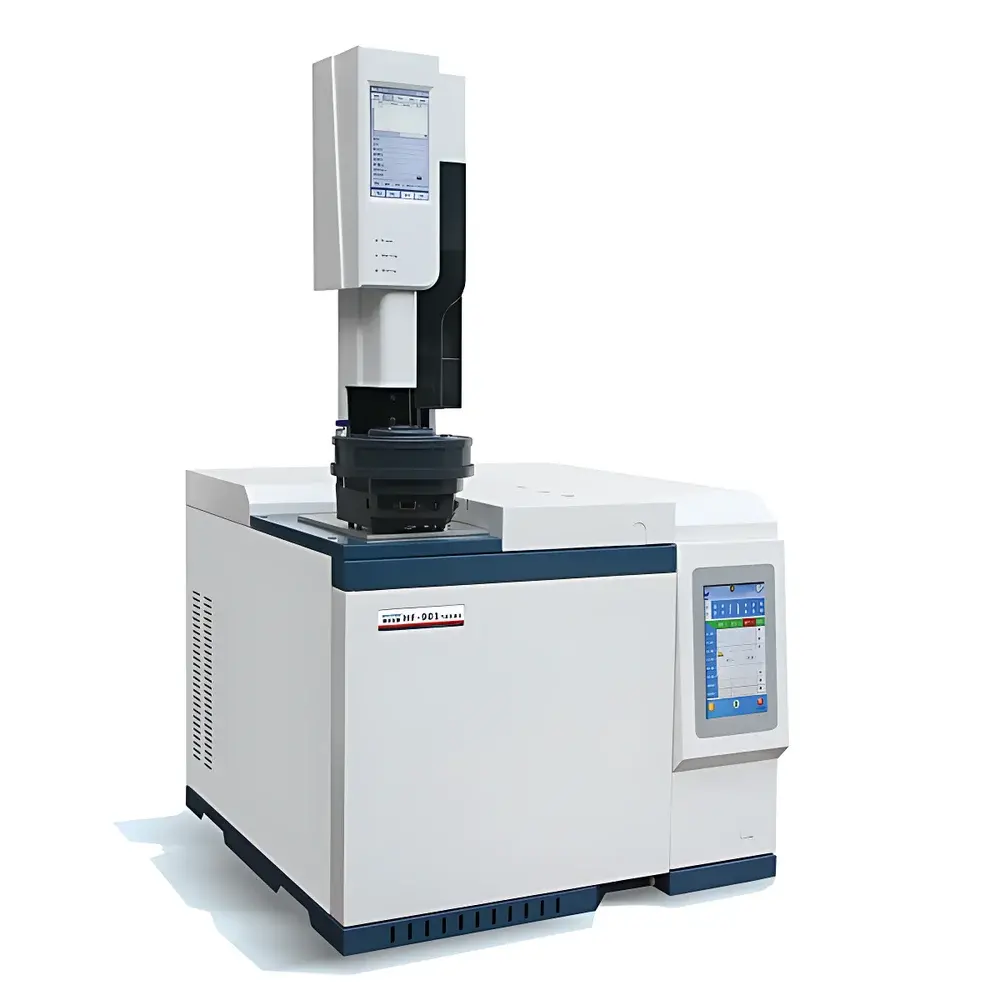
ZHONGKEHUIFEN HF-901D Power Transformer Oil Gas Chromatograph
| Brand | ZHONGKEHUIFEN |
|---|---|
| Origin | Beijing, China |
| Model | HF-901D |
| Temperature Control Range | Ambient + 3°C to 450°C |
| Ramp Rate | 0.1–40°C/min |
| Cooling Time | ~8 min (450°C → 50°C) |
| Carrier Gas Flow Range & Control | 0–1200 mL/min |
| Carrier Gas Pressure Range & Control | 0–970 kPa |
| Injector Max Temp | 450°C |
| Injector Pressure Setting Range | 0–970 kPa |
| Injector Total Flow Setting Range | 0–1200 mL/min |
| Detection Gases | H₂, CH₄, C₂H₄, C₂H₆, C₂H₂, CO, CO₂ |
| Minimum Detectable Concentration in Oil | ≤1 µL/L (for all target gases) |
| Analysis Cycle Time | ≤7 min |
| Temperature Stability | ±0.1°C |
| Power Consumption | 1.9 kW |
| Dimensions (W×D×H) | 660 × 560 × 480 mm |
Overview
The ZHONGKEHUIFEN HF-901D Power Transformer Oil Gas Chromatograph is a purpose-built laboratory gas chromatograph engineered for the precise quantification of dissolved gases in electrical insulating oils—primarily used in power transformers, reactors, and other oil-filled high-voltage equipment. It operates on the principle of capillary or packed-column gas chromatography with multi-detector parallel detection, specifically configured to meet the analytical requirements defined in DL/T 703–2015 (“Gas Chromatographic Method for Determination of Dissolved Gases in Insulating Oil”) and GB/T 7252–2001 (“Guide for Analysis and Interpretation of Dissolved Gases in Transformer Oil”). The instrument implements the nationally recommended three-detector configuration: a high-sensitivity Thermal Conductivity Detector (TCD), a low-noise Flame Ionization Detector (FID), and a nickel-catalyzed methanizer for CO/CO₂ conversion—enabling simultaneous, quantitative analysis of seven key fault gases: hydrogen (H₂), methane (CH₄), ethylene (C₂H₄), ethane (C₂H₆), acetylene (C₂H₂), carbon monoxide (CO), and carbon dioxide (CO₂). This configuration ensures compliance with routine dissolved gas analysis (DGA) protocols mandated by utility operators, ISO/IEC 17025-accredited laboratories, and OEM quality assurance departments.
Key Features
- Triple-detector architecture with dedicated TCD for H₂ and CO₂, FID for hydrocarbons (CH₄, C₂H₄, C₂H₆, C₂H₂), and integrated Ni-methanizer for catalytic conversion of CO and CO₂ into detectable methane—eliminating need for separate injections or manual reconfiguration.
- Electronic Pressure Control (EPC) and Electronic Flow Control (EFC) system with resolution of 0.01 psi (0.69 kPa) and repeatability <±0.1% of setpoint—ensuring long-term retention time stability and inter-laboratory method transferability.
- Transformer oil-optimized anti-fouling composite column packings resistant to heavy hydrocarbon carryover and polymer deposition, extending column lifetime beyond 2,000 injections under routine DGA conditions.
- Low-dead-volume, precision 1 mL liquid-phase syringe injection system with automated septum purge and backflush capability to minimize cross-contamination and baseline drift.
- Integrated self-diagnostic firmware with real-time monitoring of oven temperature uniformity, detector baseline noise, carrier gas integrity, flame status (for FID), and EPC valve actuation—displaying actionable fault codes on the front-panel LCD.
- One-touch startup sequence including automatic oven preheat, detector warm-up, gas purging, FID ignition verification, and baseline stabilization—reducing operator dependency and method setup time.
Sample Compatibility & Compliance
The HF-901D accepts standard 10 mL glass vials with crimp-seal septa for headspace sampling of degassed transformer oil, following ASTM D3612 or IEC 60567 procedures. Sample introduction is compatible with both manual liquid syringe injection and optional autosampler integration (via RS-232 or Ethernet command protocol). All thermal zones—including oven, injector, and detectors—are independently PID-controlled with accuracy of ±0.1°C over the full operating range (ambient +3°C to 450°C). The system satisfies traceability and audit-readiness requirements per GLP and GMP environments: it supports user-level access control, electronic signature-capable method storage, and audit trail logging of all critical parameter changes—fully aligned with FDA 21 CFR Part 11 data integrity principles when paired with compliant chromatography data systems (CDS).
Software & Data Management
The instrument communicates via standard TCP/IP Ethernet interface (10/100 Mbps), enabling seamless integration into enterprise LIMS or centralized CDS platforms such as Chromeleon, OpenLab CDS, or custom SCADA-based monitoring networks. Raw chromatograms and peak tables are exported in ASTM E1947-compliant .CDF format, supporting automated calculation of key DGA ratios (e.g., Duval Triangle, Rogers Ratio, IEC 60599) through configurable post-processing templates. Data archiving includes timestamped method files, instrument logs, calibration reports, and QC check results—all encrypted and version-controlled. Remote diagnostics allow authorized service engineers to monitor hardware status, retrieve diagnostic snapshots, and update firmware without physical site access.
Applications
- Routine dissolved gas analysis (DGA) for predictive maintenance of power transformers, circuit breakers, and bushings in transmission and distribution networks.
- Factory acceptance testing (FAT) and type testing of new oil-filled equipment per IEEE C57.104 and IEC 60599 standards.
- Investigation of incipient faults—including partial discharge, thermal degradation (>700°C), low-energy arcing, and cellulose insulation aging—based on gas generation patterns and concentration trends.
- Verification of oil reconditioning effectiveness after vacuum dehydration or adsorption treatment.
- Research-grade studies on gas solubility kinetics, diffusion coefficients, and fault simulation modeling in mineral and synthetic ester-based insulating fluids.
FAQ
What gas species can the HF-901D quantify in transformer oil?
It fully resolves and quantifies H₂, CH₄, C₂H₄, C₂H₆, C₂H₂, CO, and CO₂ in a single 7-minute run, meeting the minimum detection limit requirement of ≤1 µL/L for each component.
Does the system support regulatory compliance for utility lab accreditation?
Yes—it meets technical and procedural requirements of DL/T 703–2015, GB/T 7252–2001, ASTM D3612, and IEC 60567; its EPC architecture and audit-trail-ready software support ISO/IEC 17025 and FDA 21 CFR Part 11 compliance when deployed with validated CDS.
Is column maintenance required between analyses?
No routine column maintenance is needed due to the anti-fouling stationary phase design; column conditioning is only recommended after >500 injections or exposure to heavily contaminated oil samples.
Can the instrument be integrated into an existing SCADA or EMS platform?
Yes—via Modbus TCP or OPC UA protocol adapters (optional), enabling real-time DGA data streaming to substation automation systems for condition-based alerting.
What is the typical service interval for detector components?
FID jet cleaning and TCD filament inspection are recommended every 6 months under continuous operation; Ni-methanizer catalyst life exceeds 18 months at typical DGA throughput (≤20 samples/day).




