
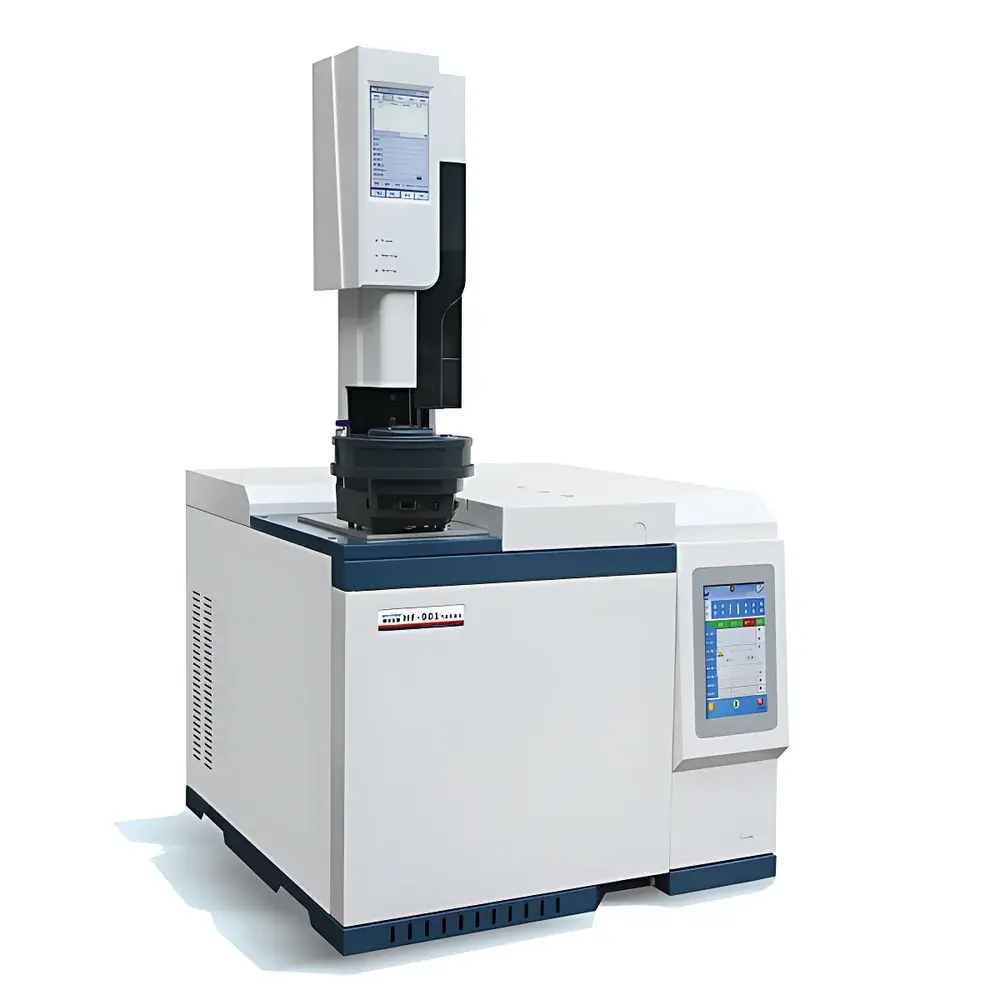
ZHONGKEHUIFEN HF-901 Gas Chromatograph for Oxygenates and Aromatic Hydrocarbons Analysis
| Brand | ZHONGKEHUIFEN |
|---|---|
| Origin | Beijing, China |
| Instrument Type | Laboratory Gas Chromatograph |
| Application Field | Universal (Petroleum Refining & Fuel Quality Control) |
| Oven Temperature Range | Ambient + 5 °C to 450 °C |
| Maximum Ramp Rate | 0.1–80 °C/min |
| Cooling Rate | 450 °C → 50 °C in ≤6 min |
| Carrier Gas Flow Range | 0–1200 mL/min |
| Carrier Gas Pressure Range | 0–970 kPa |
| Injector Max Temp | 450 °C |
| Injector Pressure Setpoint Range | 0–970 kPa |
| Injector Total Flow Setpoint Range | 0–1200 mL/min |
| Power Supply | 220 V, 50 Hz |
| Operating Ambient | 15–35 °C, 5–95% RH |
| Column Oven Dimensions | 280 × 300 × 170 mm |
| Max Run Time | 999.99 min |
| Programmable Temperature Steps | 16 |
| Detector | FID (Hydrogen Flame Ionization) |
| FID Sensitivity | <5 pg C/s (n-hexadecane) |
| FID Linear Dynamic Range | 10⁷ (±10%) |
| FID Data Acquisition Rate | 20 Hz |
| Valve Options | Motorized 4-/6-/10-port valves with electronic pressure/flow control module |
| Injector Types | Packed-column & split/splitless capillary injectors |
Overview
The ZHONGKEHUIFEN HF-901 Gas Chromatograph is a dedicated analytical system engineered for the precise quantification of oxygenated compounds—including alcohols (e.g., methanol, ethanol, tert-butanol) and ethers (e.g., MTBE, ETBE, TAME)—as well as aromatic hydrocarbons (benzene, toluene, ethylbenzene, xylenes) in gasoline and related petroleum distillates. It operates on the principle of high-resolution gas chromatography coupled with flame ionization detection (GC-FID), enabling separation based on volatility and polarity differences under precisely controlled temperature-programmed conditions. Designed in accordance with ASTM D4815 (for oxygenates), ASTM D5769 (for benzene), and ASTM D6299 (precision and bias requirements for fuel analysis), the HF-901 supports compliance-driven workflows in refinery laboratories, third-party testing facilities, and national quality supervision institutes. Its column oven architecture—featuring rapid heating and forced-air cooling—ensures reproducible retention times across repeated injections, while its fully electronic pneumatic control (EPC) system delivers stable carrier gas flow and pressure regulation critical for quantitative accuracy in complex hydrocarbon matrices.
Key Features
- Thermally robust column oven with programmable 16-step temperature gradients, operating from ambient +5 °C to 450 °C at ramp rates adjustable from 0.1 to 80 °C/min
- High-speed cooling capability: cools from 450 °C to 50 °C in ≤6 minutes, reducing cycle time without compromising thermal stability
- Dual-mode injector support: configurable for packed columns or split/splitless capillary operation, with maximum operating temperature of 450 °C and pressure/flow setpoints independently controllable up to 970 kPa and 1200 mL/min
- Integrated valve system with motorized multi-port selection (4-, 6-, or 10-port configurations), synchronized with method sequences and supported by auxiliary electronic flow control modules
- FID detector featuring auto-ignition circuitry, hydrogen leak monitoring, and real-time pressure/flow compensation; validated sensitivity of <5 pg carbon per second (n-hexadecane) and linear dynamic range of 10⁷ (±10%)
- Embedded data acquisition at 20 Hz, ensuring high-fidelity peak capture for narrow elution bands typical of volatile fuel components
Sample Compatibility & Compliance
The HF-901 is optimized for liquid hydrocarbon samples requiring minimal pretreatment—primarily gasoline, reformulated gasoline (RFG), and oxygenated blendstocks. It accommodates standard 1.0–2.0 µL liquid injections via syringe or autosampler-compatible interfaces. The system meets core regulatory requirements for fuel certification, including U.S. EPA Tier 3 gasoline specifications, China’s GB 17930–2016 (Automotive Gasoline), and EU EN 228:2012. Its hardware design aligns with GLP-compliant laboratory practices: all temperature and flow parameters are digitally logged with timestamping, and method files include audit-trail metadata. While not inherently 21 CFR Part 11 compliant out-of-the-box, the instrument’s firmware architecture supports integration with validated LIMS or chromatography data systems (CDS) that provide electronic signature, user access control, and change history functions.
Software & Data Management
The HF-901 operates with vendor-supplied GC control software supporting method development, sequence definition, real-time monitoring, and integrated calibration curve generation (linear, quadratic, or weighted). Peak integration adheres to IUPAC-recommended baseline algorithms, with customizable retention time windows and area normalization protocols essential for oxygenate and aromatic reporting (e.g., %v/v MTBE, %v/v benzene). Raw data files are stored in vendor-neutral formats (e.g., .CDF or ASCII-exportable .csv) compatible with third-party statistical tools. Software validation documentation—including IQ/OQ templates—is available upon request to support laboratory accreditation (ISO/IEC 17025) and internal SOP alignment. Remote diagnostics and firmware updates are performed over standard Ethernet connections without requiring physical service visits.
Applications
- Quantitative determination of oxygenates (MTBE, ETBE, TAME, ethanol, isopropanol) in finished gasoline per ASTM D4815 and GB/T 22030
- Benzene and toluene content analysis in gasoline and blending components per ASTM D5769 and GB 17930 Annex B
- Extended aromatic profiling (BTEX + C8 aromatics) using optional column configurations and valve-switching methods
- QC/QA monitoring during catalytic reforming, alkylation, and etherification unit operations
- Regulatory compliance testing for environmental agencies and provincial market supervision bureaus
- Method transfer and verification studies between central labs and field sites due to hardware consistency and inter-laboratory reproducibility
FAQ
What standards does the HF-901 support for oxygenate analysis?
ASTM D4815, GB/T 22030–2017, and JIS K 2536–2016 are natively supported through pre-configured method templates and certified reference material compatibility.
Can the system be upgraded for full aromatic distribution analysis (e.g., C9+ aromatics)?
Yes—by adding a second capillary column, back-flush configuration, and optional 10-port valve, the HF-901 can execute extended aromatic profiling per ASTM D5769 Annex A or IP 410.
Is the FID detector suitable for low-level benzene detection at regulatory thresholds (e.g., 0.62 vol%)?
With proper calibration using matrix-matched standards and optimized split ratios, the system achieves RSD <1.5% at 0.1–5.0 vol% benzene levels, meeting repeatability requirements of ISO 4259.
Does the instrument support automated calibration and QC checks?
The software includes scheduled calibration verification routines, bracketing standards, and system suitability tests (SST) with pass/fail logic based on resolution, tailing factor, and response linearity.
What maintenance intervals are recommended for routine operation?
FID jet cleaning every 200 injections; column trimming every 500 runs; EPC transducer calibration quarterly; and oven insulation integrity check annually—documented in the provided PM checklist.
Related Products




