
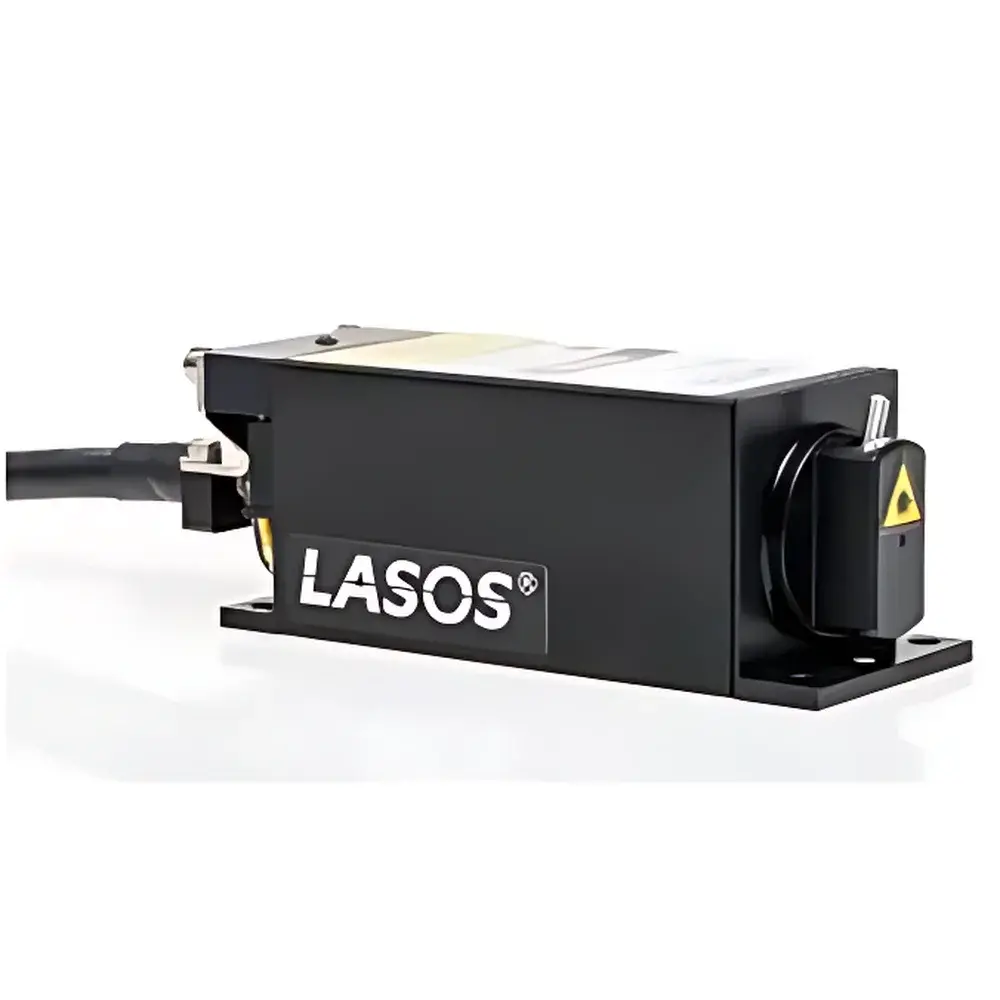
LASOS DPSS Series High-Performance Diode-Pumped Solid-State Laser
| Brand | LASOS |
|---|---|
| Origin | USA |
| Manufacturer Type | Authorized Distributor |
| Origin Category | Imported |
| Model | DPSS Laser |
| Price Range | USD 1,400 – 7,200 (FOB) |
| Core Technology | Diode-Pumped Solid-State (DPSS) Laser System |
| Operating Mode | Single-Frequency (CW) |
| Beam Quality (M²) | <1.1 |
| Typical Lifetime | >10,000 hours |
| Wavelength Options | 532 nm, 561 nm, 594 nm, 640 nm |
Overview
The LASOS DPSS Series is a family of high-stability, continuous-wave (CW), single-frequency diode-pumped solid-state lasers engineered for precision optical measurement and scientific instrumentation applications. Based on intracavity frequency-doubling of Nd:YVO₄ or Nd:YAG crystals, these lasers deliver narrow-linewidth (<1 MHz typical), diffraction-limited output with exceptional amplitude and frequency stability over extended operational periods. Designed to meet the stringent demands of laboratory-grade optical metrology, the DPSS Series integrates thermally optimized resonator architecture, active temperature stabilization of both pump diode and nonlinear crystal, and low-noise current drivers—ensuring minimal power drift (<±0.3% over 8 h) and RMS intensity noise <0.03% (10 Hz–10 MHz). Its robust mechanical design complies with ISO 10110 optical mounting standards and supports integration into vibration-sensitive platforms such as interferometric setups and confocal scanning systems.
Key Features
- Single-frequency operation with longitudinal mode stability verified via beat-note analysis against reference iodine-stabilized HeNe lasers
- Beam quality rated at M² < 1.1 across all standard wavelengths (532 nm, 561 nm, 594 nm, 640 nm), enabling efficient coupling into single-mode fibers (SMF-28) and high-NA microscope objectives
- Long-term power stability: ≤ ±0.5% RMS over 24 hours under constant ambient conditions (23 ± 1 °C, humidity <60% RH)
- Integrated digital control interface (RS-232 and USB 2.0) supporting remote power modulation (0–100% in <10 µs), TTL blanking, and real-time emission monitoring via built-in photodiode
- Compliance with IEC 60825-1:2014 Class 3B laser safety requirements; includes interlock-ready connector (2-pin LEMO) and key-switched enable circuitry
- Passive and active thermal management subsystems maintain crystal temperature within ±0.02 °C, minimizing wavelength drift (<0.5 pm/°C)
Sample Compatibility & Compliance
The LASOS DPSS Laser is compatible with standard optical breadboards (M6 threaded holes), kinematic mirror mounts (e.g., Thorlabs KM100), and OEM integration frames per SEMI E10 mechanical interface guidelines. It operates reliably in cleanroom environments (ISO Class 5–7) and has been validated for use in regulated analytical workflows compliant with USP , ISO/IEC 17025, and FDA 21 CFR Part 11 when paired with audit-trail-enabled host software. All units undergo factory calibration traceable to NIST SRM 2034 (HeNe wavelength standard) and include full test reports covering spectral purity, pointing stability (<5 µrad/h), and spatial mode fidelity (measured via ISO 11146-compliant beam profiler).
Software & Data Management
LASOS provides the LaserControl Suite v3.2—a Windows-based configuration and monitoring application supporting automated power ramping, scheduled on/off cycling, and synchronized data logging with external DAQ systems (NI PXI, Keysight U2300A). The software implements encrypted local storage of operational logs (timestamped power, temperature, error flags) and exports CSV/JSON files compatible with MATLAB, Python (NumPy/Pandas), and LabVIEW. For enterprise deployment, optional OPC UA server integration enables seamless connectivity to SCADA and MES platforms, satisfying GMP/GLP documentation requirements for instrument qualification (IQ/OQ/PQ) and change control procedures.
Applications
- Confocal and super-resolution microscopy: Stable 532 nm and 561 nm outputs serve as excitation sources for GFP, mCherry, and Alexa Fluor dyes with minimal photobleaching due to low intensity noise
- Holographic interferometry: Single-longitudinal-mode coherence length >100 m enables quantitative phase mapping in dynamic deformation studies
- Raman spectroscopy: Narrow linewidth and high spectral purity reduce fluorescence background in 532 nm-excited systems, improving signal-to-noise ratio for low-concentration analytes
- Flow cytometry: Integrated TTL blanking supports pulse-gated acquisition synchronized to cell transit time, reducing background scatter artifacts
- Optical trapping and atom cooling: Frequency-stabilized variants (optional) support Doppler cooling of alkali atoms and cavity-enhanced optical tweezers
FAQ
What is the typical warm-up time to achieve specified power and frequency stability?
Standard units reach full specification within 15 minutes after cold start; optional fast-stabilization firmware reduces this to ≤8 minutes.
Can the laser be integrated into a vacuum environment?
Yes—vacuum-compatible versions (with stainless-steel housing and ceramic feedthroughs) are available under model suffix “-VAC”; maximum operating pressure: 1×10⁻⁵ mbar.
Is wavelength tuning possible across the emission band?
No—each unit is factory-optimized for a fixed nominal wavelength; discrete wavelength selection requires model substitution.
What maintenance is required during the 10,000-hour service life?
None beyond periodic verification of collimation (recommended annually using alignment telescope) and cleaning of output window with spectroscopic-grade methanol.
Does LASOS provide calibration certificates with NIST traceability?
Yes—each unit ships with a Certificate of Conformance including wavelength accuracy (±0.1 nm), power linearity (±1.2%), and beam divergence (±0.05 mrad), all traceable to NIST Standard Reference Materials.







