
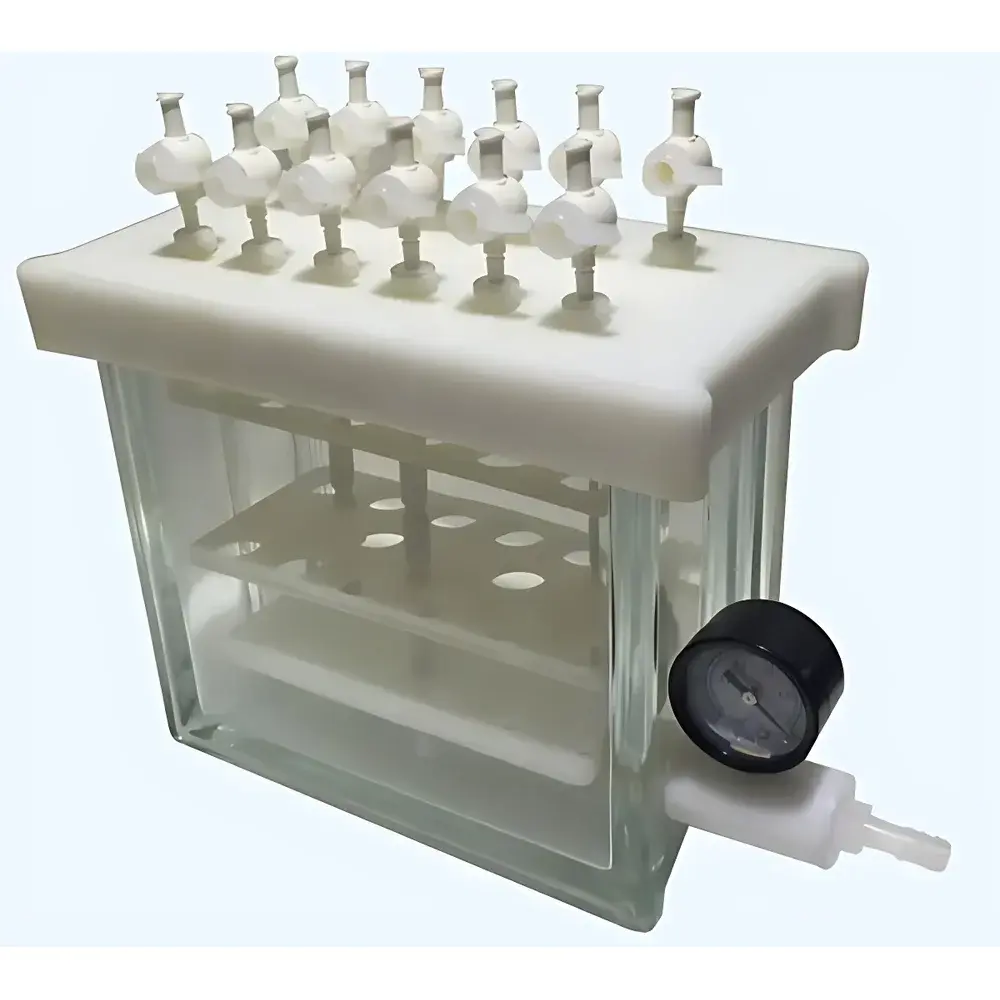
BenAng SPE-12N Solid Phase Extraction System
| Brand | BenAng |
|---|---|
| Origin | Shanghai, China |
| Manufacturer Type | Authorized Distributor |
| Country of Origin | China |
| Model | SPE-12N |
| Price | USD 680 (FOB Shanghai) |
| Automation Level | Semi-Automatic |
| Channel Count | 12-Channel Parallel |
| Extraction Format | Cartridge-Based SPE |
| Flow Rate Control Range | 0.1–30 mL/min |
| Solvent Selection | Up to 5 Independent Solvent Lines |
| Sample Capacity | 12 Samples per Run |
| Sample Loading Volume | 1–30 mL per Cartridge |
| Wetted Materials | PTFE (Polytetrafluoroethylene), Borosilicate Glass, High-Density Polyethylene (HDPE) |
| Vacuum Chamber Construction | Monolithic Thick-Walled Borosilicate Glass |
| Maximum Operating Vacuum | ≥97 kPa |
| Dimensions (W×D×H) | 270 × 170 × 95 mm |
| Net Weight | 2.8 kg |
| Collection Tube Holder Diameter | 18 mm |
Overview
The BenAng SPE-12N Solid Phase Extraction System is a benchtop semi-automatic 12-channel parallel extraction platform engineered for reproducible, scalable sample preparation in analytical laboratories. It operates on the fundamental principle of solid-phase extraction—selective adsorption of analytes onto a sorbent-packed cartridge under controlled vacuum-driven flow, followed by sequential washing and elution using solvent gradients. Unlike liquid–liquid extraction, SPE eliminates emulsion formation and phase separation complications, enabling high recovery of trace analytes from complex matrices such as biological fluids, environmental water, food extracts, and pharmaceutical formulations. The SPE-12N integrates precision fluidic control with robust mechanical architecture to support both method development and routine QC workflows. Its design emphasizes operator safety, method transferability, and compatibility with downstream instrumentation—including HPLC, GC, LC-MS, and ICP-MS—without requiring revalidation across platforms.
Key Features
- 12 independent parallel channels, each equipped with an individually adjustable needle valve for precise, channel-specific flow rate control (0.1–30 mL/min)
- Vacuum manifold constructed from monolithic borosilicate glass with uniform wall thickness—rated for continuous operation at ≥97 kPa vacuum pressure
- PTFE-coated collection tube rack with height-adjustable support; accommodates tubes up to 18 mm outer diameter and compatible with standard 12–15 mL conical or cylindrical SPE tubes
- Corrosion-resistant high-molecular-weight polymer cartridge tray; maintains structural integrity and dimensional stability under prolonged vacuum loading
- Integrated analog vacuum gauge for real-time pressure monitoring—critical for method consistency and troubleshooting
- Five independently plumbed solvent lines, permitting automated gradient elution or multi-step conditioning/washing protocols without manual line switching
- Fog-resistant vacuum chamber design minimizes cross-contamination risk between cartridges and prevents aerosol carryover during high-flow elution
- Compact footprint (270 × 170 × 95 mm) and low mass (2.8 kg) facilitate integration into fume hoods, laminar flow cabinets, or shared lab benches
Sample Compatibility & Compliance
The SPE-12N supports standard 1–6 mL SPE cartridges (including C18, SCX, SAX, Florisil, and mixed-mode chemistries) and is validated for use with aqueous, acidic, basic, and organic solvent systems. All fluid-contact surfaces—including tubing connectors, manifold ports, and collection holders—are fabricated from PTFE, borosilicate glass, or HDPE to ensure chemical inertness and prevent leaching. The system complies with general laboratory safety standards (ISO/IEC 17025 pre-analytical requirements) and supports GLP/GMP-aligned documentation when paired with validated SOPs. While not intrinsically 21 CFR Part 11 compliant, its manual operation and analog pressure readout allow full audit trail generation via external lab notebook or LIMS integration.
Software & Data Management
As a semi-automatic platform, the SPE-12N does not include embedded firmware or digital control software. All operational parameters—including vacuum level, solvent sequence, and flow timing—are manually configured and recorded per protocol. This architecture ensures full transparency, eliminates firmware dependency, and simplifies qualification (IQ/OQ/PQ) for regulated environments. Users may document run conditions using standardized templates aligned with ISO 17025 Annex A or USP Analytical Instrument Qualification guidelines. Optional accessories include calibrated vacuum gauges with digital logging capability and barcode-labeled cartridge trays for sample traceability.
Applications
- Pre-concentration and cleanup of pesticide residues in drinking water (EPA Method 525.3)
- Isolation of mycotoxins (e.g., aflatoxin B1, ochratoxin A) from cereal extracts prior to HPLC-FLD analysis
- Plasma and urine sample preparation for therapeutic drug monitoring (TDM) and toxicology screening
- Removal of phospholipids and endogenous interferences from plasma prior to LC-MS/MS bioanalysis
- Extraction of PAHs and PCBs from sediment and wastewater samples (ASTM D7237, EPA 8270)
- Method development for novel sorbents, including molecularly imprinted polymers (MIPs) and metal-organic frameworks (MOFs)
FAQ
What types of SPE cartridges are compatible with the SPE-12N?
Standard 1 mL, 3 mL, and 6 mL polypropylene or glass cartridges with fritted beds (e.g., Waters Oasis, Agilent Bond Elut, Thermo HyperSep) are fully supported.
Can the system be used under positive pressure?
No—the SPE-12N is designed exclusively for vacuum-assisted (negative pressure) operation; it lacks gas-tight seals or pressure-rated components for positive-pressure applications.
Is the vacuum gauge calibrated and traceable to NIST standards?
The integrated analog gauge is factory-calibrated; users may perform periodic verification using a NIST-traceable reference manometer per ISO/IEC 17025 Clause 6.5.
How is cross-contamination prevented between channels?
Each channel features isolated fluid pathways, PTFE-sealed valves, and a fog-resistant vacuum chamber geometry that suppresses vapor-phase migration between adjacent cartridges.
What maintenance is required for long-term reliability?
Routine inspection of O-rings, cleaning of glass manifold surfaces with isopropanol, and annual verification of vacuum integrity using a leak-down test are recommended per manufacturer’s maintenance schedule.



