
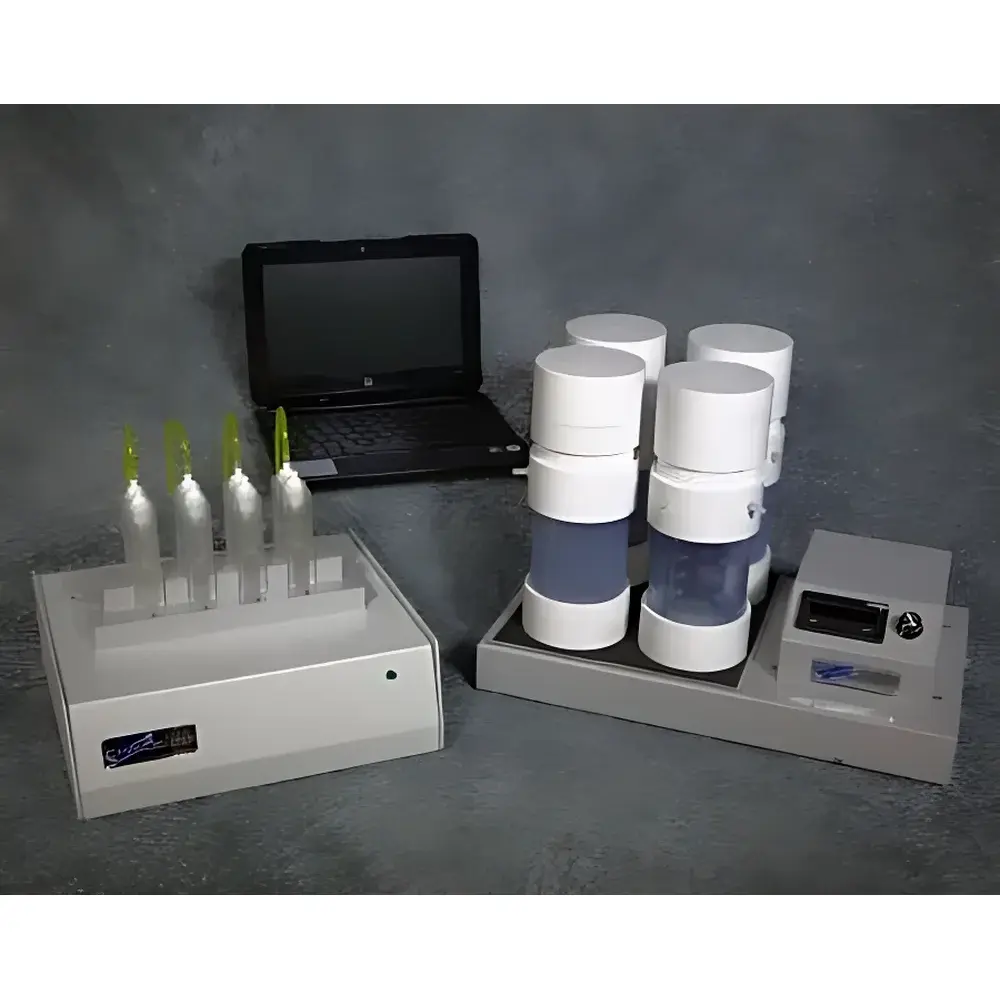
Challenge AER-208S Automated Respirometry System for Compost Maturity Assessment
| Origin | USA |
|---|---|
| Manufacturer Type | Authorized Distributor |
| Origin Category | Imported |
| Model | AER-208S |
| Instrument Type | Respirometric Compost Maturity Analyzer |
| Oxygen Demand Resolution | 0.06 mg O₂ |
| Anaerobic Gas Volume Resolution | 0.05 mL |
| Max O₂ Uptake Rate | 650 mg/hr |
| Max CO₂/CH₄ Production Rate | 500 mL/hr |
| Channel Capacity | 8 (expandable to 16 or 24) |
| Power Supply | 110/240 V, 50/60 Hz |
Overview
The Challenge AER-208S Automated Respirometry System is a precision-engineered instrument designed for quantitative assessment of compost maturity through real-time monitoring of microbial respiratory activity in organic substrates. It operates on the principle of dynamic respirometry—measuring oxygen consumption under aerobic conditions and carbon dioxide/methane evolution under anaerobic or facultative conditions—providing objective, kinetic data aligned with internationally recognized biodegradation standards including ASTM D5338 (Standard Test Method for Determining Aerobic Biodegradation of Plastic Materials in Soil), ISO 17556 (Soil quality — Determination of the ultimate aerobic biodegradability of organic compounds in soil by measurement of oxygen demand in a closed respirometer), and OECD 301 series guidelines. Unlike empirical or chemical index-based methods (e.g., C/N ratio, NH₄⁺/NO₃⁻, germination index), the AER-208S delivers physiologically relevant metrics: basal respiration rate (BR), substrate-induced respiration (SIR), cumulative O₂ demand, and CO₂ evolution kinetics—parameters directly correlated with microbial metabolic activity and stabilization status of organic matter.
Key Features
- High-resolution dual-mode respirometry: Simultaneous or independent aerobic O₂ uptake and anaerobic gas (CO₂/CH₄) production measurement with detection limits of ±0.06 mg O₂ and ±0.05 mL gas volume per channel.
- Modular 8-channel base configuration, scalable to 16 or 24 channels via hardware expansion modules—enabling parallel testing of multiple compost batches, amendment treatments, or time-series sampling points.
- Temperature-controlled incubation chamber (ambient to 50 °C, ±0.2 °C stability) integrated with humidity regulation to maintain optimal microbial activity during long-term assays (up to 90 days).
- Automated calibration sequence with built-in reference gas ports and zero-air generator compatibility, ensuring traceable accuracy across extended operational cycles.
- Robust architecture compliant with IEC 61000-6-3 (EMC emission standard) and UL/CSA 61010-1 safety certification for laboratory use.
Sample Compatibility & Compliance
The AER-208S supports heterogeneous solid-phase matrices without pre-extraction or homogenization: matured and immature composts (green waste, food waste, manure-based), sewage sludge, biochar-amended substrates, municipal solid waste (MSW) fractions, and engineered soil-biochar-compost blends. Each reaction vessel (standard 1–2 L capacity) accommodates up to 500 g of moist sample (30–65% moisture content). The system meets methodological requirements for regulatory reporting under US EPA Method SW-846 9040C (Biological Oxygen Demand), EU Regulation (EC) No 1069/2009 Annex IV (compost quality criteria), and China’s NY 525-2021 standard for organic fertilizers. Data outputs are structured to support GLP-compliant audit trails, including timestamped raw sensor readings, environmental parameter logs (T, RH), and user-defined metadata tagging per vessel.
Software & Data Management
The AER-208S is operated via Challenge RespiroSoft™ v4.2—a validated Windows-based application supporting 21 CFR Part 11 compliance (electronic signatures, role-based access control, immutable audit logs). Real-time graphs display O₂ depletion curves, CO₂ accumulation slopes, and derived indices such as Respiratory Quotient (RQ = CO₂/O₂) and Stabilization Index (SI = (Cumulative CO₂ at Day X / Cumulative CO₂ at Day 28)). Export formats include CSV, Excel (.xlsx), and PDF reports conforming to ISO/IEC 17025 documentation templates. Raw data files are stored in HDF5 format for interoperability with MATLAB, Python (Pandas/NumPy), or R statistical environments.
Applications
- Quantitative validation of compost maturity for agricultural reuse (e.g., meeting EU End-of-Waste criteria or USDA Organic Rule §205.203).
- Optimization of forced-aeration pile management through real-time feedback on thermophilic phase duration and cooling-phase respiration decay.
- Evaluation of microbial inoculant efficacy in accelerating organic matter stabilization.
- Regulatory testing of biodegradable packaging materials in soil/compost matrices per ASTM D6400 or EN 13432.
- Long-term monitoring of bioremediation progress in hydrocarbon-contaminated soils using respiration response to spiked substrates.
- Research into anaerobic digestion feedstock pre-treatment efficiency via comparative CH₄ yield kinetics.
FAQ
What biological endpoints does the AER-208S measure to determine compost maturity?
It quantifies cumulative oxygen demand, CO₂ evolution rate, methane production (under anaerobic mode), and calculates derived indices including the Self-Heating Temperature Index (SHI), Respiration Index (RI), and Dynamic Respiration Index (DRI)—all referenced against ISO 21905 and CEN/TS 16381 benchmarks.
Can the system operate unattended for multi-week assays?
Yes—fully automated operation with continuous data logging, power-fail recovery, and remote monitoring via Ethernet/Wi-Fi enables 24/7 deployment for assays up to 90 days without manual intervention.
Is calibration traceable to NIST standards?
All gas flow sensors are factory-calibrated against NIST-traceable mass flow standards; users perform field verification using certified zero air and span gases (O₂, CO₂) per ISO 17025 Clause 6.6.
How is data integrity ensured for regulatory submissions?
RespiroSoft™ enforces ALCOA+ principles (Attributable, Legible, Contemporaneous, Original, Accurate, Complete, Consistent, Enduring, Available) with electronic signature workflows, version-controlled protocol templates, and encrypted database backups.
Does the system support custom incubation protocols?
Yes—users define multi-step temperature ramps, intermittent aeration cycles, substrate addition schedules, and gas switching sequences via graphical protocol builder within the software interface.







