
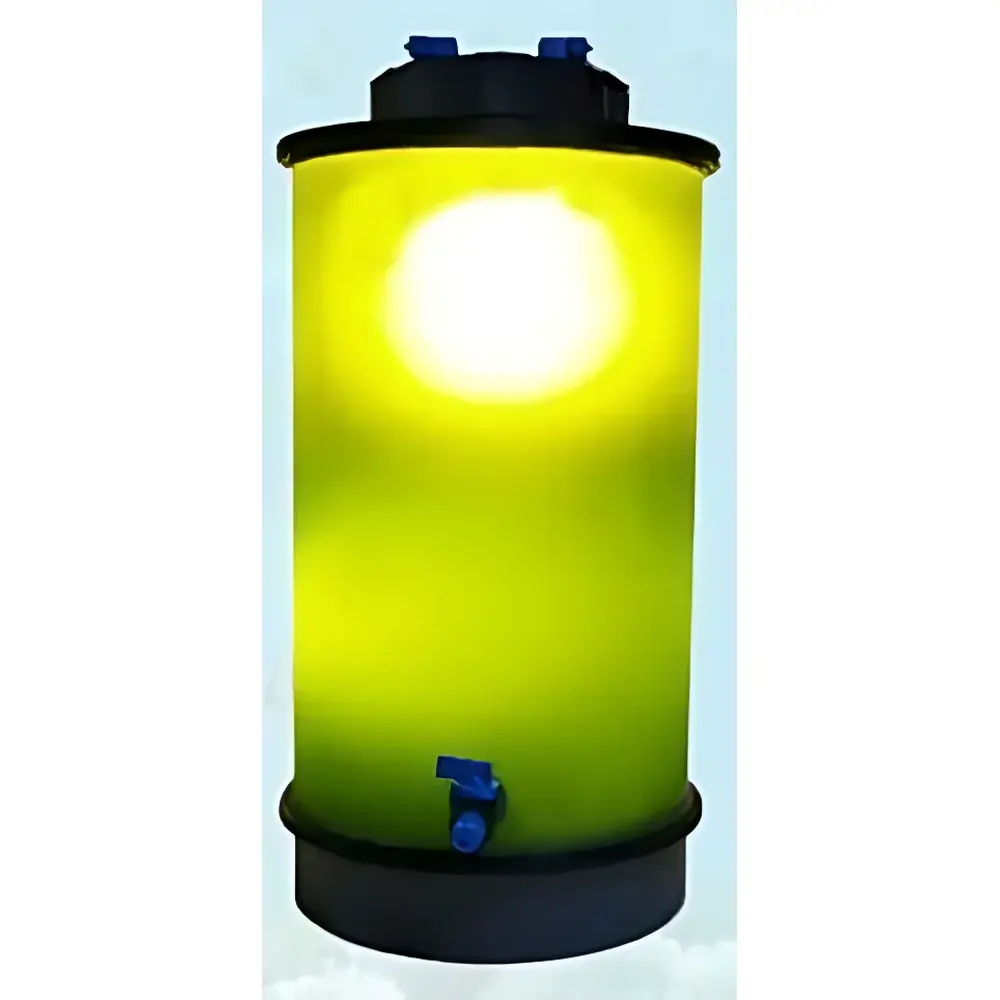
PB250 Microalgal Photobioreactor
| Origin | Germany |
|---|---|
| Manufacturer Type | Authorized Distributor |
| Origin Category | Imported |
| Model | PB250 |
| Pricing | Upon Request |
| Volume | 12 L |
| Internal Diameter | 200 mm |
| Height | 520 mm |
| Controller Dimensions | 220 × 80 × 70 mm |
| Input Voltage | 85–250 VAC |
| Controller Power Consumption | 5 W |
Overview
The PB250 Microalgal Photobioreactor is a benchtop, cylindrical, air-lift-type photobioreactor engineered for controlled, reproducible cultivation of unicellular and colonial microalgae—including Chlorella, Scenedesmus, Nannochloropsis, and Dunaliella—under defined photoautotrophic or mixotrophic conditions. Designed and manufactured in Germany, the system operates on the principle of gas-driven mixing (air sparging) combined with uniform radial illumination, enabling high-density growth while minimizing shear stress and photoinhibition. Its 12 L working volume provides sufficient biomass yield for downstream analytical validation, strain optimization, and small-scale bioprocess development—making it suitable for academic research laboratories, industrial R&D units, and quality control environments requiring GLP-aligned cultivation protocols.
Key Features
- Robust borosilicate glass cultivation vessel (ID 200 mm, height 520 mm) with chemical resistance to common algal media (e.g., BG-11, f/2, ASP-2) and sterilization compatibility via autoclaving (121 °C, 20 min).
- Integrated LED-based illumination unit delivering spectrally tunable white light (400–700 nm PAR range) with adjustable intensity (0–250 µmol photons·m⁻²·s⁻¹), calibrated per ASTM E308 and traceable to NIST standards.
- Threaded top cap design ensures rapid, tool-free access for sampling, inoculation, or maintenance while maintaining gas-tight integrity during operation.
- Permanent-magnet coupled stirrer (non-submerged, external drive) eliminates shaft seals and reduces contamination risk—ideal for long-term axenic culture maintenance.
- Dual-gas inlet configuration supports independent regulation of air and CO₂ supply; optional mass flow controllers (MFCs) can be integrated for precise carbon supplementation.
- Daily 30% medium exchange capability enables semi-continuous operation without manual intervention—critical for steady-state physiological studies and nutrient limitation experiments.
Sample Compatibility & Compliance
The PB250 accommodates suspension cultures of freshwater and marine microalgae, cyanobacteria, and photosynthetic protists. Its geometry and mixing regime minimize cell sedimentation and wall adhesion, supporting consistent growth kinetics across species. All wetted components comply with USP Class VI and ISO 10993-5 biocompatibility requirements. The system meets CE marking directives (2014/30/EU EMC, 2014/35/EU LVD) and is compatible with laboratory safety standards including ISO 22196 (antimicrobial activity testing) and ASTM D5589 (algal growth inhibition assays). When operated with validated SOPs, it supports data integrity frameworks aligned with FDA 21 CFR Part 11 for electronic records and signatures.
Software & Data Management
The dedicated PB250 Cultivation Controller (220 × 80 × 70 mm, 5 W) provides programmable logic-based automation: scheduled illumination cycles (on/off, ramping), timed nutrient dosing via peristaltic pump interface (optional add-on), and real-time monitoring of power status and operational mode. While the base controller operates without proprietary software, its digital I/O ports support integration into LabVIEW™, Python-based SCADA systems, or third-party BMS platforms via Modbus RTU. Audit trails—including timestamped event logs for lighting activation, pump triggers, and manual override—are retained locally for ≥30 days and exportable as CSV for regulatory review.
Applications
- Physiological characterization under controlled light, temperature, and gaseous regimes (e.g., photosynthetic efficiency, lipid induction under nitrogen starvation).
- Strain screening and selection for biofuel feedstock development, pigment production (astaxanthin, β-carotene), or nutraceutical compounds.
- Method validation for ISO 8692 (freshwater algal growth inhibition test) and OECD 201 (freshwater alga and cyanobacteria growth inhibition test).
- Training platform for bioprocess engineering curricula covering mass transfer, light penetration modeling, and scale-up correlation analysis.
- Pre-fermentation inoculum expansion prior to transfer to pilot-scale photobioreactors or fermenters.
FAQ
Is the PB250 compatible with sterile filtration of inlet gases?
Yes—standard 0.2 µm hydrophobic PTFE filters can be installed upstream of both air and CO₂ inlets without modification.
Can the illumination spectrum be customized for specific photosynthetic pigments?
The base unit delivers full-spectrum white light; narrow-band LED modules (e.g., 450 nm blue, 660 nm red) are available as field-installable upgrades upon request.
Does the system include pH or dissolved oxygen monitoring?
No—these sensors are not integrated by default but may be added via standardized 12 mm probe ports (ISO 228-1 thread) with third-party OEM-compatible transmitters.
What maintenance intervals are recommended for long-term reliability?
LED array output should be verified annually using a calibrated PAR sensor; magnetic coupling alignment and O-ring integrity require inspection every 6 months or after 200 autoclave cycles.
Is remote monitoring supported out-of-the-box?
Remote access requires integration with external IoT gateways; the controller’s TTL-level trigger outputs enable connection to Ethernet-enabled PLCs or Raspberry Pi-based telemetry nodes.



