
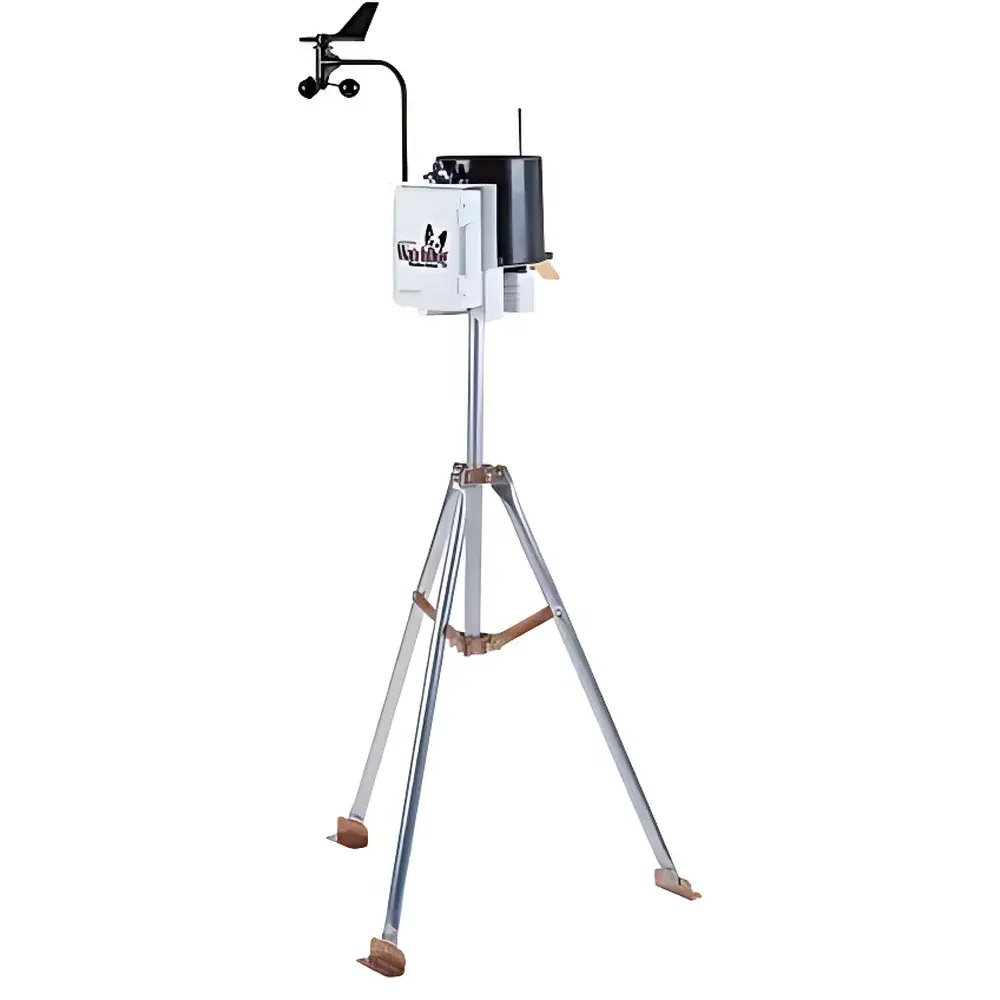
SPECTRUM WatchDog 2900ET Portable Agricultural Weather Station
| Origin | USA |
|---|---|
| Manufacturer Type | Authorized Distributor |
| Origin Category | Imported |
| Model | WATCHDOG2900ET |
| Instrument Type | Portable Weather Station |
| Temperature Range | –32 to 100 °C |
| Temp Accuracy | ±0.6 °C |
| RH Range | 10–100% (at 5–50 °C) |
| RH Accuracy | ±3% |
| Wind Speed Range | 0–241 km/h |
| Wind Speed Accuracy | ±5% |
| Wind Direction Resolution | 2° |
| Wind Direction Accuracy | ±7° |
| Solar Radiation Range | 0–1250 W/m² |
| Radiation Accuracy | ±5% |
| Dew Point Range | –73 to 60 °C |
| Dew Point Accuracy | ±2 °C |
| Rainfall Resolution | 0.25 mm |
| Rainfall Accuracy | ±2% |
Overview
The SPECTRUM WatchDog 2900ET Portable Agricultural Weather Station is a field-deployable, multi-parameter environmental monitoring system engineered for precision agrometeorological data acquisition in unattended outdoor settings. Based on robust Campbell Scientific-compatible sensor architecture and integrated microprocessor-based data logging, the system employs industry-standard measurement principles—including thermistor-based temperature sensing, capacitive relative humidity transduction, cup-and-vane anemometry with magnetic reed switching, tipping-bucket rainfall collection, silicon photodiode pyranometry, and dew point calculation via Magnus formula implementation. Designed specifically for agricultural research, irrigation scheduling, evapotranspiration (ET) modeling, and ecological field studies, the WatchDog 2900ET delivers time-synchronized, timestamped measurements across up to 12 configurable channels—enabling rigorous environmental correlation analysis without reliance on external power or network infrastructure.
Key Features
- Self-contained, battery-powered operation with optional solar charging kit (up to 12 months typical deployment life on alkaline batteries)
- Integrated 128×64 pixel backlit LCD display for real-time parameter viewing, configuration, and diagnostics
- IP67-rated weatherproof enclosure with UV-stabilized polycarbonate housing and corrosion-resistant mounting hardware
- Plug-and-play modular sensor interface supporting hot-swappable analog and digital (SDI-12, RS-485) sensors
- User-configurable sampling intervals from 1 minute to 24 hours, with programmable burst logging modes
- Onboard memory capacity of 512 KB (expandable via microSD card slot), storing over 1 million data points
- USB 2.0 and Bluetooth 4.2 interfaces for local data retrieval, firmware updates, and real-time telemetry
Sample Compatibility & Compliance
The WatchDog 2900ET is validated for continuous operation across USDA Plant Hardiness Zones 1–13 and complies with IEC 60529 (IP67), ISO 9001:2015 (manufacturing quality management), and ASTM D5098-20 (standard practice for calibration of meteorological sensors). Its sensor suite meets the performance thresholds required for FAO-56 Penman-Monteith reference ET calculations and supports data traceability per GLP-compliant field protocols. While not certified for regulatory submission under FDA 21 CFR Part 11, the system supports audit-ready data export (CSV, Excel, XML) with embedded timestamps, sensor IDs, and metadata headers—facilitating integration into LIMS and farm management information systems (FMIS) compliant with ISO 22000 and ISO 14001 frameworks.
Software & Data Management
Data retrieval and configuration are managed via Spectrum’s proprietary WatchDog Software (v5.2+), a Windows-based application supporting automated download scheduling, graphical trend visualization, statistical summary generation (min/max/avg/std dev), and customizable report templates. Raw datasets include full metadata: sensor calibration dates, firmware versions, battery voltage logs, and environmental error flags (e.g., frozen rain gauge, saturated RH sensor). Export formats include comma-separated values (CSV) with ISO 8601 timestamps, as well as direct import compatibility with R, Python (Pandas), MATLAB, and AgLeader SMS Advanced. The software enforces password-protected user roles (Admin, Technician, Viewer) and maintains local change history logs for configuration modifications—supporting internal QA/QC documentation requirements.
Applications
- Real-time irrigation decision support through crop-specific ETc estimation using ASCE-standardized coefficients
- Microclimate characterization in orchards, vineyards, and high-tunnel production systems
- Soil moisture–atmosphere coupling studies in watershed-scale hydrological modeling
- Long-term phenological monitoring for climate adaptation research (e.g., budbreak, flowering, harvest timing)
- Validation of satellite-derived land surface temperature and albedo products
- Field validation of numerical weather prediction (NWP) model outputs at sub-kilometer resolution
- Compliance monitoring for USDA-NRCS EQIP and Conservation Stewardship Program (CSP) reporting
FAQ
What is the maximum number of sensors supported by the WatchDog 2900ET?
The base unit supports up to 8 analog inputs and 4 digital sensor channels (SDI-12 or RS-485), enabling simultaneous monitoring of 12 parameters with appropriate sensor expansion modules.
Can the system operate reliably in freezing conditions?
Yes—the temperature sensor is rated to –32 °C, and the tipping-bucket rain gauge includes an optional heated version (model RG-12H) for ice-free winter operation.
Is remote data access possible without cellular connectivity?
Local wireless access is available via Bluetooth; for wide-area telemetry, third-party LoRaWAN or cellular modems (e.g., LTE-M) can be interfaced through the RS-485 port using Modbus RTU protocol.
How frequently should calibration verification be performed?
SPECTRUM recommends annual field verification against NIST-traceable references for temperature, RH, and radiation sensors; wind and rain sensors require biannual mechanical inspection and cleaning.
Does the system support integration with AWS or Azure cloud platforms?
Native cloud ingestion is not built-in, but CSV exports and API-accessible USB serial output allow seamless integration via custom Python scripts or commercial middleware (e.g., Node-RED, Ignition SCADA).
Related Products







