
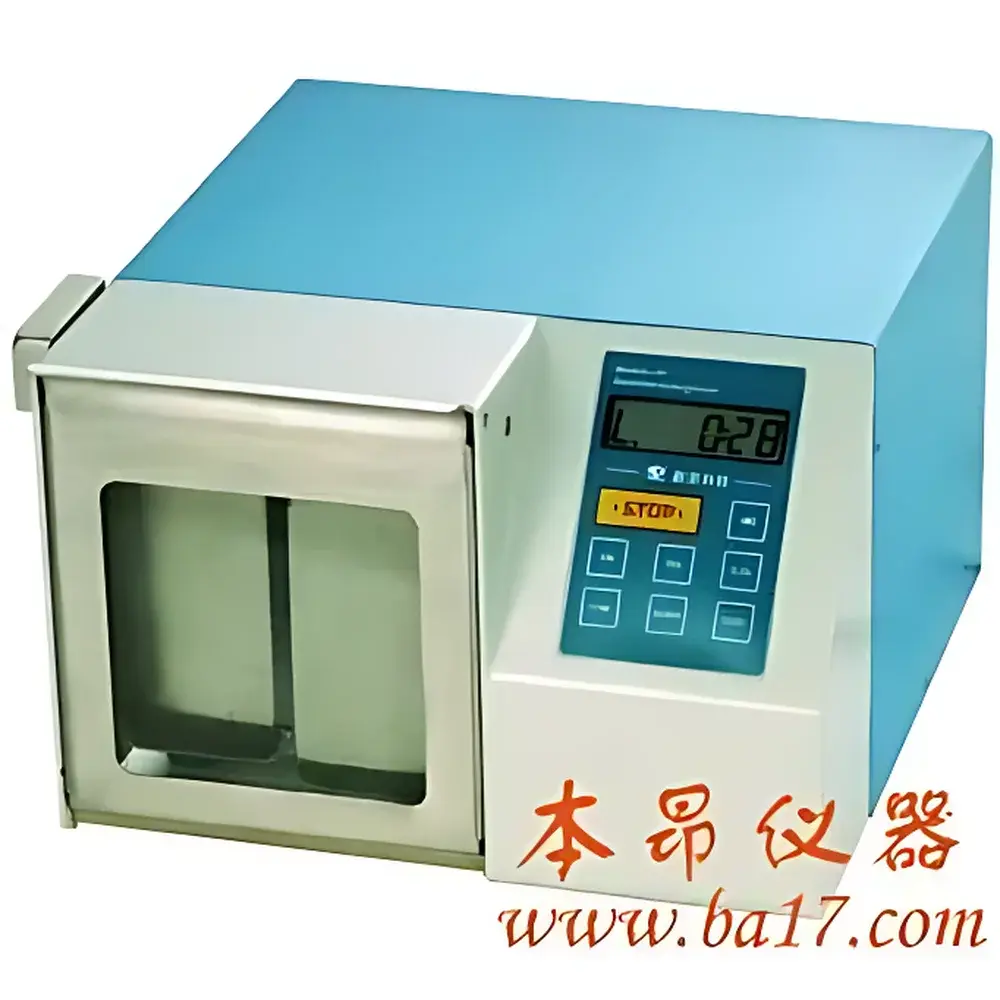
BenAng BA-3S Stomacher-type Homogenizer
| Brand | BenAng |
|---|---|
| Origin | Shanghai, China |
| Manufacturer Type | Authorized Distributor |
| Country of Origin | China |
| Model | BA-3S |
| Price | USD 4,200 (FOB Shanghai) |
| Homogenization Time Settings | 10, 30, 60, 90, 120, 180, 600 s + continuous mode (8 programmable steps) |
| Pulsation Frequency | 3–14 strokes/sec |
| Sample Volume Capacity | 400–3500 mL |
| Dimensions (W×D×H) | 450 × 650 × 800 mm |
| Weight | 65 kg |
| Power Supply | 220 V / 50 Hz |
| Rated Power | 350 W |
| Sterile Filter Bag Size | 30 × 50 cm |
| Door Type | Full-opening hinged door with polycarbonate viewing window |
| Safety | Hall-effect sensor–activated automatic stop upon door interruption |
| Leak Containment | Integrated drip tray beneath chamber |
Overview
The BenAng BA-3S Stomacher-type Homogenizer is a mechanically driven, paddle-beat homogenization system engineered for rapid, reproducible, and contamination-controlled sample preparation in microbiological and analytical laboratories. It operates on the principle of controlled mechanical shear through reciprocating paddle motion against a sterile, flexible filter bag—commonly referred to as the “stomacher” method—wherein solid or semi-solid samples are suspended in diluent and subjected to rhythmic compression and expansion cycles. This action facilitates efficient release of microorganisms from food matrices, clinical swabs, environmental filters, and biological tissues without thermal degradation or excessive cell lysis. Designed for compliance with standard methods including ISO 6887-1, FDA-BAM Chapter 3, and USP , the BA-3S ensures homogenate representativeness by achieving uniform dispersion across the entire sample volume within the sealed bag—eliminating cross-contamination risks associated with probe-based or blade-type homogenizers.
Key Features
- Programmable homogenization time with eight discrete settings (10 s to 600 s) plus continuous operation mode, enabling method-specific protocol alignment.
- Adjustable pulsation frequency ranging from 3 to 14 strokes per second, allowing optimization for delicate samples (e.g., probiotics, spores) or resilient matrices (e.g., meat, cheese, soil).
- Full-opening front door with impact-resistant polycarbonate viewport for real-time process monitoring and unobstructed access during bag loading/unloading.
- Integrated leak containment system featuring a removable stainless-steel drip tray positioned beneath the homogenization chamber to capture incidental bag leakage—critical for biosafety Level 1/2 workflows.
- Hall-effect safety interlock that instantly halts paddle motion when the door is opened mid-cycle, preventing operator injury and ensuring GLP-compliant operational integrity.
- Non-contact architecture: no internal surfaces contact the sample; the only consumable is the single-use sterile filter bag (30 × 50 cm), minimizing cleaning validation burden and eliminating carryover risk.
- Ergonomic design with low-noise motor (<65 dB[A] at 1 m) and intuitive membrane keypad interface—suitable for high-throughput QA/QC labs and regulated clinical environments.
Sample Compatibility & Compliance
The BA-3S accommodates a broad spectrum of sample types—including raw and processed foods (meat, dairy, produce), pharmaceutical dosage forms (tablets, powders, ointments), clinical specimens (stool, wound swabs, tissue biopsies), and environmental samples (water filters, air samplers). Its use of certified sterile, pyrogen-free, low-binding polyethylene filter bags (with optional 100 µm or 40 µm mesh options) supports quantitative recovery of bacteria, yeasts, molds, viruses, and protozoan cysts. The instrument meets mechanical safety requirements per IEC 61000-6-2/6-4 and is compatible with laboratory quality systems adhering to ISO/IEC 17025, FDA 21 CFR Part 11 (when paired with compliant LIMS data logging), and EU GMP Annex 11 documentation practices. All operating parameters are manually logged or exportable via optional RS-232 output for audit trail generation.
Software & Data Management
While the BA-3S operates via embedded firmware without onboard software, it supports external traceability integration through its RS-232 serial port (optional accessory). When connected to validated laboratory information management systems (LIMS) or electronic lab notebooks (ELN), homogenization parameters—including start time, duration, stroke rate, and operator ID—can be automatically recorded with timestamped metadata. This capability satisfies ALCOA+ principles (Attributable, Legible, Contemporaneous, Original, Accurate) for regulatory submissions. For standalone use, all settings are retained in non-volatile memory after power cycling, and the keypad interface displays active parameters in real time using LED indicators—ensuring full procedural transparency without reliance on proprietary software.
Applications
- Microbial enumeration (aerobic plate count, coliforms, E. coli, Salmonella enrichment) per ISO 7218 and AOAC Official Methods.
- Preparation of homogenates for PCR-based pathogen detection (e.g., Listeria monocytogenes, Campylobacter spp.) where DNA integrity and inhibitor removal are critical.
- Pharmaceutical microbiological testing of non-sterile products per USP and Ph. Eur. 2.6.12.
- Homogenization of clinical stool specimens for culture-independent diagnostics and metagenomic sequencing library prep.
- Environmental monitoring of water and air filters under EPA Method 1603 and ISO 9308-1.
- Standardized extraction of mycotoxins or pesticide residues prior to LC-MS/MS analysis, leveraging consistent particle size reduction and solvent penetration.
FAQ
What types of sterile bags are compatible with the BA-3S?
The BA-3S is designed exclusively for 30 × 50 cm filter bags made from medical-grade low-density polyethylene (LDPE), available with 40 µm or 100 µm pore sizes. Custom bag dimensions or materials require prior mechanical validation.
Does the BA-3S support IQ/OQ/PQ documentation packages?
Yes—BenAng provides factory-issued Installation Qualification (IQ) templates and Operational Qualification (OQ) test protocols aligned with ASTM E2500 and ISO/IEC 17025. Performance Qualification (PQ) must be conducted in situ using user-defined reference samples.
Can the BA-3S be used for homogenizing viscous or fibrous samples?
It is effective for moderately viscous matrices (e.g., yogurt, sauces) and fibrous foods (e.g., leafy greens, cooked meats) when diluted to ≥1:10 ratio and processed at lower stroke frequencies (3–6 strokes/sec) to prevent bag rupture.
Is routine calibration required?
No scheduled calibration is mandated; however, users must verify stroke timing accuracy annually using a calibrated digital stopwatch and confirm paddle speed consistency via tachometer measurement per SOP.
What maintenance is recommended for long-term reliability?
Monthly inspection of door gasket integrity, quarterly lubrication of hinge pins and drive linkage, and annual torque verification of paddle mounting bolts—per the Maintenance Log included in the technical manual.



